By James Eden:
“Jack London? Didn’t he used to write kid’s stories about dogs?”
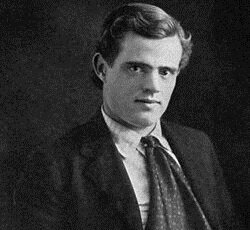
Sadly, this response to the mention of American author Jack London’s name is all too frequent. London’s legacy and reputation seems to revolve around his “doggie” books, The Call of the Wild and White Fang. Yet as with many aspects of Jack London’s life, not all is as first appears. Labelling The Call of the Wild as just a book about a dog, as we shall see, grossly insults this multi-layered and deeply philosophical work.
London had deep held political and philosophical beliefs and the purpose of this essay is to highlight London’s advocacy of such fields as racialism, eugenics, Social Darwinism, Nietzschean philosophy and Jungian psychology. All topics which, of course, are the staple of the modern White Nationalist weltanschauung, or “world view”.
This work is not intended as a biographical piece on Jack London but some details about his early life are essential if we are to have insights about the origins of his personal ideology. Jack London (1876-1916) was born, out of wedlock, to Flora Wellman and Prof. William H. Chaney in San Francisco, California. Eight months after he had been born, his mother married a man named John London and it is from him that Jack took his name.
The family were extremely poor. By the age of 13, Jack was being forced to work at a pickle cannery for 10 cents an hour working a 16 hour day. It would be this early episode, and his later experiences amongst the working classes in Whitechapel, London and the tramps and hobos of the US, that cemented in London a life-long hatred of capitalism and a fervent advocacy of revolutionary socialism. Before seasoned White Nationalists leave this essay in disgust at this revelation, please bear with me as this seeming contradiction will be examined later in this work.
London’s eternal lust for life and life-long yearning for action first manifested when he quit his dead end jobs and became an oyster pirate, eventually graduating to owning his own ship. He also became part of the great Klondike Gold Rush and these hard and bitter experiences during this period would not only shape London but also his later literary output.
He returned to the US from the Klondike still a very young man but with life experiences that most people would have to live multiple lifetimes to appreciate. London decided that his limitless energy would best be suited to a literary career so he began writing. It is a sign of his discipline and zeal that he would force himself to write 1,000 words in the morning for the entirety of his writing career. Despite initial set-backs and rejections, London’s first success came in 1903 with the publication of The Call of the Wild. It is here that we can begin to investigate Jack London’s philosophy.
As mentioned at the start of this essay, The Call of the Wild, on first inspection, appears to be a story about a dog. The basic premise of the book concerns a kidnapped pet dog named Buck who is taken and used as an Alaskan sled dog. Buck endures harsh treatment but overcomes all his obstacles and eventually escapes and returns to the wild.
Once one delves into the symbolism inherent in The Call of the Wild, however, the deeper meaning of what London is telling us becomes apparent. In the initial stages of the book, Buck is just a domesticated dog, happy and content in his materialistic environment. With his abduction and the subsequent violence and deprivation he suffers during his hard term as a sled dog, Buck is forced to revert to the wild traits that have lain dormant within him until being called upon.
Buck’s journey into atavism sees his returning to nature, where it is literally dog eat dog, where might is right, where nature is red in tooth and claw. Buck becomes so in tune with his primordial nature that he leaves forever the civilized world and joins a wild wolf pack, coming home as it were and hearing “the call of the wild.”
From these themes we can see the influence of certain philosophies that would constantly appear throughout London’s work. The “might is right” or “survival of the fittest” themes find their origins in the thought of Herbert Spencer, a philosopher who had an enormous influence on London’s world view.
Herbert Spencer (1820-1903) was one of the founders of the Social Darwinist school of thought that arose at the end of the 18th Century. Spencer was also the originator of the phrase, “survival of the fittest”, not Charles Darwin as is commonly thought. Spencer’s writings sought to apply Darwin’s evolutionary theories into the social sphere, advocating societies where only those with the best characteristics would survive.
Jack London’s debt to Spencer is shown in a letter he wrote in 1889 where he describes Spencer’s book, First Principles, stating that he believed it had “done more for Mankind, and through the ages will have done more for Mankind, than a thousand books.” London’s love of Spencer’s book is shown again in his novel, Martin Eden, where the title character is described after first reading First Principles:
“He is drunken with comprehension. At night, asleep, he lived with the gods in colossal nightmare; and awake, in the day, he went round like a somnambulist, with absent stare, gazing upon the world he had just discovered.”
London’s dedication to Social Darwinism has embroiled him in something of a literary whodunit. In 1890, a book was published entitled Might is Right by someone calling themselves Ragnar Redbeard, an obvious pseudonym. The book itself is, even now, an outrageously heretical advocacy of extreme Social Darwinism, anti-Christianity and aversion to the common slave mindset of Humanity. Despite such themes, the prose of the work is decidedly poetic and it is the themes of the book, coupled with the superior quality of the writing, that have led many to finger Jack London as the author of the book. On the face of it, it seem a likely scenario but more research into the book itself and London’s life shows that it is actually highly unlikely that London is Ragnar Redbeard, the author most likely being a New Zealand writer and poet named Arthur Desmond.
After The Call of the Wild, London’s next major work was The Sea Wolf, published in 1904. If The Call of the Wild was London’s paean to Spencer, The Sea Wolf would be his exploration of the thoughts of another person who would have incalculable influence on London: German philosopher Friedrich Nietzsche.
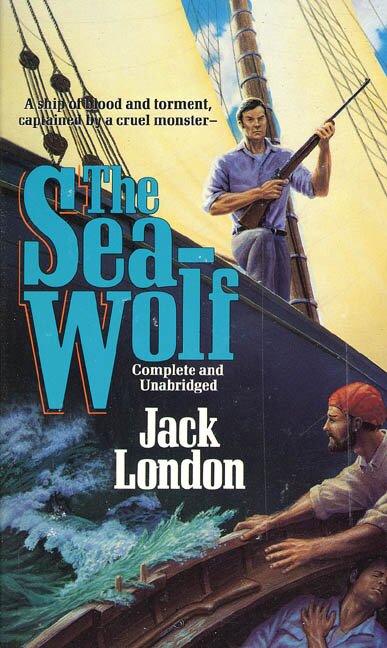
The Sea Wolf tells the story of a young, physically soft intellectual named Humphrey van Weyden who, whilst travelling on a ferry, becomes shipwrecked and is eventually rescued by a seal-hunting schooner, The Ghost, captained by one of the most fascinating characters in modern literature, Wolf Larsen. The story tells of the troubled relationship between the inexperienced van Weyden and the brutal and sadistic Larsen.
Wolf Larsen is portrayed in the novel as being borderline sociopathic, who thinks nothing of employing physical violence and bullying to achieve his ends. Yet coupled with these unfavourable traits, Larsen is also an intellectual with a thirst for learning, having taught himself such disciplines as mathematics, literature, science and philosophy. (London himself was also completely self-educated and was immensely proud of this fact.) Larsen’s violence and utter disregard for his fellow man is not mindless thuggery; his actions have a consistent philosophy behind them, one formed by Larsen’s life experience and inherent intellect.
The figure of Wolf Larsen is London’s exploration of Nietzsche’s concept of the Übermensch, or “Superman”. Jack London was clearly influenced by Nietzsche’s ideas, once stating, “I have been more stimulated by Nietzsche than by any other writer.” This stimulation was not blind adulation, however; the figure of Wolf Larsen was intended to show how Nietzsche’s take on the Superman was fundamentally flawed.
Although London admired Nietzsche greatly, he described himself as his “intellectual enemy.” Wolf Larsen, and the eponymous hero of another of his books, Martin Eden, are intended to show the negative individualism inherent in Nietzsche’s ideas concerning the Superman. London believed that the ideal Übermensch would display all of the tenacity and thirst for self-betterment displayed by Eden and Larsen, the Will to Power, but coupled with this should be an overriding ultimate aim; the aim of not selfish aggrandizement but altruism and a concern for the social welfare and betterment of others.
London spelt out his vision of the ultimate Superman, both brilliant physically, mentally and morally, when discussing another of his novels: “Read my Burning Daylight, in which I show a successful superman who at the end of his triumph and career, throws his thirty million dollars to the wind in order to win a great thing, namely love.”
It would be London’s take on the Superman concept that would form the basic premise behind his political beliefs. London was a committed socialist who would promote the violent overthrow of what he saw as the unjust capitalist system. Yet here again we see that London’s views make him hard to pigeon-hole. His belief in Nietzsche and Social Darwinism would at first appearance make his support of socialism seem problematic. Surely socialism preaches universalism, not “survival of the fittest”? How can London’s promotion of the Superman be consistent with egalitarianism? And, as we shall see shortly, how can London’s avowed belief in white racialism stand side by side by socialism’s emphasis on internationalism?
Jack London’s socialism was not of the modern variety; a nihilistic abomination propagated by the upper middle-classes for whom the working classes are an intellectual cause to be championed and patronised, not listened to and understood. London himself was of the proletariat and had experienced first-hand the deprivation encountered by the British and American working classes. London wanted social change for the working classes, obtained by the working classes.
As mentioned previously, his socialism was also merged with the individualism of the Nietzschean Superman. His ideal Man then would appear to be a Socialist Superman. His fusion of the two beliefs is perhaps never better described than in a speech he gave shortly before his death: “My final word is that liberty, freedom and independence, are royal things that cannot be presented to, nor thrust upon, races and classes. If races and classes cannot rise up by their own strength of brain and brawn, wrest from the world liberty, freedom and independence, they can never come to these royal possessions.”
In the above quote, it is clear that London placed great stead on the concept of race. Indeed, it is this aspect of his belief system that had most troubled those on the left who seek to capture him as “one of their own.” As the following will attest, London does not belong to the modern left. As American White Nationalist William L. Pierce once noted, when one considers his Nietzschean and Spencerian influences, joined with his folkish version of socialism, one should more realistically label him as a proto-National Socialist.
The subject of race permeates all of Jack London’s work. His novels are resplendent with example of how much emphasis London placed on the importance of race and the necessity of not only preserving it but improving it. From his short story, In the Forest of the North, we find the following: “He, alone, was full-blooded Saxon, and his blood was pounding fiercely through his veins to the traditions of his race.”
From The Valley of the Moon, another work in which he explores racial themes, the female character Saxon Roberts gives an explanation for her unusual name: “My mother gave it to me…the Saxons were a race of people – she told me all about them when I was a little girl. They were wild, like Indians, only they were white. And they had blue eyes, and yellow hair, and were awful fighters…They were the first English, and you know the Americans came from the English. We’re Saxons, you an’ me…”
Perhaps his most overtly racialist novel, Mutiny on the Elsinore, is an attempt by London at an allegory of white history and its battle for survival based around a mutiny onboard a ship out of Baltimore bound for Seattle. The non-white mutineers are eventually trapped by the whites in one part of the ship whilst they take to another and protect themselves with a stash of guns.
The racial composition of the new situation onboard is described by Pathurst, a young white officer:
“Every one of us who sits aft in the high place is a blond Aryan. For’ard, leavened with a ten per cent of degenerate blonds, the remaining ninety per cent of the slaves that toil for us are brunettes. They will not perish . . . they will inherit the earth . . .”
He goes on to describe his current predicament with the possible future predicament of the white race itself:
“And I look at the four of us at the table — Captain West, his daughter, Mr. Pike, and myself — all fair-skinned, blue-eyed, and perishing, yet mastering and commanding, like our fathers before us, to the end of our type on the earth. Ah, well, ours is a lordly history, and though we may be doomed to pass, in our time we shall have trod on the faces of all peoples, disciplined them to obedience, taught them government, and dwelt in the palaces we have compelled them by the weight of our own right arms to build for us. “
In a letter of 1915, London outlined what he described as his philosophical “pantheon.” Herbert Spencer was naturally included, as was Charles Darwin. There was one name that London included however, that although well known in his time would probably now be unfamiliar even amongst White Nationalists: David Starr Jordan.
David Starr Jordan (1851-1931) was an American naturalist who was a supporter of Social Darwinism and one of the most prominent advocates of eugenics, the science of improving the human race through planned genetic selection. In his book, The Blood of the Nation (1910), Jordan gives us an overview of his thoughts on eugenics and a solution for what he saw as the pressing problem of immigration into the United States:
“The most vital question concerning immigration, and the one most hard to solve, is the problem of eugenics, the problem of building up our nation with folks of sound heredity… The strength of the Republic can be maintained only by strong men, the sons of strong men.”
London himself had written a letter voicing his support of eugenics in 1913 and had first become aware of Jordan when he attended a series of lectures given by Jordan in Oakland. Another person who was influential in regards to Jack London’s thinking on race was German naturalist Ernst Haeckel (1843-1919). Haeckel was a great populariser of the Recapitulation Theory, or as Haeckel titled it, “The Biogenetic Law”, giving this school of thought its slogan, “ontogeny recapitulated phylogeny.” This theory stated that embryonic growth of the foetus in the womb recapitulates the entire evolutionary history of its species or group.
Haeckel was also a firm believer in the importance of race and race separatism. In his 1876 work, History of Creation, Haeckel wrote that blacks were, “incapable of a true inner culture and of a higher mental development.” London sent Haeckel a copy of his novel After Adam to which Haeckel sent a postcard to London thanking him for the gift in July of 1907.
Many on the left put forward the lie that London lessened his belief in racialism in a desperate attempt to include him within their ranks. They cite London and his wife’s attempted round the world trip between 1907 and 1910. The Londons visited Polynesia and witnessed first-hand the exploitation of the native Polynesians by their white rulers. London wrote of his sympathy for the natives and some see this as a rejection of his racialist view.
It was, of course, nothing of the sort. London had always said that he believed the races should be separate and free to pursue their own destinies. It is the same myopic view that sees any modern instance of white racial consciousness as being “supremacist” in nature as opposed to what it is in reality – avowedly separatist. White Nationalists should condemn exploitation of one race by another if they are true to their ideology and this is simply what London was doing.
Another indication of how important London’s racialist views were to him can be garnered when London was sent by Hearst newspapers as a reporter of the Russo-Japanese war. Upon arrival in Japan, London saw at first hand the barbaric treatment of the Russian prisoners, “my kind” as he called them, by the Japanese.
London’s dispatches were virulently critical of the Japanese and on his return to the States his socialist comrades were not slack in voicing their concern over London’s words. London gave his fellow socialists short shrift and left them in no doubt as to where his priorities lay: “What the Devil! I am first of all a white man and only then a Socialist!” The level of commitment to his racial views, and how they held the dominant place in his intellectual hierarchy, can also be seen in a letter he wrote to a friend:
“Socialism is not an ideal system devised for the happiness of all men. It is devised so as to give more strength to [Northern European] races so that they may survive and inherit the earth to the extinction of the lesser, weaker races.”
As he was nearing the end of his life, London was still intellectually active and it was in this period that he would discover perhaps the final god to add to his “pantheon”; Swiss psychiatrist and founder of analytical psychology, Carl Gustav Jung (1875-1961). It is perhaps no surprise that London should discover Jung as some have argued that Jung’s work was an attempt to synthesise a distinctly Aryan religion. Jung had pondered the reason for Hitler’s rise in his famous essay, Wotan, and had various long standing relationships with those on the right, including Chilean diplomat and founder of Esoteric Hitlerism, Miguel Serrano.
London told of his joy of finding Jung to his wife, Charmian: “I tell you I am standing on the edge of a world so new, so terrible, so wonderful, that I am almost afraid to look over into it.” He also gave a superb description of Jung’s “Collective Unconscious” and if one reads London’s work, especially The Call of the Wild, it becomes clearly evident that London himself was drawing from this resource:
“The hidden treasure upon which Mankind ever and anon had drawn, and from which it has raised up its gods and demons, and all those potent and mighty thoughts without which man ceases to be man.”
Jack London was a product of his time and his philosophical views have fallen out of fashion. But they have only fallen out of favour with those whom London was specifically railing against; those who could never appreciate the beauty and the naturalistic basis of his worldview. Those, who in London’s time, as in ours, only care for crass materialism, individualistic gratification and a resigned, slow march towards death. Those who cannot envisage the promethean levels to which Mankind can and should aspire and those who do not have the necessary will power to see this mission through to fruition. Jack London had such a vision and in the dark times we find ourselves in, London’s writing can be a welcome antidote to the timidity we see all around us and a source of inspiration for us on our ongoing and upwards journey.
By James Eden © 2013
# # # #
Michael Woodbridge
- Edit
A superbly enlightening essay! The cardinal point being London’s synthesis between socialism and racialism. Too many who believe themselves to be of the ‘Right’ still consider socialism an ideological enemy when in fact both racialism and socialism are essentially collectivist and complementary.
BritishActivism
- Edit
An interesting piece which once again shows to me that Western Spring (as a whole package) is top of the league in delivering quality articles which both encourage and give a measured insight into the very fibres of what ‘White Nationalism’ is based around as well as bringing to light some of the elements of its foundations.
.
I will be completely honest and admit that I had not heard of most of the referenced individuals in the piece. I am not all that well read on such material and have no need to pretend that I am, for what I have come to know and understand has been more an affair of the heart and of understanding various principles and concepts along the way.
.
I suppose that we all have our own ways and our own insights, anchor points and experiences – whether that be life at the direct coal face, or steeped in grappling hold of those who trod the paths before us, or a various mixture of both.
.
May Western Spring be the bridge which all quality Nationalists (of all different types of experience and background) come to travel over, and the structure which leads them towards a newly focussed and refreshed movement on the other side of some very troubling waters.
jackdaw
- Edit
Ditto BA .
frederickdixon
- Edit
Perhaps the best racialist article I have read anywhere. It brings home to me the existence of a fund of intellectual treasures which are available to us and, if more widely known, would greatly strengthen our cause.
Anonymous
- Edit
It’s very good to see Jack London’s political side get the recognition it deserves. He, like many other less-known radicals have been sidelined over the course of the last century in favour of mediocre Marxists and other shallow Judeophiles. It’s high time that this hidden stream of Western thought (‘Aryan socialism’ if you will) was brought to light again.
The two aspects of London’s political philosophy that seem contradictory at first – his socialism and his Darwinism, are admirably harmonized in his classic story: ‘The Strength of the Strong’:
https://www.online-literature.com/london/strength-of-the-strong/1/
It’s a rather long story, but it is well worth reading – since it is a metaphor for the rise and fall of human societies.
Those interested in his transformation from individualist to socialist, should read:
Why I Became a Socialist.
https://www.online-literature.com/london/war-of-the-classes/7/
Those wondering what contemporary relevance his writing has, are advised to consider:
The Question of the Maximum
https://www.online-literature.com/london/war-of-the-classes/4/