By Michael Woodbridge:
On Tuesday 16th April, James Harding, the former editor of The Times, was named as the new Head of News at the BBC.
Harding is to replace Helen Boaden, who stepped aside after criticism of the way in which the BBC handled the reporting of child sex-abuse claims made against the late TV host Jimmy Savile. The BBC has been criticized over its decision to cancel a show which examined claims that Savile abused children and previously, this scandal had also led to the resignation of the BBC’s then Director General, George Entwistle.
According to the new BBC Director General, Tony Hall, “James [Harding] has a very impressive track record as a journalist, editor and leader. I believe James will give News a renewed sense of purpose as it moves on from what has been an undeniably difficult chapter.”
James Harding became editor of The Times in 2007 at the age of 38, but resigned last December in the wake of the disruption caused by the Murdoch hacking scandal. Mr. Harding will receive a salary of £340,000 per annum upon taking up the new post on August 12th.
However, it might take more than Mr. Hall’s endorsement of James Harding to reassure the British public that the BBC is about to shed it’s disgraceful reputation for bias. During his tenure as Times Editor the paper was notorious for it’s pro-Israeli distortions, not least in its reporting of events in Iran and other Middle Eastern countries.
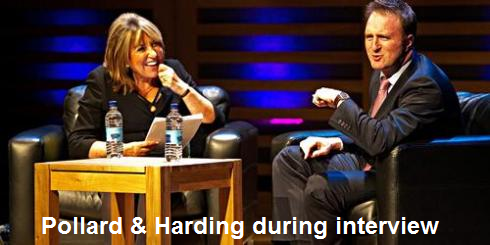
As a self-identifying Jew James Harding has spoken candidly to the Jewish Chronicle about the pressures of being a Jewish editor. He was interviewed by former Sunday Express editor Eve Pollard at a Jewish event, discussing his career, anti-Semitism and the media, and British reporting of the Middle East. “I am pro-Israel,” he said.
“I believe in the state of Israel. I would have had a real problem if I had been coming to a paper with a history of being anti-Israel.
“And, of course, Rupert Murdoch is pro-Israel.”
When on occasion he has been accused by his co-Religionists of not being sufficiently pro Jewish or pro Zionist he relates how he particularly enjoys writing back beginning his letter with, “Dear estranged relative …”
So while it may safely be said that the BBC is about to tighten it’s grip still further on dissident opinion, Tim Llewellyn, the former BBC Middle East correspondent, says it wasn’t always so. He is reported to have stated at a book launch in 2012, “I was there (at the BBC) when we weren’t interfered with. But the last 10-12 years, since the beginning of the second Intifada, Israel has decided to mount a tremendously well organised, careful, assiduous and extremely well financed propaganda campaign, especially in Britain.
“The BBC has completely and utterly become feeble and has misreported, in my view; misrepresenting the situation in Israel-Palestine. It has done this maybe because of intense Jewish and pro-Israeli pressure from within this country, from political elements like the Friends of Israel of our three main political parties.
“The propaganda can sometimes be extremely intense, it can be bitter, it can be angry, it could be violent, it can be other forms of coercion. But it’s something the suits at the BBC find very hard to resist. So what has developed over the past 10 years at the BBC, and at other broadcasting institutions like ITN, not so much Channel 4, is a kind of self-censorship.
“It is known now by the reporters if they are reporting on an atrocity by the Israelis, in the occupied territories or elsewhere, that they have to add on to the end of their story some kind of appeasing story of how terrible the Palestinians are or how the Israelis have suffered.”
Llewellyn is reported to have said, furthermore, that:
“The BBC is very sparing in the amount of delegations or visitors it allows from the Palestinian side. Whereas from remarks that have been heard from the head of BBC News, Helen Boaden, the British Board of Deputies (of British Jews), for example, practically lives at the BBC. They’re there all the time.”
At the same event, Jackie Rowland, from Al Jazeera broadcasting, described how the BBC’s obligation for accountability, because of its public funding, has been “used and exploited by very well organised pro-Israeli, pro-Jewish lobby groups.”
She said that she knew someone who worked in the complaints department of the BBC who told her “that 85% of the complaints he dealt with were complaints by pro-Israeli, pro-Jewish lobby groups complaining about the perceived bias of the BBC’s Middle East coverage.”
Many of us have long since learned not to take at face value anything the Times or the BBC might report about the Israeli/Palestinian conflict, and now with the appointment of James Harding as News Director at the BBC, it would appear to be ‘business as usual’.
While some nationalists may not be unduly concerned about fairness and the objectivity of our mass media in their reporting of events in the Middle East, the key implication of such strongly pro-Israeli bias within the media, is that it tends to confirm our worst suspicions regarding the scope that exists for minority ethnic groups in general, and for Jewish groups in particular, to covertly exercise influence over British politicians and the general public, pressuring them to pursue policies, which while legitimate from the perspective of the minority groups in question, are almost invariably inimical to the interests of we indigenous British. Policies such as permitting uncontrolled mass Third World immigration, the introduction of laws outlawing racial preference and the suppressing of our freedom of speech on issues such as race and nationality, for example.
By Michael Woodbridge © 2013
# # # #
frederickdixon
- Edit
You’ve certainly opened my eyes, Mike. I would not have suspected that someone called “James Harding” was anything other than pukka Anglo-Saxon. I suppose its naïve always to expect a Jew to have a name which screams “Jew”.
Of course,Jewishness in itself is not proof of any particular bias, but a declared devotion to the cause of Israel most certainly is, and as that cause is a matter of great controversy Mr. Harding should not have been appointed.
Franks
- Edit
But then Eve Pollard sounds very Anglo-saxon
Steve
- Edit
Plenty of these people are not Jews in any sense but are strong zionists, quite why I don’t know, I guess the rewards must be something to do with it.
Look how rich Murdoch & Blair are.
Michael Woodbridge
- Edit
I think the problem we have in understanding the role of Jews in our society is that we’re discouraged from examining their influence dispassionately. It’s not a question as to whether we feel any personal animosity towards them. It’s a question of understanding what their representatives are up to in trying to influence public opinion. The fact that James Harding has moved almost seamlessly from Editor of the Times to director of BBC News is something we seriously need to concern ourselves about.
jackdaw
- Edit
Good article Mr Woodbridge, opened my eyes too, had no suspicions regarding Hardings background. £340,000 per annum , how the other ‘alf live eh?
Steve
- Edit
There’s BBC watch & CIF watch & they are both very vocal zionist lobby groups, if you ever want a lesson in zionist trolling techniques, go on those sites & say something anti Israel & see the storm you release, these people are relentless, even if they have things their own way, they still bitch & moan non stop.
Steve
- Edit
I think that might be a technique to fool people into thinking the BBC is neutral when in fact it is actually quite biased.
One trick they also do along with the regular MSM is to omit information, to tell half a story which has a distorting effect.
I was watching a documentary on “British Pathe” & smiled as it was described as propaganda & patronising.
I thought that is exactly what people will say in the future, how did we believe the crap we got told all the time by the MSM.