By Max Musson:
From time to time, the advocates of multiculturalism and multiracialism trot out the hackneyed assertion and untruth that one or more of the various immigrant groups in this country are perfectly entitled to colonise Britain because their forebears fought for this country during the two World Wars, and in this centenary year in which we are as a nation commemorating the sacrifices of our grandfathers’ and great-grandfathers’ generation during World War One, which started 100 years ago, that same lie is being repeated virtually every day.
In the following video, David Cameron sent out a message to Muslims in Britain and he has sent out similar messages to other ethnic groups falsely crediting their forebears with having made a great contribution to the freedoms that we in Britain used still nominally enjoy.
The key passage comes approximately one minute and eight seconds into that video, where Cameron says: “This Ramadan I hope that we can reflect upon a key aspect of our shared history – the bravery of those who fought and died for our freedoms nearly a hundred years ago.
“Just days after Eid, we’ll be marking 100 years since the First World War. More than a million men and boys from India fought with our troops during that conflict and many thousands of them were Muslims. They travelled right across the world to fight to defend our freedom, guided and sustained by their bravery, their comradeship, and above all by their faith.
“Their selflessness and their courage helped to secure the liberties that we all enjoy today. So this Ramadan and this centenary, we will remember them and reflect upon their sacrifice.”
We will also remember the Question Time programme from 2009, in which Nick Griffin of the BNP appeared opposite among others, Jack Straw, and during which Jack Straw referred to a military cemetery in Northern France in which more than half of the dead buried there are men with Asian names who died during the Battle of the Somme during World War One. Referring to both the English and the Asian men buried there, Straw ended has statement saying: “These people died together, to fight for us, and that’s why having a multiracial society and ensuring that race based politics has no place in our society, is fundamental to the decent British values that are held by most people in this country”.
What then is the truth of the matter?
In 1914, the Indian Army was the largest volunteer army in the world with a total strength of 240,000 men and its structure and composition had been determined by Lord Kitchener during the period that he was Commander-in-Chief of the Army in India.
The structure Kitchener decided upon was one in which each division of the Indian Army would contain one battalion from the regular British Army. Furthermore the army also contained auxiliary formations that were recruited entirely from the British colonial population of the Raj, and further still, the entire officer corps of the Indian Army was composed of British Army officers. No ethnic Indian officer cadets passed through Sandhurst until 1919. All in all, this meant that some 88,000 of the 240,000 strong Indian Army was made up of people of ethnic British extraction and only 152,000 were ethnic Indians.
Some sources claim that almost 1.3 million Indian soldiers ‘served’ during World War One, however, this would appear to be the number of men who volunteered rather than the number who served, and while this number may have volunteered at some point during the course of the war, it would appear that only 800,000 of these volunteers volunteered for the Army, the remainder only volunteered for non-combat support roles.
Furthermore, as the Indian Army consisted of 240,000 men in 1914, rising to 548,311 in November 1918, even if we add to this latter figure the number of India Army soldiers who were killed or injured in the fighting, c. 150,000 in total, this would tend to indicate that only approximately 700,000 men in total served in the Indian Army despite the larger number who volunteered.
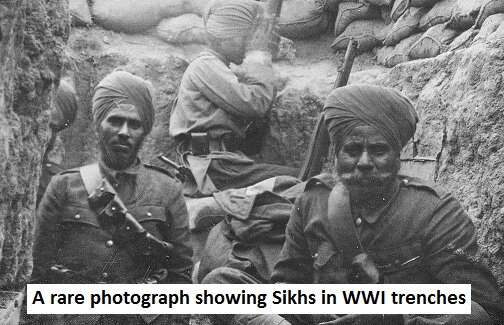
If one were to listen to establishment politicians and media pundits, one might be forgiven for thinking that all of the 700,000 ‘Indian’ soldiers fought in the trenches of Flanders and northern France, however only 130,000 were deployed on the battlefields of Europe, of which 40,000 were in battlefield support roles, not fighting in the trenches.
Prior to the war the Indian Army was deployed maintaining internal security and defending the North West Frontier against incursions from Afghanistan. This role did not come to an end with the declaration of war and four divisions, totaling approximately 50,000 men were deployed along that frontier until the end of the War. A further five divisions also continued to be deployed along the North East Frontier, in Burma and in Aden, just as they had before the War.
Some of the Indian Army soldiers formed two expeditionary forces tasked with invading German colonial territories in East Africa. The first of these expeditionary forces composed of 8,000 men took part in the ‘Battle of Tanga’ where they were soundly beaten by a much smaller German force under the command of the legendary German guerilla warfare pioneer, Lieutenant Colonel Paul von Lettow-Vorbeck, ‘Der Löwe von Afrika’, as he became known.
The second East African expeditionary force was similarly ineffective and in one engagement was also beaten by a smaller German force at the Battle of Kilimanjaro.
The largest of the Indian Army expeditionary forces was dispatched to Mesopotamia where they were to secure and guard British oil installations in and around Basra. This campaign was long and involved variously successes and setbacks, but eventually the Indian forces prevailed over the Turks who surrendered and the Armistice of Mudros was signed late in 1918 as the war was coming to a close.
Other Indian units served in Palestine and Egypt and some were involved in the abortive Gallipoli Campaign, which ended in defeat for the British led forces involved.
Overall, while many of the 90,000 ‘Indian’ soldiers who found themselves in Europe on the Western Front did fight bravely and a small number distinguished themselves in battle, Indian troops were largely ineffective.
The front line units arrived in France in September 1914 and were divided into two corps: an Indian Cavalry Corps; and an Indian Infantry Corp, and the infantry corps saw their first action the following month in the Battle of La Bassée. Losses were heavy however, with the 47th Sikhs suffering 50% casualties.
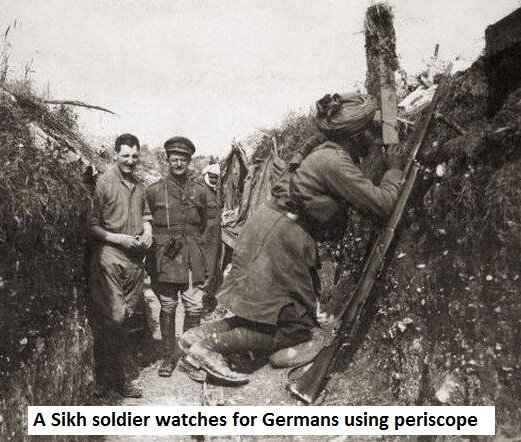
In March 1915, the 7th (Meerut) Division was chosen to lead the assault in the Battle of Neuve Chapelle, but the Indian Infantry Corps did not stand up well psychologically to the cold weather, the pressures of unremitting trench warfare and the intense artillery bombardments. One man wrote home ‘this is not war; it is the ending of the world’.
Morale seemed to pick up in the spring of 1915, only to decline towards the end of the summer when it became clear that an end to the war was not in sight. The Indians again took heavy losses at the Battle of Loos in September. Many soldiers fled the scene of the battle and the infantry divisions were finally withdrawn to Egypt in October 1915.
The Indian cavalry divisions remained on the Western Front until March 1918, when they were transferred to Palestine to take part in the offensive against the Turks.
Fourteen soldiers of the Indian Army were awarded the Victoria Cross during World War One, and their names were as follows:
Khudadad Khan, 129th Duke of Connaught’s Own Baluchis;
Darwan Singh Negi, 39th Garhwal Rifles;
Frank Alexander de Pass, 34th Prince Albert Victor’s Own Poona Horse;
William Bruce, 59th Scinde Rifles;
Eustace Jotham, 51st Sikhs attached North Waziristan Militia;
Mir Dast, 55th Coke’s Rifles;
John Smyth, 15th Ludhiana Sikhs;
Kulbir Thapa, 3rd Gurkha Rifles;
Lala, 41st Dogras;
John Alexander Sinton, Indian Medical Service;
Shahamad Khan, 89th Punjabis;
Gobind Singh, 28th Light Cavalry;
Karanbahadur Rana, 3rd Gurkha Rifles;
Badlu Singh, 14th Murray’s Jat Lancers.
As you can see from the highlighted names in the list above, five of the fourteen nominally ‘Indian’ soldiers to receive the Victoria Cross were ethnic British soldiers serving in the British battalions attached to Indian divisions.
It is not my intention here to denigrate unnecessarily the contribution made by ethnic Indian soldiers during World War One. Many of them fought bravely, some conspicuously so, but they did not play a major or decisive role in the main theatre of the war — in the trenches of Flanders and northern France, where the British Army grew to number approximately 4 million men and suffered over 2 million casualties, with 673,375 dead or missing in action and another 1,643,469 wounded — and it is a travesty of history to suggest that they did.
Furthermore, the vast bulk of Indian Army soldiers either served to defend their own country against incursions by Afghans, Chinese and Burmese Kachin tribespeople, or served largely inconspicuously and in some cases embarrassingly poorly in the Middle East and East African theatres of war which must have seemed a ‘walk in the park’, compared to the unremitting horror of the trenches of the Western Front.
Lastly, it is alleged that the Indian troops fought for ‘Britain’ and the ‘values’ and ‘freedoms’ that we hold dear, but in the main this is not the case. Indian support for Britain and the British Empire during World War One was largely in direct response to vague promises of self-governance which had been made by the British government to the Indian National Congress, and it was the subsequent reneging on these promises that angered post-war Indian leaders and provided a great impetus for the Indian independence movement.
Elements of the Indian Army provided much support for the Indian independence movement and during the height of the war attempted to take advantage of the situation in which the British Army was fully committed on the battlefields of Europe by rebelling against British rule on the Indian sub-continent. There was the Ghadar Conspiracy in which various elements within the Indian Army planned an uprising against British rule, which was to have taken place on 21st January 1915, but plans for which were detected and thwarted by British intelligence.
The Ghadar conspiracy however led on to a second incident, the Singapore Rebellion of February 1915, in which Indian troops rebelled against British rule in Singapore initially, in the hope that their rebellion would spread to other parts of the Indian Army throughout the sub-continent. This rebellion lasted for several days before it was eventually quelled.
From these facts it is therefore plain to see that Indian support for Britain during the First World War was not motivated by a desire on the part of Indians to fight for British values, but a by a desire to please the imperial authorities and thereby advance the cause of Indian independence from Britain.
Secondly, far from being steadfastly loyal to Britain there were substantial elements within the Indian Army that both plotted and carried out acts of violent rebellion against British rule in India, thereby undermining the war effort.
Thirdly, it would appear that 1.3 million volunteers did not serve in the Indian Army and very few of them saw action on the Western Front. Those that did largely performed inconspicuously or inadequately and were consequently shipped off to less challenging theatres of war where much of their role was simply to guard outlying parts of the Empire.
All of the above information is freely available on the Internet or in history books and it is inconceivable that David Cameron’s researches would not have been aware of it. This issue is therefore revealed as yet another cynical manipulation of the truth by our current Conservative government, attempting to curry favour with ethnic minorities by misleading the British public.
By Max Musson © 2014
# # # #
Shaun
- Edit
It is shocking that the authortities lie to us in order to manipluate the White Englishs’ natural feelings of fair play, empathy and descency — what a terrible tactic! The Internet, however, is allowing us to cut through all their lies, and we’re begining to get a clearer picture of the Mind Benders and all their cynical tactics. I suppose they’ll continue to try, but their game is starting to be exposed.
GEORGE
- Edit
The way that this is being put is that Africans and Asians stood steadfastly behind Britain in both World Wars. Africans and Asians fought against the British in both wars. That is not to be mentioned though is it? Muslim wars against white countries are to numerous to list here.
How many ‘people of colour’ do you see in films and photographs from the conflicts? Perhaps the photographers were just racist.
Michael Woodbridge
- Edit
Whilst on the subject of Coloured Troops fighting for the British Empire I’m reminded of Rudyard Kipling’s superb poem ‘Gunga Din’.
Every bit a racialist, Kipling nevertheless possessed the magnanimity to give praise where praise was due in his terse, unsentimental yet supremely moving way
The poem may not make quite the same point as Max in his painstaking analysis of the role of Indian troops in the ‘Great War’ but the homage it pays to heroism and loyalty are beyond the wildest imaginings of Prime Minister Cameron and his clique of race traitors..
.
Gunga Din
You may talk o’ gin and beer
When you’re quartered safe out ‘ere, An’ you’re sent to penny-fights an’ Aldershot it;
But when it comes to slaughter
You will do your work on water,
An’ you’ll lick the bloomin’ boots of ‘im that’s got it.
Now in Injia’s sunny clime,
Where I used to spend my time
A-servin’ of ‘Er Majesty the Queen,
Of all them blackfaced crew
The finest man I knew
Was our regimental bhisti, Gunga Din.
He was “Din! Din! Din!
“You limpin’ lump o’ brick-dust, Gunga Din!
“Hi! Slippy hitherao!
“Water, get it! Panee lao
“You squidgy-nosed old idol, Gunga Din.”
The uniform ‘e wore
Was nothin’ much before,
An’ rather less than ‘arf o’ that be’ind,
For a piece o’ twisty rag
An’ a goatskin water-bag
Was all the field-equipment ‘e could find.
When the sweatin’ troop-train lay
In a sidin’ through the day,
Where the ‘eat would make your bloomin’ eyebrows crawl,
We shouted ” Harry By!”
Till our throats were bricky-dry,
Then we wopped ‘im ’cause ‘e couldn’t serve us all.
It was “Din! Din! Din!
“You ‘eathen, where the mischief ‘ave you been?
“You put some juldee in it
“Or I’ll marrow you this minute
“If you don’t fill up my helmet, Gunga Din!”
‘E would dot an’ carry one
Till the longest day was done;
An’ ‘e didn’t seem to know the use o’ fear.
If we charged or broke or cut,
You could bet your bloomin’ nut,
‘E’d be waitin’ fifty paces right flank rear.
With ‘is mussick’ on ‘is back,
‘E would skip with our attack,
An’ watch us till the bugles made “Retire,”
An’ for all ‘is dirty ‘ide
‘E was white, clear white, inside
When ‘e went to tend the wounded under fire!
It was “Din! Din! Din!”
With the bullets kickin’ dust-spots on the green
When the cartridges ran out,
You could hear the front-ranks shout,
“Hi! ammunition-mules an’ Gunga Din!”
I sha’n’t forgit the night
When I dropped be’ind the fight
With a bullet where my belt-plate should ‘a’ been.
I was chokin’ mad with thirst,
An’ the man that spied me first
Was our good old grinnin’, gruntin’ Gunga Din.
‘E lifted up my ‘ead,
An’ he plugged me where I bled, An’ ‘e guv me ‘arf-a-pint o’ water green.
It was crawlin’ and it stunk,
But of all the drinks I’ve drunk,
I’m gratefullest to one from Gunga Din.
It was “Din! Din! Din!
“‘Ere’s a beggar with a bullet through ‘is spleen”
“‘E’s chawin’ up the ground,
“An’ ‘e’s kickin’ all around:
“For Gawd’s sake git the water, Gunga Din!
‘E carried me away
To where a dooli lay,
An’ a bullet come an’ drilled the beggar clean.
‘E put me safe inside,
An’ just before ‘e died,
“I ‘ope you liked your drink” sez Gunga Din.
So I’ll meet ‘im later on
At the place where ‘e is gone
Where it’s always double drill and no canteen.
‘E’ll be squattin’ on the coals
Givin’ drink to poor damned souls,
An’ I’ll get a swig in hell from Gunga Din!
Yes, Din! Din! Din!
You Lazarushian-leather Gunga Din!
Though I’ve belted you and flayed you,
By the livin’ Gawd that made you,
You’re a better man than I am, Gunga Din!
Note on vernacular expressions
bhisti – water-carrier
hitherao – come here
panee lao – bring water
Harry By – O Brother
juldee – quickly
marrow – hit
Rerevisionist
- Edit
Very good piece. And I have little doubt the same sort of thing applies to French empire troops-and to the propaganda uses they are put to in France. And of course films etc in the USA have been trotting out similar lies.