In this article I hope to generate debate and ideas on the subject of how to communicate our message and move the Movement forward with recruitment. Promotion of the Cause and its publications has always been one of my passionate interests. I now write to bring this issue into focus, as I feel it is a necessity in which we here in the U.K. find ourselves severely lacking.

Agitation: an age-old political manoeuvre that, of course, agitates –it excites, stirs up. Propaganda, however, concerns itself more with the propagation of creed or doctrine. Admittedly, there is significant overlap, and the two are essentially interpreted by a passive audience to be synonymous and interchangeable. Thus we arrive at the peculiar term agitprop.
Agitprop (a portmanteau of ‘agitation’ and ‘propaganda’) operates at the emotional level, seeking to stir and rouse immediate action on a single hard-hitting issue. Propaganda on the other hand tends to engage more at the level of cognition –more detailed and systematic– with its subjective use of facts and figures and the ‘lying by omission’ of contrary points. Think of agitprop as being the art; propaganda as being the text.
For example, a propagandist would, say on the issue of immigration, write or talk at length about the many connivances and contrivances of the actors responsible, deliberate its results, and with the presentation of many ideas would go on to highlight the inevitable outcome of inaction. The agitropist, however, would –with the public’s short attention span in mind– take an illustration of, say, a dispossessed starving native family surrounded by dozens of seething malcontent invaders baying for their blood, and present that single idea along with a caption of few words.
We see in agitprop a stylistic imagery that stirs the emotions and communicates at the base level –hence conveying in its iconography a more simplistic, arousing, and hard-hitting message. Political propaganda disseminated through art, literature, drama, etc is a method our enemies know only too well. In its inquiry it is in essence the foundation of metapolitics: the politics of culture where the doctrinal discourse of, say, a political manifesto is not so evident and the agenda, while perhaps subliminally interpreted, is not so overt.
The Communists and National Socialists especially well understood the importance of agitprop.
A Picture Speaks a Thousand Words

We can’t, and probably never will, combat the media on their terms. Hence my support of agitprop. On the streets, people walk, people see, people read. The streets are essentially our ‘television’.
Picture this: a family of our folk, like millions nationwide, is of the weekend sat at home in front of the idiot box, lapping up the lies, the propaganda, the given ‘popular’ culture and sentiment of the System’s agitprop. Let’s say this family is an average middle-class constituency. The parents work lengthy hours and the children, after school, stay with relatives until their return. When the family is finally together of a week-day evening, the few hours together are spent in isolation. Dad might send a few work-related emails or browse the controlled press online; Mum might listen to the State’s BBC Radio 4 while in the kitchen; the children on social media keep abreast of the latest fatuous memes, aberrant ‘pop culture’, and sanctimonious group-think on the youth’s current ‘hot topics’. What other imagery do they see? To what other perspectives and messages are they introduced? The System –by dint of its servitors in the media– thus has a monopoly on their consciousness.
But the family goes out to walk the dog. A chance respite from the controlled narrative, the mind control? Perhaps. That is until they encounter the ubiquitous advertising hoardings; the rolling posters in bus shelters; the emblazoned telephone boxes; the advertisement stanchions… all portraying the typical Black man and White woman embraced with ‘their’ mixed-race kids, the poster-family championing some superfluous gadget, bank account, or pernicious film –inevitably a future approximating the omnipresent advertisements in the film Blade Runner.
Off on a tangent; alluding to Los Angeles, 2019? Not if one is to have a cursory glance of any modern-day city, with its projection of same, designed to corral the thoughts of citizens and compel their purchase and conformity. And so it is here we find this family inundated with all manner of indoctrination and perfidious programming as they walk the dog.
Advertising boards and such like are there for a reason. If the streets were irrelevant then they wouldn’t invest so much time, money, and effort advertising there, and would concentrate only on TV and radio.
Of course, we don’t condone fly-posting or any other illegal activity, but nevertheless many have said that we need, somehow, our material on the streets –off the internet’s echo-chambers and into view of the public. I’ve heard it said that such activity would suit those who prefer to be active at night, under the cover of darkness, to covey our message.
Dissemination of ideas and perspectives, explanation of our position, must captivate the audience and rouse support. It simply cannot be confined to the spheres of internet, seen and discussed by already-converted dissidents back-slapping each other in the ether’s echo-chambers. While the advent of memes and trolling (modern-day agitprop) has been extremely advantageous to the Cause, I feel we are still falling short. The internet: the preserve of the youth –both the dissident Alt-Right ‘Shitlords’ and their appositional ‘normies’. Yet those perhaps with the greater concern for their Family, Folk, Future –the working caring father; the concerned but busy doting mother; the patriotic pensioner lamenting the future of the grandchildren to whom she will bequeath –have little or no access to the internet and the culture war currently there in place. It is they I believe we should access.
What can we do?
Put simply, help us to help you. Get in touch; network; offer your services by using the contact form below if you can provide any of the following:
- Graphic artists;
- Leaflet/poster designers;
- Printers;
- Artists/Cartoonists
- Web designers;
- Those with skills in Photoshop and other such software;
- Video editors/those who can compile Youtube videos;
- Any other such skills not listed.
What I feel to be the benefits of legal agitprop:
- Directly accesses the public;
- Cannot be ignored unless removed;
- Incites a climate of doubt and at least compels consideration of our message. It implants the idea, perhaps sowing the seed for fruition at a later date;
- Serves to boost morale and confidence of patriots and nationalists while out on their travels;
- Publicity ought to reignite energy and enthusiasm as well as acting as a deterrent to those seeking to occupy our areas;
- With hate crime laws now essentially infused with anti-terror laws it is better to go underground;
- The clampdown is tightening, restricting our activity –especially online. Perhaps now is a good time to re-visit the previous methods.
All literature must be positive, even if it embodies a negative message or context. For example, anti-invasion posters are essentially useless if they merely highlight the problem (negative) without the solution (positive) or what we stand to lose. This is not to say I reject negative agitprop –that is to say negative insofar as, say, it highlights our plight, rather than negative in the sense of adverse consequences for the Movement. Indeed, I embrace it –but as only a secondary, complimentary production to the positive material which leads.
In acknowledging the far-superior numbers and therefore greater talent in the U.S., we in the U.K. are still left floundering. Our cousins across the Pond have stolen a march on us and I, and I’m sure many others, like to think we have ideas and input in the waiting in this regard but are perhaps in some areas thwarted by the lack of skills listed above and are left wanting.
Further Reading:
Audio/visual:
Pedro Varela – ‘Revolutionary Ethics’
Professor Kai Murros – “That which does not kill us only makes us stronger.”
Brian Anse Patrick – The Ten Commandments of Propaganda [Many more useful links herein]
OmniPhi: Visual Aesthetics in Media Production
Top Political-art Sites:
By Rick Lee © 2016
# # # #
JOIN WESTERN SPRING
Western Spring is not just a website. We are a community of people dedicated to achieving the Six Prerequisites and thereby acquiring the wherewithal needed to win political power and through that secure the future survival, proliferation and advancement of the British people and other White peoples of European descent, wherever they may live. Please join us:
# # # #
IRONKRAFT
- Edit
It’s all been overdone. Street stalls, leaflets, protests, and the now, frazzled and almost ignored-by-all, “internet activism” and social-media. Millions still vote the trad-pol garbage, millions moan in bars, bus-stops, at work, furtively returning to their norms, without a second thought, waiting for the next big “outrage”.
What is needed, is a quieter, subtle tactic. Cheap, simple, bullet-point, post-card size literature, is
Far more effective. These, as long as the message (s), are uniform, can get an organisation in the public mind quickly, and within a month, do two things. One: The message is public. Two: The mainstream media will pick up on it. Then, your strategy and constitution, principles, etc, will produce the required results. All else is at this stage, futile.
Rick Lee
- Edit
Hello Ironkraft,
I’m not at suggesting the methods of old which you mention in your opening line –especially not leafleting people’s houses. What I am suggesting is we follow the examples set by Identity Europa and Traditionalist Worker Party (see links below in my reply to Bentley).
Internet activism and social media should not be discounted, as they have made great inroads for the Cause. Yes, millions of apathetic folk continue to moan in the places you have mentioned. What better way to reply to their lament than to have our attractive, short and snappy answer at those places, full in their faces.
On the issue of pub-politics, the owner of Wetherspoons, Tim Martin, carried out such a campaign during the Brexit campaign.
I don’t disagree with your considerations of “quieter, subtle tactic. Cheap, simple, bullet-point, post-card size literature” –every and all methods should be utilised, each suited to the demographic and socio-political contingent of the area selected. For example, the Traditionalist Worker Party would not put out its message in, say, well-to-do Beverly Hills, any more than we would put out, say, anti-capitalist/globalist/big business messages in the City of London.
“The mainstream media will pick up on it” –yes, if an area receives the message and then we, as ‘concerned residents’, report it to the local press.
diane green
- Edit
I agree Ironkraft. Clear message with fact based key points.No party politicking!Clear concise and easy to read! We need to ‘red pill’ the sheep! I have done this with friends,those on the left.The obvious vacuum or perhaps wilful ignorance bulldozed forever!
Expose those who are really running the show,party politics will die.
Bentley Graves
- Edit
Good article, Rick, and although obvious to some, these are important points that can sometimes pass us by.
I think that if something works we should be doing it and although, as you have pointed out in the article, not everybody gets to see the result of internet activism, I think it has become a powerful tool for spreading our messages to a larger audience, especially when looking at the huge impact that memetics (memes) are currently having.
I would also agree that American activists, be they online or a visible presence on the street, are stealing a march on us, although we have to allow for the fact that their First Ammendment rights give them a lot more freedom to diseminate information and say things that we here in the UK simply cannot do without putting our livelyhoods and freedom at risk.
Rick Lee
- Edit
Bentley,
Yes, I feel this issue has passed us by and we (the Movement as a whole) have lost sight of the power and influence of agitprop.
A notable exception to this is National Action’s posters and publications
Across the Pond, I’m impressed with the snappy positive agitprop of Identity Europa and with the iconography and message of the Traditionalist Worker Party
Your consideration of the First Amendment is an important variable and one which we must work round to be smarter with our message. This can be done.
britishactivism
- Edit
Hi Rick, thanks for this article. I agree with the premise and the suggestions put forward within it. I think there could be great potential for a new age of content that could be packaged to the masses in a more sophisticated and perhaps more scientific way than most of the traditional methods we are used to employing in this cause.
What you say about being both snappy and positive is important. Finding that sweet spot between expressing the danger we are in and offering hope for something better, all planted into a single image or message is going to to be the ideal.
I am not generally a fan of street movements, their banners, etc – perhaps because they are often too harsh on the messages, too small in numbers and / or perceived as being hostile or confrontational. Like many say, you really shouldn’t feed steak to a baby – and most of society seem to be intellectual infants when it comes to the subject matters we tend to grapple with.
Shock and awe is one thing, but it ought to be done in way that can build support as well as receive condemnation and brouhaha from opponents and the media.
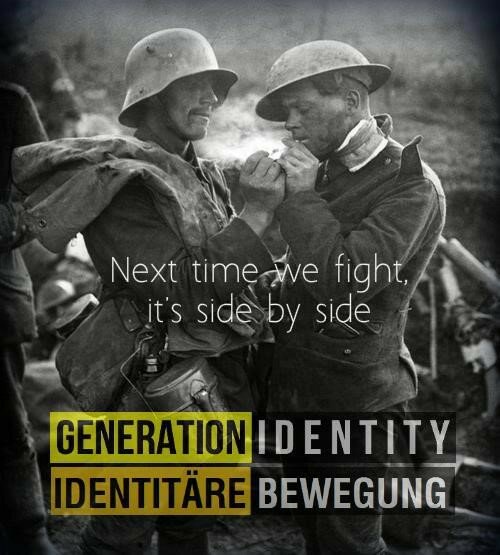
The Generation Identitaire poster in the article is a bit more sophisticated. It is soft, yet gives a deep meaning. It can easily be explained without the need to enter into things people aren’t yet ready to hear or think about.
There are a lot of good “memes” being generated on the Alt-Right that could also be used. Some of them are too far-gone for general consumption in public spaces, but even some of the more edgy ones could be valid if they make a clever and irrefutable point in a simple manner.
Two of the most notorious and memorable political campaign images from UKIP in recent times were the escalators rising up to the top of the white cliffs of Dover, and the one of the “refugees” snaking around the countryside ready to arrive in some unsuspecting nation or other.
They were simple, they had a message, they were easily defensible and they duly caused uproar with our opponents that gained a lot of publicity and even further reach by being covered in the newspapers and on television. We may not like UKIP all that much, but I think they did those things right.
One of the advantages of the new breed of political movement (that lays outside of the old “party” and “group” system) is that it should be possible to put things up, put things into the public sphere, without need for any official party image, or group name on them. Not ‘generation identitaire’, not ‘National Action’, not National Front’ or ‘BNP’ – (if they are still even a going concern!).
It could be an advantage because it would make it harder for people to identify and prosecute people who put this stuff into public spaces.
As somebody who is of the age to remember the emergence of the rave culture, I recall how people used to fly-post their events all over the place on boarded up buildings, underpasses, overpasses, or on run down billboards. They were decent sized posters, maybe double the size of an A0 sheet, and applied with simple flour water and a brush. They’d be out at night, in dark clothes, sticking them all over the place whilst nobody can confront them.
In those cases, the heat could come back to the venue or the organisers hosting the event…..but in our own case, who could they come to, if there is no logo, no name, no idea who it is linked to? Could even entire billboards be hijacked for this end, if we had the ability to do prints of such scale? Or would that be too risky?
I am not sure what the penalties would be, if caught, or even what the law is these days and how things stand with that. I wouldn’t wish to advocate criminality of any kind, I am just throwing out some suggestions of what still tends to go on in urban and semi-urban environments. People could look into what the laws are, and whether they could be bypassed (for example, it is not strictly advertising for a venue or a party or event).
I’m sure there are going to be techniques to such things – like also applying paste over the top to make them hard to peel off, or figuring out where posters tend to be old, lingering, meaning the councils don’t tend to put much effort into removing them there. Maybe groups of three…..two to do it, one for a lookout.
Agitprop used for specific groups and organisations is one thing – but if the idea is to just help shift talking points and introduce new and confrontational ideas into the public domain, as a wider cultural effort to help build or reinforce our viewpoints, I don’t think it is important who gets the acknowledgement, support (or blame!) for it.
Are there any ways for technological advertising? Mass emails from public acquired databases, pop-ups on some websites, creating sites with similar names to other things, so when people click on google searches for “Ikae” instead of Ikea, they are presented with one of our themes?…Maybe there is way to blue-tooth anonymous people with ads, or take control of TV displays in electrical shops that have front windows, or maybe there could be light shows, lasers beamed anonymously from moving targets into the night sky… I don’t know!
I realise I could just be talking complete nonsense here and getting a bit far fetched, but I hope people get the idea that there could be possibilities that could far outreach megaphones, table-tops, stickers, and so on.
Rick Lee
- Edit
Hello, BA.
I did think this would be your area of interest and expected you would comment.
You say that not putting the name of the organisation/contact details could be an advantage because it would make it harder for people to identify and prosecute people who put this stuff into public spaces. I have considered this but concluded that perhaps the message alone is not good enough. What recourse do people have when presented only with the problem but not the solution?
Yet the consequences of fly-posting, the comeback on the organisation, has been mentioned, and it is a fair point. But I know of one organisation in particular whose activists would often go out and saturate bus stops, phone boxes, toilets, with stickers. If the organisation was contacted to protest against it, they would simply deny it: “Anybody can go out and fly-post; what makes it the fault of the organisation whose details are on the material? Prove it was we that committed the act.”
But your point remains, and this is perhaps why Identity Europa put on their material only “IDENTITY EUROPA” –which as read and without a logo or identifying features is only a statement. I guess those two words are sufficient enough to compel folk to search for them on the internet, which will produce the organisation at the top of the list. Hey presto, I guess.
“I’m sure there are going to be techniques to such things – like also applying paste over the top to make them hard to peel off, or figuring out where posters tend to be old, lingering, meaning the councils don’t tend to put much effort into removing them there. Maybe groups of three…..two to do it, one for a lookout.” –Spot on.
“Agitprop used for specific groups and organisations is one thing – but if the idea is to just help shift talking points and introduce new and confrontational ideas into the public domain, as a wider cultural effort to help build or reinforce our viewpoints, I don’t think it is important who gets the acknowledgement, support (or blame!) for it.” –My sentiments exactly.
I’m fascinated by your points in the second-to-last paragraph and would like to see these thoughts developed –perhaps by one of our youth who are far-ahead than we in this area. As I said, I have my own technical limitations in this subject but I, like you, do have the ideas to drive it.
Thanks, BA.
britishactivism
- Edit
Thanks for the reply Rick. I can’t add much more, but the point regarding having no contact information was really on the basis of simply promoting ideas and concepts that could chime with people, or conversely, get them so upset that it perpetuates our message in the uproar, if uproar was deemed to be an appropriate aim.
In your article you cite how people are bombarded with messages that condition wider society. They are not always blatant with what they are doing, or what they are unwitting parts of. They are selling visions of what they feel society is, or ought to be, whilst trying to maximise their market. We see it because we know what it is – yet most people don’t even see it at all.
I feel that, at this time, it could be more important to simply promote the challenges to this orthodoxy in general, as part of the establishment of counter-culture and shifting discourse and indeed ‘argumentations’ our way, so we get more coverage in general.
Not wishing to do any specific groups down, especially those I have no insight of, but lets say there was a contact name or a group attached to the agitprop. Lets say they are a small band of people, as is notorious with these kinds of groups, and not entirely set-up or well versed with public interactions with new / curious people.
They may get in contact, wait ages for a reply, then wonder what the hell they are getting into or involved with, or quite frankly just not like them, what else they have to say or just otherwise be put off. It may therefore be more important to achieve a more ready stream of ‘attitudinal change’ within people, within society, who could go on to find their feet at their own pace, in their own ways, in their own time.
What we talk about in nationalism and the ‘alt-right’ is essentially whitewashed from all spheres. It is not on any radio stations, it is not in plays, or theatres, or music, arts, television, film, advertisements, newspapers. I think it a battleground for ideas and trying to unpick what is around us, more than trying to drum up support for specific organisations or groups.
What we would tend to show people is often going to be a mental hurdle for them to even comprehend the concept of. Taking what we are used to seeing online and depositing it into the wider public domain is going to be, quite frankly, shocking and provocative for people, even if it is as tame as the Generation Identitaire poster about no more brother wars. Maybe it will work offline, maybe it won’t. Nobody knows.
Maybe it is only once these themes and ‘memes’ have had a chance to ‘sink in’, that they can start to make people question things a bit more.
John Rice
- Edit
A group which have not gone down the electoral road and as been active distributing street propaganda for forty years or more without success is British Movement. Nothing is new that has been mentioned here it has all been tried before, snappy posters, flash demos etc etc.
John S.
- Edit
Ridicule is useful tool against Liberal-Left. In their seriousness, they really think they have Truth and Light on their side in their in attacking the supposed lie and darkness of the Cause. I suggest using mockery to break their conditioning and show them to be, in the eyes of the public, the clown and infants they are. Memes on the internet are doing this really well, but the author is right in saying this too needs to be in the real world.
Max Musson
- Edit
An interesting article. The fact that many forms of agitprop have been tried before by unsuccessful organisations, does not mean that agitprop principles are wrong. It could simply mean that the quality of agitprop material produced in the past was lacking, and that with continued practice we may one day get it right.
Heather
- Edit
Has there ever been a better time than the present. The effects of mass immigration, as just one example of things that are being mishandled are now more widespread than they were even only a short while ago. Despite the lies of media and political class to the contrary, it is a top concern, if not the top concern of folk.
I doubt the distribution would cause as much of a headache, as the actual content. It will have to try and say so much to an audience that only knows something is wrong and they want change, but they don’t want anything to do with something that may seem a bit bigoted, racist, and heaven forbid intolerant, because they are buttered up night and day via mainstream media as to their tolerance.
That’s a difficult thing to get right, and as already mentioned humour would be a softer approach and more likely to be remembered than something that tries to convey too much, in a too deep and intellectual way.
I have noticed that people do seem to be very fond of quotes, and young women especially of the more emotional, romantic kind of quotes and posters. I’m not suggesting a Barbara Cartland/Mills & Boon approach, but I’m sure there’s plenty of young artistic talent that could come up with a romantic vision of saving race and homeland.
AAA
- Edit
The first part of this podcast will be extremely useful for those with an interest in pursuing the method of agitprop. A very enjoyable show with great insights and convincing perspectives: https://ia801503.us.archive.org/34/items/RT091216/RT%20091216.mp3
The show’s description:
“Sven Longshanks, Grandpa Lampshade and Zeiger are back with another Radio Aryan Roundtable and Zeiger starts the program off with a presentation on how to succeed with your propaganda efforts, using the recent Pokemon GO Nazi Challenge as a case study. There were complaints from some about this recent recruitment effort and Zeiger takes the time to address these complaints one by one before detailing the sort of planning that should take place for embarking on a project like this.
You should know exactly who your target audience is before you start and tailor what you are doing to suit them, you will need to stand out from the crowd and you also need to avoid certain pitfalls such as appearing generic or boring. Advertising companies like to shock people as this has proved effective in selling a product, so we should be following their example and doing the same. This is a subject that has been studied extensively by advertising companies and we should be making use of their findings.
After analysing how the Pokemon Challenge measured up to these standards, Zeiger opens the subject up for discussion and Grandpa and Sven talk about how propaganda needs to be kept as simple as possible, so that everyone can understand it. A picture can tell a thousand words and the improvements to online image manipulation technology have been a big help to us in simplifying the message. By being extreme we also make the more moderate among us look more acceptable, which is a tactic the homosexuals have been using for decades with their ‘Gay Pride’ demonstrations.”
Stefan
- Edit
To paraphrase what I said before, you don’t need to reach the masses, only the right minority & that podcast touches on why.
A lot of people will always be politically inert apart from certain extreme situations & then they revert back to neutral.
Only a minority will constantly be political.
Stefan
- Edit
So you would need broadly two campaigns, one aimed at attracting alt Right types & another one that explains ideas to the apolitical or neutral types.
The second would probably be needed once you had a larger more established political movement & wanted to attract floating voters to a party or specific campaign.
Stefan
- Edit
Another tactic is to point out to those interested how the propaganda works especially that which is used on us or more generally on White people.
You demonstrate that in your article about Harlow & the gang that killed a Polish man.
Stefan
- Edit
Have you seen the posters “The use of a legal name is illegal”, which has got people interested in what it means but seems to originate from one persons obsession & that they have the money to support their campaign.
But there are no contact details & it seems to lead people nowhere, so in the end I’m not sure what this person wants to achieve with their campaign.
I think it has something to do with the use of your official identity that ties you to the state & what it does with that.
AAA
- Edit
Recent agitprop in action: Race-hate stickers appear on lamp posts and bus stops in coastal town saying ‘Rapefugees not welcome’ https://www.dailymail.co.uk/news/article-3800478/Race-hate-stickers-saying-Rapefugees-not-welcome-appear-South-Shields.html
Note the many positive comments in support.
Max Musson
- Edit
Yes, well done to whoever it is that is putting them out!
Mein Volk
- Edit
While my site is not updated as often as I want, I encourage anyone to use what is posted in the gallery section. I have learned the key to good agitprop is something appealing, not too edgy and visually aesthetic. I am continually creating more and more for use on twitter. I chose the WW2 posters from the gallery at meinvolk.com due to the simplicity and proven track record of use through the years. Simply changing the text and occasionally some of the picture keeps it relevant in the struggles we face today. Please feel free to use what is on my site however you see fit. That is what it is there for. No link backs or credit is necessary.
Walter Greenaway
- Edit
Thankyou Mein Volk.
Rick Lee
- Edit
Mein Volk,
thank you very much for taking the time to comment. Admittedly, part of my motivation for linking to yours and others’ websites was to network as well as bringing your work to a wider audience.
I agree with your considerations –especially on utilising simplicity and images with a proven track record of use through the years.
If you can offer any further advice and assistance on this subject, please do use the contact form (or I can contact you directly?)
Thanks again,
Hail Victory.