By Frederick Dixon:
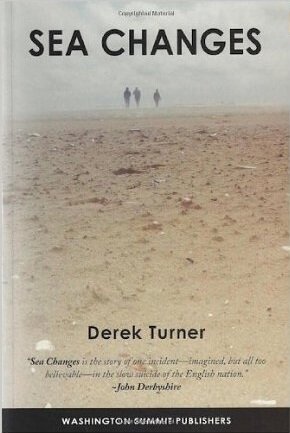
Most of us will know of Derek Turner, editor of The Quarterly Review and formerly of Right Now. He has written a novel, “Sea Changes”, and an interview with him, ostensibly about the book but in fact wide ranging, appeared on the “Alternative Right” website on the 29th March. Turner makes many valid points in the interview about the present plight of our country and people; his tone is downbeat and fatalistic, and although not all of us are so pessimistic (after all, Western Spring exists to ensure that even if the worst comes to pass there will be revival and rebirth) he does well to remind us of the beloved country for which we fight and of the very great evil which is being done to her. An extract follows but the whole interview is well worth reading:-
“..it seems oddly difficult getting people to accept that the English people made England, and if they were replaced by non-English people it would not be England, but just a place.
“The book is about subtle changes- gradual erosion, accumulating alienation, growing grief, a death of a thousand cuts, population replacement one person at a time, one family at a time, one house at a time, one street at a time, one district at a time. Mass immigration is not an invasion – it’s more of an infiltration.
“But the overall theme of English extrusion is desperately sad, and I wanted the sadness and waste of it all to register with readers who may not necessarily have thought about such things before. The downfall of a proud people, the end of an old line, seeing an old house’s furniture being sold off in front of the shuttered building, should always be cause for chivalric pity….England is one of the most ancient nations on the face of the earth – Bede used the term “English” as long ago the 8th century, and many people in England have ancestral roots in the country going back even further. Every inch of England is littered with English remains, and laden with English significance. To see such a people, such a country, so abased is a truly pitiable spectacle – as pitiable as the extirpation, penning and gelding of the Red Indians, or the ethnic cleansing of today’s Tibetans by the Chinese.”
By Frederick Dixon © 2014
# # # #
BritishActivism
- Edit
I remember reading about this book when it came out and I actually added it to my list of books to buy, which has admittedly grown rather long. As with some of the others on the list, I never got around to it though – but this reminder may spur me on.
.
I got a pile of about 15 books about five or six years ago and to my shame I have still not got through them all.
.
Some of them are because what they were proposing has already come to pass in the meantime (and are now irrelevant), some of them just were not very good (and I became bored with them), some were only confirming what I already thought to be the case and thus ended up being not very interesting – whilst others were wider political, statistical or scientific style books of the sort that can be a chore to wade through (‘The Origins of the British’, by Stephen Oppenheimer being one of them, in my opinion).
.
I read so much content on-line now that I rarely set enough time aside to pick up proper books. Sea Changes seemed to be different to all these though because it was a fictional piece – and I don’t think there are all that many good ‘nationalist’ fiction books (though to be fair, I have not looked around that hard for them).
.
I remember that Sea Changes was described as a tale of a situation that develops one day and thus documents the turmoil of the consequences that unravel along the way. It seemed entirely the way things would happen and thus seemed all too believable – perhaps too believable and a bit depressing!
.
It was getting well praised at the time and it sounded an interesting read. In fact, Sea Changes is one of the books I was suggesting the other day that may be transferable to a drama or film in the future. However, as I have not yet read it, I will have to reserve judgement about that suitability. From the outline though, I do not see why not.
.
I plan to buy it later today before I forget, and if it is a good a read as they say (and if it makes our situation or thoughts better understood than usual methods), I may try and pass it on to some of my (somewhat liberal!) friends.
.
I know they would never pick up a ‘nationalist’ book (or even works by Peter Hitchens for example) – but they may humour me by reading a fiction, if only out of curiosity.
.
They don’t even need to be told about the nature of the politics behind it, I could just introduce it as what I thought to be a good story about some difficult subjects. (This is why I think it is important to include fictional works in our tools of the trade).
.
I haven’t read much about it since it came out, so I shall head over to Altright and see what is being said in the new interview. I haven’t been to the Altright site all that much since they split over the Radix Journal thing. I gather I will have a lot of catching up to do.
Mark Cotterill
- Edit
It’s an interesting book, and you make some good points. However, you should have noted that the “Derek” Turner is Irish – not English. He should be just as concerned about whats happening in Ireland, than in England.
frederickdixon
- Edit
Turner does make the point in the interview that he’s not English, although I wasn’t aware that he’s Irish. I doubt if it matters, he’s an enthusiastic Anglophile and probably – with a surname like Turner – of English descent. It’s often the case that those who are not quite members of a particular nation are its most ardent and eloquent defenders; the late Michael Wharton (Peter Simple) being a very good example of the type.
Diane Green
- Edit
I too have some Irish in me,I think we may be of the warrior class.We are fighters.We have opposed every so called ‘progressive’ move by the Marxist,anti British establishment at every possible turn.Whilst of course we are depressed about the depravity that has been foisted upon us,I am encouraged by the awakening of others,no longer afraid of the ‘racist’ charge.We must be positive, we must be organised.For far too long Nationalists have been on the back foot,on the defensive.A position I was never comfortable with.We are moving forward,the word is spreading.We stand proud not confined by our masters,but inspired to be disobedient to them.Look at the politically incorrect statements via Facebook,there is change and we must harness it.
Valhalla Valkyrie
- Edit
We must understand the ideology behind the word ‘racism’. After all the word ‘racist’ was first used to discredit Slaves who wished to protect their peoples’ future against the cultural Marxism of the Bolshevik regime. For the latter the biggest obstacle to imposing an artificial identity to control a population is monoracialism and monoculturalism.