It’s well known that Boris Johnson has a taste for big projects; you’ll remember the “Garden Bridge” and “Boris Island” from his time as Mayor of London, both attractive projects (or so I thought), both fantastically expensive, neither realised – yet. Now Prime Minister with a big majority he can indulge that taste for grandiose projects to his heart’s content with no-one to say “no”, not even his neutered Treasury. So we are to have HS2, we may see the House of Lords relocated to some brownfield land near York train station (why not the whole Parliament? York is far more centrally situated in the UK than London), and now we have his scheme for a bridge from Scotland to Ireland! I’m not sure how to describe the bridge idea – wild? daring? crazy? brilliant? daft? pointless?
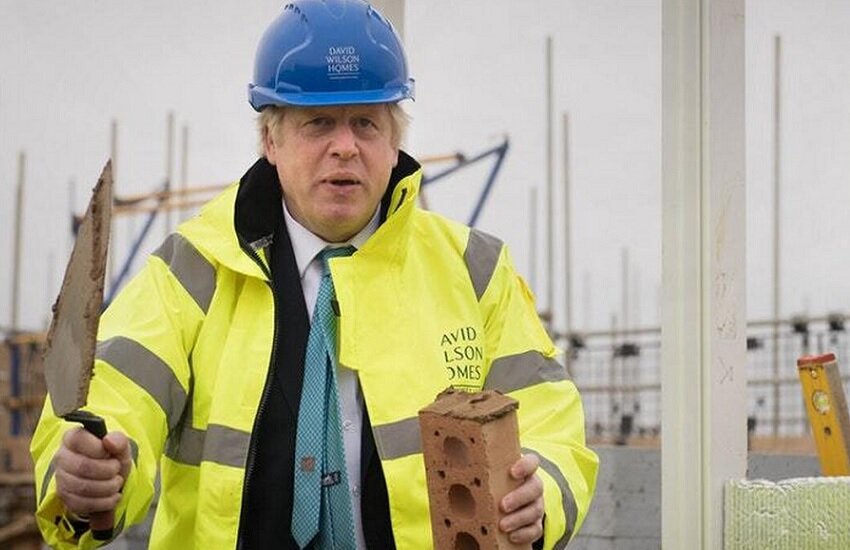
Anyway, whatever we think of the bridge and his other wheezes, it demonstrates that Boris is in some ways a rather Victorian figure, in love with the sheer elan of the great 19th century engineers and their transformation of the landscape and infrastructure of Britain. Unsurprisingly, in view of his flamboyance and slightly exotic origins, it has been said that the Prime Minister that he most resembles is also a Victorian, Benjamin Disraeli.
But when we compare the Britain of a century and a half ago with the Britain of today, the Victorian analogy falls down. Then, the United Kingdom (then including Ireland), had the brains and the surplus manpower to carry out that transformation of our landscape and infrastructure in little more than half a century. Not only did our burgeoning population have the capacity to carry out that immense task without the need to import labour, but so great was the surplus that we were able to populate much of North America, Australasia and southern Africa at the same time.
No longer. Far from exporting population we are a net importer on a grand scale. The Government’s new immigration proposals have received a generally warm reception from the public and the media, and it is not entirely without merits – an end to unskilled immigration and a requirement for immigrants to manage without in-work benefits are among them. But the downsides of the new policy are far greater than its merits. The cap on numbers is abolished alongside the requirement to advertise a position in Britain before looking to recruit abroad. Educational requirements are reduced from degree level to ‘A’ level equivalent and the minimum salary from £30,000 to £25,600 (or £20,480 in shortage occupations). Skilled occupations now exposed to competition from much poorer countries include plumbers, painters and decorators, carpenters and even child minders! Some of these occupations now command decent wages for British workmen, wages far above £25,600, but how enticing would such a wage be to a workman from India or Jamaica? The crucial thing to note about those who will come here under these proposals is that they will do so on “Tier 2 visas” which will lead after five years to permanent residence for the immigrant and his dependants – successive British governments seem reluctant to use time limited work permits, preferring for reasons which can only be guessed at to keep them here with us.
As Nick Timothy, writing in the Telegraph on the 23rd February, said of this new policy “but while it ends free movement and takes back control of our borders, the number of people coming to Britain under such a system is likely to be at least as high as in the days of unrestricted European immigration. The profile will change in that it will become higher skilled and more ethnically diverse, but the overall numbers are unlikely to come down.” In other words, Africans and Asians will replace Europeans and immigration from outside Europe, already at the highest levels since Blair was in office, will continue to rise. The Office for National Statistics has forecast that if immigration continues at its present level (let alone continues to rise) under 18s will be predominantly non-White British within sixteen years from now, so in the unlikely event that any readers of Western Spring are under the illusion that we have plenty of time to get things under control, think again.
If there is indeed a need to import skilled labour from everywhere to make Britain the world’s most connected country we have to ask why, and how, have successive British governments failed to equip our own people with the necessary skills? We now send half our youngsters to university, but to learn what?
I would certainly not suggest that immigration be shut off altogether. Migration can be a win-win arrangement, but only when it is carefully controlled to ensure that the host country enjoys the labour of the migrants without damaging its own identity or disadvantaging its own people. So a nationalist immigration policy would have to be very different from that now proposed by Ms. Patel. It might, if my fantasy nationalist government took any notice of me, have as its main feature extensive rights to settle in Britain for people of British Isles origin who are not at present British or Irish citizens. Such people would, overwhelmingly, be Americans, Australians, Canadians, New Zealanders and South Africans who, as White English speakers of British descent, would come to Britain ready assimilated – Nick Griffin once called such migration “homecoming, not immigration”. This would reinforce our native population while strengthening links with the rest of the English speaking world. It would of course be condemned as “racist”, but it is precisely the same as the policy of the Indian government to allow members of the Indian diaspora to return to their country of origin, and no-one calls the Indian government “racist” for doing so.
Anyway, to return to reality, Nick Timothy, having informed us that numbers are unlikely to come down, continues his article with these words:- “Time will tell whether this is what the Red Wall converts, or the majority of voters who say they want sharp reductions in immigration expect from the Government”. Quite so – we all know that many former Labour voters “leant” their votes to the Tories last December, if the Government disappoints them on this they might well join the even greater numbers of former Labour voters who preferred to stay at home. Or they might vote for something else. Either way, the government will be badly damaged at the next general election if it gets this policy badly wrong.
By Frederick Dixon © 2020
Martin
- Edit
Boris is part Turk by his own admission. Those in power are NOT from among the native tribes of this land.