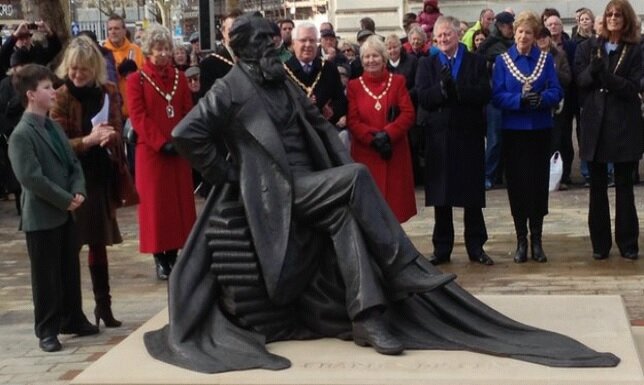
On Friday 7th February, 2014 (his 202nd birthday) a long-overdue and much-anticipated statue of Charles Dickens was unveiled to the left of the town hall in Portsmouth’s Guildhall Square. Portsmouth, as most will be aware, is the birthplace of Charles Dickens and is now the only place in the U.K. where his statue is erected. However, it is disappointing that his statue is positioned at ground level and not placed upon a plinth – as is Queen Victoria on the other side of the square. Her imposing statue still dominates the square and in the process outshines Portsmouth’s most famous historical figure. While not expecting anything approximating Nelson’s Column, I would nevertheless like to have seen a more commanding statue (as should all historical figures of the Occident) in a sense reach for the stars.
Complications had hitherto arisen regarding this statue. It was said that, according to his will and testament, Dickens wanted “no monument, memorial or testimonial”. However, the Dickens family and Tony Pointon, a professor and chairman of the Charles Dickens statue committee, have argued successfully that such a declaration had been misinterpreted. Mr. Pointon went further to claim that, “It’s ridiculous to suggest that just because he wanted a quiet funeral he never wanted a statue made. He sat for several sculptors in his lifetime and there are millions of copies of busts of Dickens around.”
Charles Dickens is best known as a writer of novels about children and adolescents. He is especially noted as a champion of the oppressed and persecuted poor. This support of the working-class should perhaps have granted Dickens an element of reprieve by those who, ostensibly at least, are the supposed guardians of the downtrodden. But in the manifest modern-day hysteria – the terrorism of ‘racism’ and its attendant clichés, soundbites and buzzwords – one of England’s best journalists and prose writers must be decried by that so irksome an itch: the liberal-left, or more accurately the deconstructionist Cultural Marxists.
This article intends to look at Dickens’s most famous and widely-read novel, Oliver Twist, its antagonist, Fagin, and Dickens’s subsequent detractors.
The charge sheet compiled by Dickens’s detractors is endless: ‘racism’, ‘xenophobia’, ‘biological determinism’, ‘social Darwinism’… and yes, that old chestnut, ‘anti-Semitism’.
This hype is nothing short of a retrospective witch-hunt devoid of objectivity and with little or no adherence to context. And such hysteria has informed a perception whereby text is heedlessly and reflexively interpreted as ‘racist’, ‘xenophobic’… Such is also true in the reading of the many eminent writers both before, after and of Dickens’s time.
But, in an objective analysis of Dickens, do such labels befit a man who quite simply was aware of stereotype and popular perception; a man who as a journalist and author was dutifully mindful and reflective of such considerations in order to remain true to the essence underpinning his narrative? According to two of the most extensive works ever undertaken on Dickens, such charges are groundless.
In G.K. Chesterton’s Appreciations and Criticisms of the Works of Charles Dickens[1], and his biography, Charles Dickens[2], Chesterton clearly argues against such charges and recounts Dickens’s work for the abolition of slavery. Dickens was actively against slavery, even travelling to the United States to lecture against it[3]. According to Ledger and Ferneaux[4], Dickens did not advocate any form of ‘scientific racism’ regarding heredity; indeed, he had no concept at all of a superior ‘master race’ and could not be described as either a white supremacist or separatist. However, Ledger and Ferneaux do suggest that Dickens had antipathy for the lifestyles of native peoples in British colonies, and believed that the sooner they were civilised, the better.
But, in context, does such a view imply the meaningless cliché of ‘racism’? Writing and observing as Dickens was in the early-to-mid nineteenth century, what was one to make of peoples who had only just been introduced to the wheel, had little or no sanitation, and a number of whom still practiced cannibalism[5]? While it is difficult for the conditioned mind of the modern-day ‘progressive’ to take cognisance of such realities, these considerations of Dickens must be placed in context and not, as is now the case, be viewed retrospectively through ‘enlightened’ eyes and decried using present value judgements. To do so is nothing short of critiquing any number of historical figures for not sharing one’s sentiment. It is supposedly ‘racist’ only now that such weapon has been constructed.
But when is observation (in the fantastical minds of our detractors) ‘racist’ or, ahem, ‘anti-Semitic’?
In looking at Oliver Twist – to his detractors the most ‘controversial’ of his novels– it is said to suggest (at least to those of a parochial mindset) an overt or covert ‘anti-Semitism’. Brushing aside the uncomfortable fact that, for instance, Palestinians are also Semites and that the buzzword is used exclusively to conjure up notions of gas chambers in the theory known as the ‘Holocaust’, what are we to make of the racial identity of the antagonist, Fagin?
Perhaps it is no surprise that Fagin – “the receiver of stolen goods”; “the Jew”[6] – is Jewish. Dickens did not shy away from commentary on such perceptions as to the nature or otherwise of a significant number that comprised the different races. Such a perception was expressed some 242 years earlier in William Shakespeare’s The Merchant of Venice. Here, Shylock –not too dissimilar to Fagin (or as we shall see the White equivalent, Scrooge) – assumes the same malevolent role – and it is not evident in any academic discourse that this is grounded in any purposeful criticism.
Observations naturally form stereotypes and stereotypes are natural concepts that inform perception. Without having observed characteristics, traits, and foibles, such stereotypes, rightly or wrongly, could not have been constructed. There is, then, perhaps an element of inner truth in the concept of stereotype.
But it is not the purpose of this article to thoroughly dissect the concept of stereotype or offer suggestions as to why the Jews have at one time or another, been deported from every country in which they’ve ever been guests. Neither is it for me here to speculate on the grounded stereotype of the Jews being ‘moneylenders’ (vis-à-vis Shylock) or the present-day reality that a disproportionate amount of their number do by any objective measure own a large number of the world’s banks. Lest to say, how stereotypes are formed and how they are to our detractors suitability and routinely used when advancing their own subjective interpretations is, indeed, a reality.
Such subjectivity is evident in their selective interpretation of Dickens’s employment of Jews as characters. For in casually overlooking Dickens’s Our Mutual Friend – wherein is a sympathetic narrative to a Jewish character named Riah (in Hebrew meaning ‘friend’) – his detractors inadvertently pronounce their agenda, or else ignorance. For in this novel Riah’s goodness almost replicates Fagin’s evil. Riah says:
Men say, ‘This is a bad Greek, but there are good Greeks. This is a bad Turk, but there are good Turks.’ Not so with the Jews … they take the worst of us as samples of the best…[7]
Such a passage perhaps indicates Dickens’s perception that there is an element of Jewry who are not like Shylock or Fagin. Then again, maybe it is – like so much of his work, as I have thus far shown – also taken out of context. In regard of the latter, perhaps Dickens simply sought to pacify his detractors? We will never know.
But to the liberal/left Totalitarian Humanists, or more specifically the hard-line Cultural Marxists, this is scant worship at their altar. To them it is tokenism; perhaps Dickens’s recant of his earlier characterisation of Fagin. But a recant it was not because a specified criticism it was not. Dickens did not and should not apologise for anything. But even in his day Dickens encountered considerable hostility to the characterisation of Fagin.
Even in the nineteenth century – before Marxism and the rise of their present-day ‘Leftist’ errand boys– the machination of influential Jews was well oiled. Dickens biographer, G.K. Chesterton, claims that the character of Riah, a “kind old Jew”, was introduced into Our Mutual Friend to counterbalance the claim by a “Jewish correspondent”[8] that the nature of Fagin suggested that all Jews were bad. According to Chesterton, the claim by the “Jewish correspondent” is “so lightheadedly absurd that it is hard to imagine any literary man submitting to it for an instant.”[9] But, it seems, submit to it Dickens did –and if alive today there is no telling how many, and how often, grovelling apologies Dickens would now have to make at the altar of those who are seemingly beyond reproach.
For today, in the maelstrom of self-righteousness, the neo-Puritans clamour for self-satisfaction amidst their own-inflicted terrorism of ‘racism’. Everything must be deconstructed – not in objective literary criticism but in agenda-driven deconstructionism – to find a supposed inner essence ‘evidencing’ deviation from the liberal politically ‘correct’ orthodoxy.
The role of Fagin in Oliver Twist continues to be a self-imposed challenge, a moral crusade for actors who struggle, like infants battling elementary history, with questions as to how to interpret the role in a post-Nazi era. Various Jewish writers, directors, and actors have searched for ways to redeem Fagin and in essence bastardise the tale and thereby absolve themselves from textual supposed criticism that only they, and those influenced by their paranoia, perceive.
But this mania produces some interesting and highly entertaining results. The most accurate and thereby ‘controversial’ adaptation of Oliver Twist is David Lean’s 1948 film with Sir Alec Guinness as Fagin. Guinness was made-up to replicate the illustrations from the novel’s first edition. Many would welcome such authentic legitimacy in remaining true to the nature of Dickens’s work –but then such controversy was not the result of a negative portrayal of a White character (à la Ebenezer Scrooge) but of the self-described ‘Chosen ones’, a Jew. The release of the film in the U.S. was postponed due to Jewish protests that kept the film out of American circulation for a number of years[10]. This particular adaptation of the novel is banned in Israel[11] and, conversely, banned in Egypt for portraying Fagin too sympathetically[12].
And the speculation and uncertainty goes on in this merry-go-round of deconstruction of Dickens. But serious Dickens scholars like Grace Moore see Dickens’s ‘racism’ as having decreased in his later years, while cultural historian Patrick Brantlinger and journalist William Oddie see it as having intensified.[13] Moore contends that while Dickens in later life became far more sensitive to the unethical character of British colonialism, he never lost his distaste for those whose life style he regarded as primitive.
But such opinion does not dissect the possibility that Dickens simply baulked at the lifestyle and culture rather than the race of individuals. In, say, lamenting the actions of dogs defecating on the pavement, one is obviously not drawn to chastising the dog but merely his actions. That is not, of course, to draw any comparison between people and dogs; it is merely to restate the fact that a nature/lifestyle/culture is not universally suitable to all and, as Moore seems to admit, a nature/lifestyle/culture is a product of a people/race and that this nature/lifestyle/culture does not inform a people/race but that they inform it. It is therefore not altogether clear who or what Dickens had distaste for, but, as I have shown in highlighting his work for the abolitionist cause, there is a significant amount of doubt as to his supposed ‘racism’ and in other works, ‘anti-Semitism’.
But such is the seething vortex of conjecture, supposition, and paranoia within the realm of Dickens detractors. G.K. Chesterton goes on to parody the ‘controversy’ surrounding Fagin. Chesterton states that for every such “complaint [that is] frantic” Dickens must, “in unnatural agony and toil”[14], balance (for isn’t everything, and aren’t we all, ‘equal’?) the one against the other. For every negative there must be a positive; and according to the hysteria of some of critics, Dickens should have spent his life endlessly counterbalancing his work lest a person, community, or a certain race should feel aggrieved.”
But balance and fairness was never the projected aim for Dickens – or especially his critics. Dickens simply wrote; and in the convention of any novelist-journalist whose work contains an element of social criticism, he was in tune with the atmosphere of society and aware of the characters therein. But his detractors side-step this attribute and overlook his work Our Mutual Friend and its portrayal of the “kind old Jew”. Dickens’s effort in the abolition of slavery is secondary to balance and fairness as it simply does not fit their deconstructionist narrative.
In conclusion we can see clearly that Scrooge and Fagin were both portrayed negatively in line with their repugnant character. But in the wanton hysteria they were both different and were therefore treated as such. Scrooge – the cold-hearted misanthropic miser with his “nipped and pointed nose” who “spoke out shrewdly in his grating voice”[15] resonates with Fagin’s cruel-hearted inhumanity, hooked nose, and his nasal voice mannerisms (so often evident in the early and pre-bastardisation productions of Oliver Twist). See the difference? In this description of the essence of their character, there is none. But in a closer look, one character is a White and one is a Jew – and it is the latter’s kinsmen who are both beyond reproach, well organised, and agitational.
As we have seen, much of the criticism of Dickens as a ‘racist’, ‘anti-Semite’… is the work of academic and political agitators, media hype, and journalistic sensationalism. That is not to say that all such professions as so terribly single-minded – only to state that there is a certain element so pre-disposed.
Ask the common man on the street what he thinks of Dickens and he will not recite any of the fallacious charges levied against him, perhaps instead saying no more than “a fine author”, a “defender of the ‘underclass’”, or more likely, “a national and cultural hero”. The more insightful of Dickens’s fans might even opine that a modern-day Dickens – commenting on the present state of the working class and how little has changed since the slums of Victorian England – would not be published for fear of the publishers highlighting the same status quo that has remained and is thereby still in much part responsible for the unfortunate lot of those Dickens championed.
The statue of Charles Dickens in Portsmouth’s Guildhall Square should serve as an example and reminder of the great heights to which Occidental man has and can attain. Upon studying it one should reflect not only on Dickens’s great talent as a writer but on the essence and nature of his work that circumvents the present artificial liberal orthodoxy.
The youngest descendent of Dickens – nine-year-old Oliver Dickens – unveiled the statue. Perhaps he might one day be the first of such descendants to mirror the work of his most famous family member and continue the literary heroism of Occidental man.
Let it so be.
By Rick Lee © 2014
# # # #
Author’s Notes:
[1] Chesterton, G.K. (1911). Appreciations and Criticisms of the Works of Charles Dickens. London: J.M. Dent & Sons.
[2] Chesterton, G.K. (1906). Charles Dickens: A Critical Study. New York: Dodd Mead & Company.
[3] B.B.C. (2014). Charles Dickens (1812 – 1870). Retrieved 8th February, 2014, from: https://www.bbc.co.uk/history/historic_figures/dickens_charles.shtml (para. 4).
[4] Ledger, S. &Ferneaux, H. (2011). Dickens in Context. Cambridge: Cambridge University Press. (pp. 297–299).
[5] Cannibalism in Africa has evidently not been eradicated. See: https://smashcm.blogspot.co.uk/2014/02/gastronomical-diversity.html for further details.
[6] Pierce, G.A. (Ed.). (1894). The Writings of Charles Dickens: The adventures of Oliver Twist. Houghton: Mifflin and Company (p. xxiii).
[7] Baumgarten, M. (1996). Seeing Double: Jews in the Fiction of F. Scott Fitzgerald, Charles Dickens, Anthony Trollope, and George Eliot. In Bryan Cheyette (Ed.) Between “race” and Culture: Representations of “the Jew” in English and American Literature. Stanford, U.S.A.: Stanford University Press. (pp. 44-61). (p. 53).
[8] Chesterton, 1906. (p.295).
[9] Ibid.
[10] O’Connor, J.J. (23rd March, 1983). TV: Gorge C. Scott in ‘Oliver Twist’. New York Times. Retrieved 9th February, 2014, from: https://www.nytimes.com/1982/03/23/arts/tv-george-c-scott-in-oliver-twist.html (para. 3)
[11] Quinn, B. (2008). On the London Stage, New Depiction of Fagin Revives an Old Stereotype. Retrieved 9th February, 2014, from: https://www.jewish-theatre.com/visitor/article_display.aspx?articleID=3136 (para. 22)
[12] Brooks, X. (8th August, 2000). The Ten Best Alec Guinness Movies. The Guardian. Retrieved 9th February, 2014, from: https://www.theguardian.com/film/2000/aug/08/1 (para. 1).
[13] Moore, G. (2004). Dickens and Empire: Discourses of Class, Race and Colonialism in the Works of Charles Dickens. [Unknown]: Ashgate.
[14] Chesterton, 1906. (pp. 295-296).
[15] Dickens, C. (2000). A Christmas Carol and Other Stories. London: Random House. (p. 2).
# # # #
ConnalOakesHolt
- Edit
As the modern day Iconaclasts continue to tear at and ‘deconstruct’, a euphemistic insult that tries to hide the true motives of culture vandals if ever there was one, the culture that provided them with their intellectual status and living standards enough to persue endeavours beyond a life of toil, struggle and then finally death, hastening upon themselves the eventual outcome of their folly. Equals to all, in a savage landscape, where peering inside themselves they find the primal origins of that seed idea they so hated and thus projected onto their world, ‘The Racist’!
Michael Woodbridge
- Edit
So what the dickens if Dickens is hated by our enemies as being. ‘racist’ and ‘anti-Semitic’. Surely under the “politically correct” cultural dictatorship from which we all suffer, such strictures can only be viewed as the highest of commendations.
In fact it would be much quicker and easier to compile a list of worthwhile authors who didn’t transgress the bounds of our contemporary ‘Cultural-Marxist’ fanatics… James Joyce is possibly one.
On the other hand such a well known “left-winger” as J.B. Priestley, who was a founder member of the liberal ‘Common Wealth Party’ during the War and later of the ‘Campaign for Nuclear Disarmament’, wrote ‘Angel Pavement’ in 1930 which would have ‘The Board of Deputies of “British” Jews’ in paroxysms of anguish were it written today.
In many ways it’s shameful that Cultural Marxists have hijacked the literary debate. Art and Literature at their best are full of unpredictable nuances and are much better left altogether free of political dogma.
Michael Woodbridge
- Edit
Thank you R.Lee for a long overdue critique of Charles Dickens. In political terms Dickens wasn’t really exceptional and it’s a sad comment on our present day society that a noteworthy feature is that he has upset the “politically correct” apple cart by portraying the fictional Jew Fagin in an unflattering light. Before the Second World War English writers of all political backgrounds saw it as their mission to portray life as they saw it regardless of who they might upset in the process. For instance, the writer Henry Williamson, a keen follower of Sir Oswald Mosley’s Fascists, made no specific criticism of Jews whilst J.B. Priestley, an indefatigable campaigner for “left-wing” causes described various Jewish characters in his 1930 book ‘Angel Pavement’ in such a way that would send ‘The Board of Deputies of British Jews’ into paroxysms of anguish had it been published today.
Graham
- Edit
Fagin was not the only Jew in Dickens; there were a few characters that were inferred as being Jewish. Much of Dickens splendid sense of comedy comes from his sly inferences about people and the customs and practices of the time. The crooked legal team of Samson and Sally Brass from ‘The old Curiosity shop ‘were possibly inferred as being Hebrews, certainly they operated out of Bevis Marks which was the only place that the Jews were allowed a temple in Christian England. Come to that I am not altogether uncertain that Daniel Quilp was not inferred to as being Jewish but maybe that is going too far.