By Frederick Dixon:
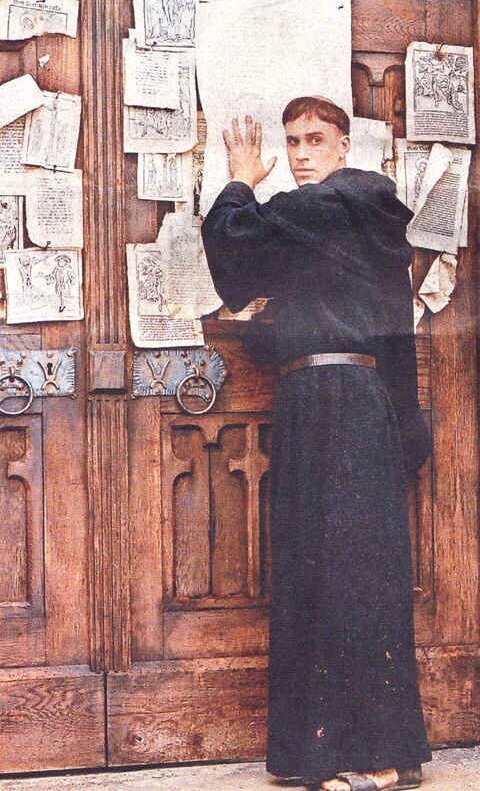
It was in 1517 that Martin Luther nailed his “95 Theses” to the door of Wittenberg church in Saxony and thus launched the Reformation. Although Luther was a remarkable man, there was nothing in his background or in his life as a monk to hint that here was one who, without intending to do so, turned the world of his time upside down. In another time Luther would have lived out a quiet life in the cloister, but it was not another time, it was a time for revolution and if Luther had not lit the spark another would have done so.
It was a time for revolution because new ideas had penetrated through Europe as the Middle Ages gradually gave way to the Renaissance, and the arts and philosophies of the classical world were re-discovered. The spread of new ideas was greatly aided by a new technology – printing; the first book printed using movable type came off the presses in Gutenberg’s workshop in 1456 and very quickly books and pamphlets became available on a hitherto unimaginable scale. The growth of a prosperous, literate middle class in the late Middle Ages provided a market for these works which in turn fed the imaginations of a self confident bourgeoisie which was no longer willing to be told what to think by priests – and that in turn led on to the Reformation.
The parallels with our present age are clear; in place of a Catholic church which had become corrupt, oppressive and worldly (although, in the Counter-Reformation, it was to prove itself capable of renewal), we have the official religion of the secular state, Equality and Diversity – no less corrupt and oppressive, no less demanding of belief in absurdities. Our new secular religion may not require us to believe that we can buy a short cut to heaven, but it does require us to believe in the nonsense of human equality. And then there is the Internet, the new technology which, just like printing before it, is spreading access to knowledge and ideas on a scale previously impossible, and now we begin to see that this new technology may have an effect similar to the old technology before it.
There has been a good deal of recent Press interest in something called “the Dark Enlightenment”. This is a loose on-line group of ultra- Right intellectuals which would have been far more difficult to bring together in those long-lost days before there was an Internet. Inevitably the Dark Establishment has been characterised by the newspapers as “neo-fascist” but in reality those who are associated with the group are far too disparate to fit any particular label; some would not shy away from the “fascist” word while others are neo-monarchists. What they have in common is their dismissal of democracy and equality and their opposition to “the Cathedral”. It is interesting that in their attack on the secular faith of Equality and Diversity which now dominates every aspect of public life in the West they have chosen to call it by a name which is so redolent of the medieval religious establishment which was shattered by the Reformation, surely no coincidence?
What is important about these people, and about other ultra Right thinkers who may have no connection to the Dark Enlightenment, is that they challenge the Cathedral’s ownership of territory over which it has long claimed exclusive possession, the realms of the intellect and of ethics. Once the Left’s claims to intellectual and moral superiority have been shown up for the empty shams which they are, then enlightenment will indeed dawn.
This is very necessary, the long failure of Nationalist street action and political activity is due in no small part to our perceived moral inferiority – and yet, in a number of continental countries Nationalist street action and political movements are now enjoying unprecedented success; could this be due to a new intellectual vitality? Perhaps. One thing is certain, such unprecedented levels of success are yet to be seen in the English speaking world; this may be due to the innate English suspicion of intellectuals and the conservatism which always delays the arrival on our shores of continental trends, England was way behind the curve in its adoption of the Reformation, but adopt it we did.
So how close are we to a new Reformation? I do not know, but as Alex Kurtagic once said – we may not know that we have won until long afterwards.
By Frederick Dixon © 2014
# # # #
AAA
- Edit
The author highlights in the article an important point: that the internet is the new modern-day Gutenberg Press.
.
While it is true that the internet is as powerful and influential for both our Cause and the cause of our enemies, the internet is nevertheless probably the most beneficial vehicle for dissent ever conceived. It therefore must be passionately protected, because the collective enemies of dissent –the State, government, Establishment, New World Order, status quo; call it what you will– is the enemy of ALL truly-dissension groups.
.
Our Cause has many enemies. They to my mind fall into two groupings: the System (an amalgamation of the above subsidiaries) and its inadvertent(?) liberal-Left foot soldiers.
.
It is perhaps fair to claim that the System comprises elements of the liberal-left and that they as a whole are in tandem. Such a perception has been espoused by Third-Wave anarchists such as Keith Preston of the “Attack the System” movement who, in his articles and podcasts, has covered in detail how the System has co-opted a significant number of its hitherto opponents and formed a synthesis of State-capitalism/Totalitarian Humanism.
.
While the nature of dissent in our Cause is undoubtedly our collective enemies’ most significant threat, there are however those on the other side of the political fence who will also suffer should the internet be in any way curtailed and regulated. Their lack of internet is our lack of internet. For this reason I in part lament that element within out Cause who scoff at the work of non-nationalists in fighting against our collective enemies, the Machine. Because, by and large, their upholding of the vehicle of dissent by confounding any restriction on the internet is obviously good for us. We should not so easily and readily stigmatise the machinations of anarchists, Leftists, libertarians, and other anti-Establishment figures in perturbing the intrigue and actions of our collective enemies. Because, regarding the internet and its vehicle of dissent, what is good for them is, paradoxically, good for us.
.
However, it is unwise to put all our proverbial eggs in the one basket. I recall with much impressiveness an article by Peter Philips now but not then of the British Democratic Party on the nature, influence and power of agitprop and how artistic posters and stickers, snappy leaflets, and forceful booklets, can and do still hold in thrall the man on the street.
.
Our message on the vehicle that is internet is perhaps a niche mode of communicating. By this I mean that one has to become aware of our websites, find the time and effort to click on the links, and read the at-times long articles that most do not have the attention span to digest. Ultimately, one has to be home or at work, etc, in order to study our message. On the streets in walking the dog, dropping off the kids at school, or his bus journey to work he sees only THEIR message of advertisement of multi-national corporations festooned with the customary half-breed and artificial enjoyment. This, as well as the television, is far more influential on the common man than our excellent and informative websites.
.
Perhaps it is time to again take our message back to the streets to compliment our splendid work online.
.
If Peter Philips catches site of this article, do please send it to Max. (I have looked but cannot find). Thank you.
ConnalOakesHolt
- Edit
The Reformation was an incredibly lengthy process, which as has been noted may only have been recognized as a period by historians.
If we are in a Reformation period and I believe that we are, then we are only in the early stages.
What other changes in our society may occur throughout this period?
What happens once ‘The Cathedral ‘ has fallen ?
I do not think that once the old order loose their power, that that power will automatically shift to WhiteNationalists.
Quite possibly ,a protracted period of vying for dominance will ensue as groups and allegiences are builded upon racial aswell as ideological lines.
The King is Dead, Long Live The King. The end of the old order is the beginning of the new one and it is that , that WhiteNationalists will do well to focus upon. The wheel of the old order is turning, but it is running on inertia and that inertia will be expended in due course.
Young Nationalists must seriously consider careers in Law. Law makers in the new order of things will weild great power as the foundations of any civilized society are its Laws.
frederickdixon
- Edit
As a former lawyer myself I appreciate your sentiments, but I think that the career with the greatest potential for influencing the future has to be that of teacher, provided that the young nationalist teacher makes sure that he or she always works in predominantly white British schools – why cast one’s pearls before swine?
ConnalOakesHolt
- Edit
Teachers do hold a valuable position in society and it is undoubtably one that has the potential to inspire young minds to achieve great things. Yes it would be the offering of what is holy to dogs , for a Nationalist teacher to work in any other school than a predominantly ethnic British one.
Who knows, some of those taught may even go onto to become Lawyers.
Shaun
- Edit
This author has made a good analysis of the modern age. Be under no illusion: the Internet in changing the nature of human thought. Have we got another Martin Luther in Europe? No doubt there are thousands — perhaps even hundreds of thousands.
Many people may be laughing at radical nationalist ideology, but the history that matters to us — the White races’s history — is an example of perpetual change.
Yes, I learned a lot — thanks to the author!