On 6th January 2000, after the turn of the millennium had come and gone without mishap, the Economist magazine reported that ‘Y2K’ had turned out to be ‘Y2OK’. Only weeks beforehand however, and for some years, there had been dire warnings of computer crashes, aircraft falling out of the sky, power stations exploding and a veritable apocalypse, so much so that Labour minister Margaret Beckett was appointed ‘Minister for the Millenium’ and so important was her role in the eyes of government that she was assigned an entourage of flunkies and armed bodyguards so that she would be kept safe and could take charge the moment disaster struck.

‘Operation scare’ regarding the millennium began with an article in Computer World magazine in 1993, which was one of the first attempts to bring it to a wider audience. “Have you ever been in a car crash?” the article asked. “Unfortunately, unlike the car crash, time will not slow down for us. If anything, we’re accelerating toward disaster.”
In 1998 the government backed campaign group ‘Action 2000’ began its £10 million campaign, exhorting small and medium-sized businesses to take action to protect against the Millennium Bug and starting with posters and regional and national press advertisements, the campaign moved on to TV and radio advertisements later that year. Eventually in the final months of 1999 an eight page booklet was distributed as a supplement in national newspapers advising the public regarding the action they should take to protect themselves. The booklet advised what to do about video recorders, answer phones and fax machines and home computer.
Action 2000 warned both the public and businesses to prepare. Electronic machines needed to be “year 2000 compliant”, they warned, and “Your business is in danger” a leaflet stated in large yellow letters.
The bug was about the limitations of the clocks inside computers. Since the 1960s computers denoted years such as 1998 as 98 to save memory. As a result, when the new millennium arrived, it was expected many computer clocks would see 00 and understand that to mean 1900. All of a sudden every time bound or time delineated function performed by devices controlled by silicon chips would be confounded, computer experts at the time warned.
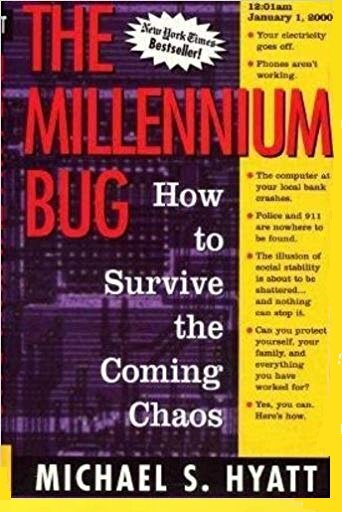
While some sources warned that the preparations for the millennium and the lurid warnings that appeared in the media were excessive, the implications of the Millenium Bug were described by Tony Blair at the time as “one of the most serious problems facing not only British business but the global economy today”, and Margaret Beckett said the bug had the capacity to “wreak havoc”.
As we all know, the millennium passed almost without incident, certainly without serious incident:
On 1st January 2000 the US official timekeeper, the Naval Observatory, reported the date as 19100 on its website;
In Australia some bus ticket validation machines failed;
Across the world there were many instances of utility bills and official documents being wrongly dated; and
Here in Britain some credit card transactions failed.
There were no deaths however, no explosions at nuclear power stations, no rail or aircraft crashes and the sky did not fall in on us, and by now we will all have started to notice the same ‘Project Fear’ panic tactics being employed today, by government and media sources in their reporting of the dire consequences we could suffer if we opt for a ‘clean break’ Brexit. The fears aroused over the Millennium Bug are strikingly similar to those first aroused by Mark Carney, the Chairman of the Bank of England, during the EU Referendum campaign and repeated periodically since. They are strikingly similar to the fears aroused by David Cameron and George Osborne at that same time, and which are being peddled by many liberal/left wing politicians and the mass media today.
The use of the terms ‘car-crash’ and ‘crashing out of the EU’ are strikingly similar, as are the warnings of the ‘havoc’ that a clean break Brexit is supposedly going to bring with it
The truth is that we have been trading with the EU for some forty-odd years and there are presently no tariffs or import duties applied to British produce entering the EU, nor to EU produce entering Britain and our respective economies are functioning reasonably well. There is certainly no state of emergency. On the 30th March, the day after we are due to leave the EU, we will still be able to trade in the same way with the EU and they will still be able to trade with us – as long as neither our government, nor the EU, decides to impose bureaucratic restrictions and impediments to trade.

As far as the Irish border is concerned, there has been no hard border there for twenty years, so whether we are technically in or out of the EU, there is no need for a hard border to be constructed. Trade can continue uninterrupted.
The much vaunted ‘Single Market’ is a political construct and a country that operates similar production standards as those operated within the EU should be able to trade freely with either the UK or the EU without causing any problems whatsoever. Should we in Britain decide at a later date to change one of our production standards bringing it into conflict with those applicable to the EU, then that might be cause for limited tariffs to be introduced in that one respect. Otherwise everything can continue as before, if that is what we wish and there is good will on both sides.
The real issue regarding our exit from the EU relates not to trade at all but to politics and the desire of the EU for dominion over the UK. This is about empire building and the megalomania of the architects and current rulers of the EU. They want power over us – the power to impose their political will upon us and to stifle our freedom and self-determination. In short, the EU seeks to wage a war of conquest using trade as an economic weapon, in place of the military weapons that European tyrannies have tended to employ in their failed military adventures of the past.
This is why we must call their bluff. They no-longer have the stomach for a real war of military conquest and in my opinion neither will they have the stomach for a trade war with Britain. If we stick to our guns and insist on a clean break Brexit, we will find that this whole controversy has been a ‘storm in a tea-cup’ and just as happened with the passing of the millennium, twelve months on from now we will look back at our exit from the European Union and laugh at all of the current hand-wringing and doom-mongering by establishment politicians.
By Max Musson © 2019
# # # #
JOIN WESTERN SPRING
Western Spring is not just a website. We are a community of people dedicated to achieving the Six Prerequisites and thereby acquiring the wherewithal needed to win political power and through that secure the future survival, proliferation and advancement of the British people and other White peoples of European descent, wherever they may live. Please join us:
[contact-form to=’[email protected]’ subject=’Membership Enquiry’][contact-field label=’Name’ type=’name’ required=’1’/][contact-field label=’Email’ type=’email’ required=’1’/][contact-field label=’Phone No.’ type=’name’ required=’1’/][contact-field label=’Postal Address’ type=’name’ required=’1’/][contact-field label=’Post Code’ type=’name’ required=’1’/][/contact-form]
# # # #
Jock Lewes
- Edit
Although leaving the EU need not, in itself, cause trade problems at the border, there will be cases where both sides will want to impose new restrictions. For example, we have been prevented by the EU from prohibiting the importation of certain plants from Europe that may be carrying diseases or parasites that could affect plants or crops here. We will want to impose some precautionary restrictions on these imports.
But the 310-mile land border in Ireland would appear to be an issue that needs a clear decision followed up with decisive action if the UK is to secure its border against the immigrants/invaders who are presently crossing the Channel to enter our country illegally along the south coast. Could Carlingford become the new Calais?
SteveA
- Edit
Max, I cannot but agree with you 100%. There is however, in my opinion, more than just The EU’s relationship with Great Britain at play. Should Great Britain, and I have no reason to doubt it, successfully leave the EU many other countries may follow (Italy, Hungary, Greece etc) which could bring (please God) the whole rotten house of cards crashing down.
Stefan
- Edit
I am inclined to believe that they will first delay Brexit but somehow they need to get a vote through parliament to achieve that & then get their anti democratic move sanctioned as democratic, by staging & winning the second referendum & saying that is what the people want.
But there will still be a hell of a lot of people who want out of the EU & its institutions.
That is likely to increase as we stay in.
Though that plan may not work the way they think it will.
First business will hate further delay & what happens if the second referendum is too close or not in their favour?
They are betting on voter fatigue to win this, that people are so sick of the constant & long winded debate on Brexit that they will give into the establishment wishes.
Then there is the issue of “Be careful what you wish for”, if we remain, things will not continue as before, we will need to commit ourselves to the EU, to do our share.
As the EU becomes more stressed & inefficient, it will cost more & more to hold it together.
If the EU becomes more Right wing, then some remainers will wonder what they signed up for, maybe we will get an influx of “Europeans” seeking a more liberal country to live in.
That will further fuel the backlash that Chris Grayling was going on about.
It was said that the idea of Turkey joining was just a scare story but haven’t you noticed how many Turks are already here, the sheer amount of restaurants that have opened in the last 2 years, how did that happen?
Stefan
- Edit
Yes we can survive leaving the EU, we are being bullied into staying.
Alec Suchi
- Edit
It would seem that “Project Fear” continues as dire warnings are given should the UK leave the EU without a negotiated settlement. Economic considerations are important but despite certain inconveniences the UK would survive relatively unscathed with or without an agreement with the EU.
The biggest threat which confronts us is the continuing immigration of non European peoples which has changed the racial composition of Western Europe and the UK.. The difficulty anticipated regarding the Irish border is much exaggerated and has assumed farcical proportions.
Valerian
- Edit
Much of the doom-mongering about Brexit coming from the remainers has been inspired by a document published by the government and authored by the Treasury titled ‘EU exit – Long Term Economic Analysis. November 2018’. Much of this document consists of graphs and tables, and is too technical for the layman to understand, so most people focus on simple summaries of the research on pages 5, 6 and 7. The figures for percentage changes in GDP presented here are misleading and are, I believe, deliberately intended to be so. What everyone, including the national press believe they mean is that GDP will have declined by 9.3% after 15 years from the formal exit from the EU next year. What the figures actually mean is that GDP will be 9.5% less in 15 years time compared to what it would have been had the we stayed in the EU. In other words GDP growth will be 0.6% less bringing it down to 1.6% per annum. The authors of the paper make it clear that this is the correct interpretation when they state ‘It is expected that in all scenarios considered in this publication, the economy will continue to grow in the long run’. Even though Mrs May reiterated this during prime ministers question time the Blairite Guardian newspaper and other remainers continue to make hyperbole about ‘falling of the cliff’, ‘Armageddon’, and ‘staring into the abyss’. If you want to know what ‘falling of a cliff’ is really like consider the fate of the former peoples democracies and Soviet republics after the collapse of the Soviet Union. Even worse examples of ‘falling of a cliff’ can be found in our own time in Venezuela and Zimbabwe. Even in Britain joining the WTO caused severe disruption throughout the 1980s with most of our manufacturing base disappearing and the north of England permanently depressed. A GDP growth rate of 1.6% is not such a big deal when you consider the fact that Japan had an average growth rate of 1.1% for many years yet the Japanese continued to lead secure and happy lives without the scourge of mass immigration and unemployment, and without having to surrender their national sovereignty to a super-state.
Max Musson
- Edit
I agree completely, Valerian.
Stefan
- Edit
Due to the ineptitude of our ruling class, we are probably going to have a recession whether we stay in or leave now.
The uncertainty to business is very damaging to planning anything.
They say they want a delay of a few months to sort things out but they already had 2 years, so what will change?
Across the board the politicians are feeble, the perfect time for some charismatic demagogue to come along & get support, to seize power.