A frequently heard falsehood often repeated during television interviews with pro-globalist, pro-mass migration politicians and media pundits, is that immigration is good for us as long as the immigrants concerned have come here to better themselves, to work hard and provide a better future for their families. So often has this falsehood been repeated that we often see ordinary, otherwise quite sensible people repeat it especially following accusations that immigrants target Britain in order to exploit our benefits system.
Such people hope to deflect accusations of racism by asserting the mistaken belief that while we all deplore those immigrants who do come to Britain to take advantage of our benefits system, we do of course acknowledge that the vast majority simply want to ‘work hard, pay their taxes and provide a better future for their families’, and the implication being that we should be happy to accept as many of this latter category of immigrant as wants to come and work here [sic].
It is of course better to accept immigrants who want to work hard and pay their taxes than to accept immigrants that are indolent and work-shy, but both categories of immigrant have a negative impact upon the life chances of the indigenous British and we should therefore protest against mass immigration on both counts.
Pro-mass migration and pro-globalist politicians and media pundits will obfuscate and try to use all manner of statistics and jargon to cloud this issue, but the way to demonstrate the truth of what I write is to reduce the argument down in terms of the numbers involved. To reduce the argument down to numbers that the average person can get their heads around and in which there is no scope for jargon, high-blown statistical analyses or obfuscation.
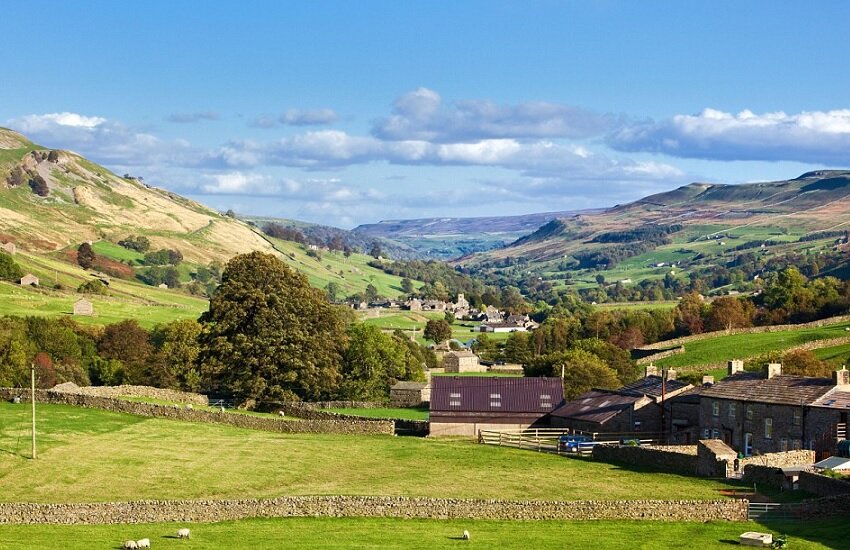
Let us envisage a community composed of ten farmers who farm land in a self-sufficient way, and who have ten, individual plots of land available to them that they farm intensively and to the maximum of their capacity. The farmland is owned by a wealthy landowner and each farmer pays a small tithe to the landowner in return for the right to farm his plot of land. And let us suppose that due to soil erosion, one farmer’s plot of land is lost and he is left unemployed.
Such a situation could spell disaster for the farmer who has been left unemployed, but luckily the other farmers have a small surplus crop and they agree to share this surplus with the unemployed farmer until such time as he is able to establish a new plot of land to farm. In other words they agree to provide an unemployment benefit for the dispossessed farmer providing he continues to seek work that will enable him to support himself once more.
Let us suppose that some time later an immigrant arrives in this community — an immigrant who has no land — and seeing that the disposessed farmer is being paid an unemployment benefit he asks to be paid such a benefit also so that he too can live within and be provided for by this community. If the community were to accept this immigrant it would then create a situation in which instead of receiving 1/10th of the bounty of the farmland available to them, each community member would subsequently only receive 1/11th. Clearly accepting an immigrant who has no intention of working would simply make the original members of the community poorer and this is what happens on a larger scale when a nation accepts immigrants who come with no job and who are happy to live for some considerable time and perhaps indefinitely on benefits.
Now let us suppose that an immigrant arrives in this community who wants to work hard and pay his taxes and provide a better future for his family, and coinciding with the time of his arrival the tenancy agreement of one of the existing farmers comes up for renewal. The farmer concerned offers to pay the usual tithe to the landowner in return for the right to continue farming the land, but the immigrant offers to pay more.
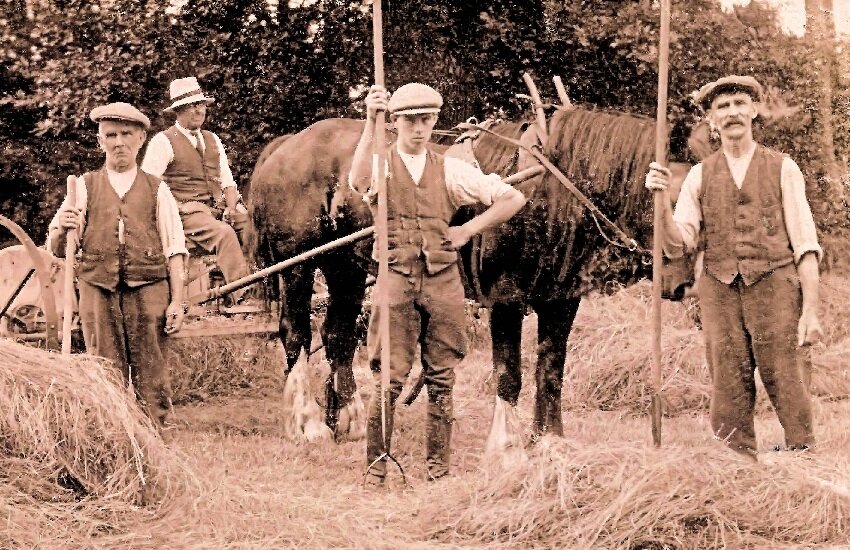
This is the equivalent of a situation in which there is competition for a finite number of jobs and immigrants coming from poor Third World countries offer to do the same work done by indigenous workers but for lower wages. Such a situation increases the profit margin for the employers concerned and the tithe paid by each farmer in our analogy is the landowner’s profit margin. By employing the immigrant in place of the original farmer the landowner will make more profit, and as that is why he is in business, he opts to take advantage of the cheap labour offered by the immigrant.
Our community of ten has now become a community of eleven, with nine employed and two unemployed and even if our immigrant agrees to pay a small amount of his produce to provide unemployment benefit for the two unemployed farmers, each farmer will subsequently receive just 1/11th of the bounty of the farmland instead of 1/10th and the original members of this community will all be worse off.
If the amount of farmland available to the community in our analogy was limitless, analogous to the number of job opportunities within a nation being limitless, then on purely economic grounds uncontrolled immigration could be said to have no adverse impact upon the indigenous people of a nation, but that is not the case. Britain is full to capacity, our public services are overstretched, we are struggling to stay out of recession and there are only limited job opportunities.
In my previous article in this series, I stated, “Only underdeveloped countries, such as the USA and Canada and Australia were during the 18th, 19th and 20th Centuries, and to some extent still are today, actually benefit from net inward migration. When the capacity of the land in terms of the space and the natural resources offered is so great that the land and its natural resources lie untapped, then and only then will net inward migration be a benefit to the existing population. In these circumstances the new immigrants will occupy unused land, and occupy genuinely new jobs exploiting those untapped natural resources. Furthermore, the economic activity generated building houses for these new immigrants and as a result of them buying goods and services once they arrive, will create a genuine increase in both GDP and GDP per capita.
“Today however, Britain and Europe are full. We have no vast untapped resources and so immigration will not benefit our people one iota. Even in countries like the USA, Canada and Australia, the most easily exploitable natural resources have already been tapped and the scope to absorb new immigrants is rapidly diminishing.
“Mass immigration into the West is driven primarily by population growth caused by uncontrolled birth rates in the Third World. It is claimed that the migrants are simply seeking a better life, and this is to some extent true, but they are the cause of the population growth that is creating poverty in their homelands and it is up to them to banish poverty by controlling their numbers. They need to achieve a situation in which their numbers are in balance with the capacity of their countries to support them, they should not be granted that better life at our expense — by taking what is ours — by insisting that we share what we have with them.”
By Max Musson © 2018
See other articles in this series:
The Truth About Immigration #1 – The Quantification of Immigration
The Truth About Immigration #2 – The Macro-Economic Impact of Immigration
# # # #
JOIN WESTERN SPRING
Western Spring is not just a website. We are a community of people dedicated to achieving the Six Prerequisites and thereby acquiring the wherewithal needed to win political power and through that secure the future survival, proliferation and advancement of the British people and other White peoples of European descent, wherever they may live. Please join us:
[contact-form to=’[email protected]’ subject=’Membership Enquiry’][contact-field label=’Name’ type=’name’ required=’1’/][contact-field label=’Email’ type=’email’ required=’1’/][contact-field label=’Phone No.’ type=’name’ required=’1’/][contact-field label=’Postal Address’ type=’name’ required=’1’/][contact-field label=’Post Code’ type=’name’ required=’1’/][/contact-form]
# # # #
AJ
- Edit
Absolutely. In my time in the Green Party I repeatedly argued for sustainable economics: your so-called immigration policy (rate of increase) is meaningless unless you have a sustainable population policy preceding it.
Alec Suchi
- Edit
Regarding the exponential population growth in the developing world which then causes migration movements to the developed world, Theodore Lothrop Stoddard observed in his magnum opus ” The Rising Tide of Color” (the American spelling notwithstanding), written in 1921, that the spread of western civilisation had provided medicines and increased sanitation which has contributed greatly to the rising population levels in Africa particularly.
Previously decease and famines kept the population levels stable and to a level which could be supported by the resources available. The West’s ingenuity and great organisational and technical skills allowed the exploitation of resources which then allowed greater population levels.to be sustained.
The populations of countries like Nigeria have increased exponentially over the years and are not sustainable, and subject to famine on a regular basis, the worst effects mitigated by foreign aid.
Alec Suchi
- Edit
The Green Party at one time supported stable and sustainable population levels but has abandoned this in favour of open borders and acceptance of unlimited number of migrants which they insist are helpless refugees fleeing persecution.
At one time The Green Party also favoured the UK leaving the EU on the basis that it was a supra-national organisation which
potentially undermined the decisions of national governments and that decisions are best made at the lowest level of organisation, namely “Subsiduarity”. Within those terms it was argued that most decisions should be taken at local government level involving the community and then at regional level.In this way only a small amount of decisions would then be made at national level.It is clear with its support for the EU, the Green Party has now rejected the implications and consequences of subsiduarity.
Originally a party committed to sustainability within ecological parameters and once called The Ecology Party”, this has given way to overt cultural Marxism and a fanatical observation of the worst manifestations of political correctness.
janet mills
- Edit
you will keep on getting what you are getting so long as you keep on electing traitors instead of patriots. Theresa May? That phony Lord Mayor of London? those people don’t care about the British people.
panadechi
- Edit
The study looks only at the economic point of view, but the racial part is important because having different races and cultures in the same space generates conflicts, in addition to the racial lineage is unique, and when it is lost is forever.
Max Musson
- Edit
You are quite right Panadechi, there is a racial dimension to this issue and the racial dimension is the most important aspect, and further articles will illustrate this point.