Yesterday brought us news of the death of Margaret Thatcher, one of the most significant and controversial politicians in recent British history.
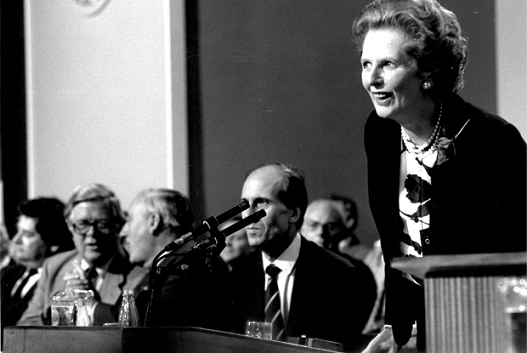
Firstly her life is significant, if only because she became Britain’s first and so far only female Prime Minister. That in itself is sufficient to secure her a place in our history books, but the most crucial question and the most hotly debated is whether or not her political career and tenure at 10 Downing Street was beneficial for our nation and therefore worthy of celebration.
On the political left there is no shortage of critics, many of whom will be celebrating Margaret Thatcher’s death with barely disguised glee. She was from a somewhat puritanical Methodist background and was not therefore sympathetic to the needs of people at the poorer end of the social spectrum; she opposed the labour unions at a time when they were at the height of their influence and through the introduction of anti-union legislation and through her handling of the miner’s strike, ultimately breaking the power of that most powerful of unions, Margaret Thatcher became the darling of the business classes and a hate figure for those on the left.
Indeed it was Thatcher’s forceful personality and her image as the ‘Iron Lady’ that won her many admirers even among common people and especially amongst traditionally minded women of all classes. In terms of personality and image, Margaret Thatcher was the kind of strong leader that many people believed was necessary and still believe is necessary today for Britain to remain strong in an uncertain and often hostile world.
The high point of Margaret Thatcher’s career was her successful leadership of Britain during the Falklands conflict. The successful outcome of that war, coming as it did at a time when our nation was widely perceived as senile, ‘toothless’ and ‘washed-up’, had a remarkably invigorating effect which all nationalists will appreciate and which repositioned us once more as a nation to be reckoned with.
It was for her handling of the Falklands conflict that Margaret Thatcher will be most keenly remembered by those who look back at her period in office fondly as without a doubt, had she not been Prime Minister at that time, the Conservatives and the Labour Party would have caved-in and conceded defeat to the Argentinians, thereby accepting for Britain a very much more lowly and reduced position in the world power rankings than we have today.
Emasculated in this way, it is certain that as a nation, our decline in the intervening years would have been steeper and more rapid. Mrs Thatcher’s legacy therefore, despite all that her critics may throw at her, is that she gave our nation back, temporarily at least, some belief in our ability to regain our former greatness.
From a nationalist perspective there is little positive, apart from an admiration for her style of strong leadership and her handling of the Falklands conflict, with which to credit Margaret Thatcher. Significant though her contribution to the national consciousness was during her premiership, she was responsible for breaking trade union power (not necessarily a bad thing in itself) which then led on to a wholesale dismantling of British industry by hoards of unscrupulous asset strippers. Almost gone now is most of our heavy industry; our motor industry, our ship building industry, and our coal and steel industries, all reduced to a fraction of their former size.
Margaret Thatcher’s government was responsible for the sale of many of our national assets; our utilities companies that were ‘privatised’ and our national housing stock, much of which was sold at heavily discounted prices to council tenants under ‘right to buy’ schemes.
Despite voicing strong opposition to the encroachment of the EU into British national affairs, Thatcher’s vocal opposition turned out to be empty rhetoric, as when it came to action, Margaret Thatcher kept us in the EU and her government signed both the Schengen Treaty, opening our borders to mass immigration from within the EU, and the Single European Act. Furthermore, continued membership of the EU continued the process of destruction of much of British farming under the auspices of the Common Agricultural Policy.
Thus, deprived of our core manufacturing industries, and our farming, with most of our utilities companies in foreign private hands, we face as a nation a future in which it will be almost impossible to establish a balance of payments and this is one of the primary reasons for our continual budgetary deficit and constantly rising national debt. A nation that imports most of the manufactured goods and most of the food stuffs that it’s people need, will always need to borrow money in order to pay for such things.
The Conservative victory at the General Election in 1979 was largely due to Margaret Thatcher’s bold statements on immigration in the run-up to the elections. Her standing in the polls rose by 11 percent after a January 1978 interview for World in Action in which she said “the British character has done so much for democracy, for law and done so much throughout the world that if there is any fear that it might be swamped people are going to react and be rather hostile to those coming in.”; and “in many ways [minorities] add to the richness and variety of this country. The moment the minority threatens to become a big one, people get frightened.”
Sadly however, these bold statements in defence of the ethnic integrity British people again turned out to be nothing but rhetoric and mass non-White immigration into Britain continued unabated throughout Mrs Thatcher’s term in office.
The key to understanding the gaping contradictions that characterise Margaret Thatcher’s political career; the carefully cultivated image of the bold leader, the ‘Iron Lady’ who on a matter of pride and principle fearlessly led our nation in a war to secure small islands in the South Atlantic, on the one hand; but who allowed our nation to be asset stripped, subjugated to foreign hegemony within the EU and invaded by a tidal wave of inassimilable Third World immigrants on the other, is to examine the people from whom she took advice and with whom she surrounded herself:
In 1938 at the behest of Margaret’s older sister, the Thatcher family provided a temporary home for her sister’s pen pal, Edith Muhlbauer, a Jewish girl, who was fleeing newly Nazi controlled Vienna.
Edith Muhlbauer 17 years old at the time, shared a bedroom with Margaret and her stories of persecution and Jewish suffering under the Nazis evidently had a great impact upon the younger girl. Margaret was only 12 years old in 1938 and we can only imagine how worldly wise and sophisticated 17 year old Edith would have appeared to her young and impressionable room-mate. It is telling that in later life Thatcher often said that her greatest accomplishment was helping to save a young Austrian girl from the Nazis.
Margaret Thatcher graduated from Oxford in 1947 with a degree in chemistry and before she entered politics worked alongside Jews as a chemist at J. Lyons and Co., a Jewish-owned company.
Her first big career step was taken when she was elected as MP for Finchley in 1959. She had been an unsuccessful candidate in a number of constituencies previously, but finally she had found her constituents: middle-class, entrepreneurial, Jewish suburbanites. Thatcher regarded Finchley’s Jewish residents as “her people” and became a founding member of the Anglo-Israel Friendship League of Finchley as well as a member of the Conservative Friends of Israel.
Chaim Bermant, a Jewish journalist once claimed that Thatcher had “an almost mystical faith in Jewish abilities”, and her policies resulted from the influence of three men; Keith Joseph, a member of Parliament who was a practicing Jew; Alfred Sherman, a Jewish former communist turned free-market thinker; and the monetarist economist and Jewish author Milton Friedman.
Together with Thatcher, Joseph and Sherman founded the Centre for Policy Studies in 1974, ostensibly to inject classical liberal ideas into Britain’s Conservative Party. One outcome of this project was the publication of a book co-written by Joseph in 1979, entitled, ‘Equality’, which argued in favour of equality of opportunity, thereby establishing the ‘moral justification’ for the subsequent appointment of individuals of ethnic minority origin within any future Conservative administration and removing any obstruction that might exist as a defence against the social and economic advancement of organised minority groups at the expense of our indigenous people.
Predictably, once she became prime minister, Thatcher appointed a government of ‘outsiders’ and this led Harold Macmillan to comment, that Thatcher’s cabinet “includes more Old Estonians than it does Old Etonians”, an obvious reference to the number of Jews appointed to office by her:
In addition to Nigel Lawson, she appointed Victor Rothschild as her security adviser, Malcolm Rifkind to be secretary of state for Scotland, David Young as minister without portfolio, and Leon Brittan to be trade and industry secretary. David Wolfson served as Thatcher’s chief of staff.
Under monetarist economics, ‘the bottom line’ becomes the arbiter of all things and consideration of all other priorities is subordinated to the goal of maximising economic turnover and therefore profits in strictly monetary terms.
If selling off national assets creates greater profits, then monetarist economics supports such an idea; if the subordination the nation to foreign domination produces more profits, then monetarist economics supports that idea; if flooding the country with cheap foreign labour produces more profits, then monetarist economics supports that idea also. Monetarist economics supported all these things irrespective of the negative impact in qualitative terms for the majority of our people; in terms of our loss of self-determination, social cohesion and racial integrity.
Furthermore, in a nation in which ‘money talks’, the profits were not shared by the nation, but ended up in the hands of the banks and monopolistic multinational corporations who wield the greatest financial clout.
In short, our nation became a tool of money-power, instead of the economy being a tool for the benefit and the enrichment of our nation as a whole.
In summary therefore, Margaret Thatcher’s legacy as our first female Prime Minister and as the saviour of our national self-respect through her firm handling of the Falklands crisis has been substantially degraded by the adverse impact of Jewish inspired monetarist economic policies, tarnished by her failure to honour her commitment to restrict immigration, and further coroded by her deliverance of much of our national wealth into the hands of organised ethnic minorities. She was primarily a liberal conservative who employed traditionalist rhetoric in order to influence others, and whose primary failing was to allow the Jewish minority with whom she felt an affinity, a disproportionate influence over social and economic policy, rather than tailoring social and economic policy towards serving the nation as a whole.
Despite her flaws however, Margaret Thatcher is still probably the best Prime Minister in recent British history, which is not so much a measure of her worth as a statesperson, so much as a recognition of the pitifully poor quality of the other Prime Ministers that have disgraced our nation over the last half-century or more, all of which have shared her failings and none of which have shared her mitigating qualities.
By Max Musson © 2013
# # # #
Steve
- Edit
Quite right!
I have had the dubious honour of living through her era & do remember the union strife before that as well.
She is probably the least worst of our recent politicians but that’s no praise, as in my mind that’s like being a form of cancer & being asked “Do you want the slow one or the fast one?”
Like Murdoch or Reagan, she’s described as right wing, a lefty hate figure but why have we or the US ended up being PC & left wing leaning, globalist & anti Nationalist but supporting the extremes of Israeli policy?
The Falklands war was right but Iraq was wrong, Tony Blair’s attempt at the same sort of thing.
All I know is that big money including the zionists have done well out of all of them.
Thatcher’s sell off of assets delivered them into the hands of foreign powers.
Steve
- Edit
“The Tarnishing of an Iron Lady”
Surely she rusted?
Rust In Peace?
s.ducain
- Edit
The facts that she allowed big business to asset strip most of our industries, and that she was a little bit more than Jew-friendly inevitably begs the question, was she bought like
Blair, Cameron, Heath etc.
Steve
- Edit
Certainly sold us out!
Michael Woodbridge
- Edit
I was at a National Front London discussion meeting at the time of the Falkland invasion.The Argies had just attacked the island of South Georgia and everyone at the meeting assumed that Britain would cave in with some sort of fudge. Even John Tyndall was pessimistic. But I asked the group to take a more optimistic view; what if something in the old British spirit reasserted itself? What if we withstood the pressure of America, the World and all the faint hearts in our own country and once again stood up for ourselves? The others in the meeting smiled at me as if to say, “Yes I remember a time when I was naively optimistic”. Well, if nothing else I’m grateful to Mrs.Thatcher for proving my optimism justified.
frederickdixon
- Edit
A nicely balanced view Max. In defence of Mrs.Thatcher’s relative inactivity on Europe, she did at least manage to claw back part of our annual contribution. That was probably about as much as she could have done in the 1980s when the EC (as I think it still was) was far less pervasive and threatening than it has since become and, as a consequence, public attitudes to Europe were far less hostile.
As for the Jewish advisors with whom she surrounded herself, it was very much a matter of comment at the time. Some of these men were pretty right-wing in OUR sense of “right wing” – I’m sure I remember Sherman writing a series of articles in the Telegraph which were very hostile to immigration, and I certainly remember Sir Keith Joseph getting into hot water in the early seventies for speaking out about dysgenic breeding and suffering permanent damage to his career as a consequence. Lawson has more recently been outspoken about the global warming panic and the damage it is doing to British consumers.
Steve
- Edit
Thay talk a good talk but not much else.
Steven
- Edit
Harold Macmillian (a former Tory MP who attended Eton College) remarked that Mrs Thatcher had “more old Estonians in her cabinet than old Etonians). I don’t remember him being called an ‘anti-semite’ blah, blah, blah for this.
jackdaw
- Edit
She was an international capitalist as opposed to an international socialist, with INTERNATIONAL being the operative word. Seemed to do a lot of flag waving but did little to stop us being ‘swamped’.
Steven
- Edit
You have neatly summed-up the definitive characteristics of the two main British political ‘tribes’. Labour – the party of INTERNATIONAL SOCIALISM (though this is nowdays not so accurate) and the Tories – the party of INTERNATIONAL CAPITALISM.
Is it any wonder with these two parties the only parties able to form a government on their own (although the Tory Party is possibly past this now) the British people are divided against themselves?
Steve
- Edit
All globalist & therefore against Nationalism for any European country.
ernie
- Edit
I am sure that the yellow brick road has it’s origins in an allegorical study of the bankers doing what they do best! I shall look it up (it peez me off to have to keep looking up). Hollywood , I must admit, did a brilliant job of inversion .
The ‘establishment’ must be laughing their csocks off, at all those twats in Multicultland dancing to ‘their’ tune
dofornow