By Frederick Dixon:
As the traveller in southern Greece descends from the uplands of Arcadia into the country of Laconia – the far south-eastern corner of the Greek mainland – he encounters a scene of extraordinary beauty. There, before him in the sun, lies a broad and smiling valley whose pastures and fields lie among vineyards and olive groves, citrus and almond orchards. This is the valley of the slow, green, River Eurotas, a valley known anciently as “hollow Lakedemon”; hollow because it lies low between two tremendous mountain ranges which run from north to south on either flank of Laconia – Parnon on the east, Taygetus on the west. Amongst the orchards and vineyards in the northern part of Laconia, and close to the banks of the Eurotas, lies a small and pleasant town of low, white buildings, and wide roads shaded with orange and lemon trees. This unassuming place is one of the most famous in all of history, for this is Sparta.

We all know Sparta as the formidable military power which dominated much of Greece in the fifth century BC and whose king, Leonidas, and the three hundred men of the royal bodyguard, won immortal glory at Thermopylae (480 BC). Less known is that the Spartan state rested on three pillars – racial purity, military supremacy and social equality, – but underlying all was a fatal flaw.
Let us look at the three pillars in turn. The Greeks descended into their country from the north in several waves beginning about 2000 BC. The last of these waves was that of the Dorians who, some time after 1000 BC, introduced the working of iron and conquered most of the Greek mainland and many of the islands. They swept away the power of the Achaeans, their bronze age predecessors. There had been an Achaean Sparta, for it was the kingdom of Menelaus, the husband of the lovely Helen whose abduction by Paris precipitated the Trojan war. That older Sparta was never entirely forgotten for Helen was paid divine honours at her shrine there for many centuries to come.
Dorian Sparta probably began sometime around the year 800 BC in a gathering together of five villages on a central site. This was a conscious separation from the other Dorians of Laconia who had begun to amalgamate with the earlier inhabitants. Such intermarriage was strictly forbidden at Sparta and such was the xenophobia of the Spartans that all foreigners – even important ones, such as the envoys of other Greek states – were obliged to withdraw from the city at night. Maintaining the purity of the Dorian stock was the point and purpose of the city’s existence, and this uncontaminated northern heritage may have played some part in the later reputation of the Spartans as the most handsome of the Greeks. It will surprise no-one to learn that in modern histories of Sparta (i.e. post 1960s) this racial aspect of the Spartan state is evaded or completely ignored; earlier historians, following ancient precedent, were much more explicit.
The second pillar, military supremacy, became evident very early in Sparta’s history and she had probably subdued all of Laconia by 700 BC. The Spartans appropriated the fertile agricultural parts of Laconia for themselves and used hereditary state slaves, the Helots (“captives”), to cultivate these lands and provide the Spartiates – Spartan citizens of pure stock – with agricultural produce. The upland parts of the country were given over to the subject cities of the perioeci (“outdwellers”). These Outdwellers were Dorians of mixed ancestry whose cities, few of which would have been much more than villages, ruled themselves according to their own institutions but under Spartan supervision. Their military levies fought in the ranks of the Spartan army, Spartans and Outdwellers together being known as “Lakedemonians”.
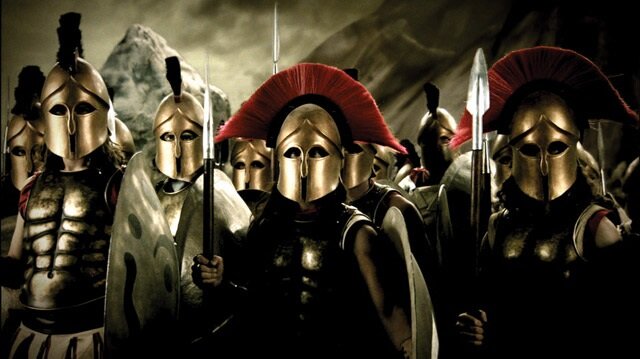
The Outdwellers were the mercantile and artisan class of Sparta, the Helots provided daily sustenance and domestic servants. The Spartiates , thus relieved of the need to do any other kind of work, were required to devote themselves exclusively to lifelong physical austerity, rigorous exercise and training for war. That is what gave Sparta her military supremacy, that is what made the Spartiates “artists and craftsmen in war.” This lifelong military education, the “agoge”, was not restricted to men; to the scandal of other Greek cities, where women were confined to the home and were permitted no part in public life, girls were educated in the same manner as the boys (although presumably without the weapons training) in order to fit them for their eugenic purpose, namely giving birth to more Spartiates. Serving the same eugenic purpose was the inspection of new born infants to ensure that they were fit to live, the sickly or malformed being exposed amid the crags and chasms of Taygetus.
The third pillar was social equality. The expansion of Sparta did not end with the conquest of all Laconia, but continued westwards across the formidable barrier of Taygetus, eight thousand feet high and snow capped, into the fertile lowlands of Messenia which lie beyond. There is only one transverse east/west pass through the mountains and that is the way which the Spartans had to take. The First Messenian War, in which the Spartans conquered the country, seems to have been fought soon after 700 BC. The Second Messenian War was probably fought about fifty years later when the Messenians rose in a great rebellion which took years to suppress. Both wars were hard fought and for long the outcome was doubtful. At some point, thought by most authorities to be during the Second Messenian War, a social revolution occurred in Sparta. How it was done we do not know, but it is reasonable to suppose that the circumstances of the war afforded to the common soldiers the opportunity to make certain demands and obliged their masters to concede those demands.
From this time onwards, and in reforms always associated with the name of the lawgiver Lycurgus, all Spartan citizens were “homoioi” meaning “the same” but usually rendered into English as “equals”, all received at birth an equal allotment in the farmlands of the State together with an equal allocation of Helots to work it – on the citizen’s death these reverted to the State for reallocation. Each citizen had an equal vote in Sparta’s legislative bodies and in the election of the five “Ephors” (overseers) who, from this time onwards took over the government from the kings; in an arrangement which must have arisen from the circumstances of the city’s foundation,Sparta had two separate royal lines with two kings ruling simultaneously, but under the Lycurgan reforms their powers were largely restricted to the command of the army. Lycurgus is also credited with the agoge. These reforms did not establish perfect equality among the homoioi, for there remained an aristocracy with its own hereditary estates, but they did ensure that the common Spartiates now had a real stake in their city.

It was at about the same time, and again in reforms associated with the name of Lycurgus, that the Spartiates adopted their regime of rigorous austerity. There are plenty of indications that before the mid-seventh century the arts of music and sculpture flourished at Sparta, but thereafter they withered and died. The austerity of the Spartan way of life had some curious effects on the Spartiates themselves. One such was the terse manner of speaking which the Spartans developed and which is still known as “laconic”; this is well illustrated in the traditional injunction of a Spartan wife when handing his shield to her husband as he set out for war: “with it or on it” i.e. come back victorious or come back dead. Another curious effect can be seen in the attitude to death in battle – after the battle of Leuctra in 371 BC when four hundred Spartiates died, the families of those who survived retreated into their homes and dressed in mourning, while the families of the dead went about smiling and joyful for they had done what a Spartiate was meant to do.
The fatal flaw in the Spartan system was their total dependence on Helots. In Laconia these people were probably descended largely from the pre-Greek inhabitants, but in Messenia they were themselves Dorians although of mixed stock like the Outdwellers. Not only did they provide the Spartiates with all their supplies of food, wine and oil, but they were domestic servants, nursemaids for Spartiate children, personal attendants on campaign (at the battle of Platea in 479 BC each Spartiate had seven Helot attendants) and sometimes fought as light infantry. The Helots were obliged to yield up one half of the produce of each allotment to their Spartiate master and he in turn handed over a proportion to the common messes where Spartiate men took their meals – if he was unable for any reason to pay his dues to his mess he lost his citizenship and sank into the ranks of “Inferiors”, thus the Helot contribution was critical to the Spartan institution of citizenship
Yet, dependant as they were on the Helots, who outnumbered them by at least twenty to one, the Spartiates hated and feared them; they always felt, they said, “as if they held a wolf by the ears.” So we find the strange ritual by which the Ephors annually declared war on the entire body of Helots in order to remove blood guilt from those who killed the disaffected. Such killings – secret murders – were the business of the Crypteia, the Spartan secret police and the world’s first known such institution.
The expulsion of the Persians from Greece following the battle of Platea in 479 BC (where the entire Lakedemonian army was deployed with some eight thousand Spartiates and probably twice as many Outdwellers) was followed by a period in which Athens and Sparta were the dominant powers in Greece and this led in time to rivalry and to war. Sparta was victorious but the constant drain of her best blood had reduced the number of Spartiates from around 8,000 at the time of Platea to some 1500 at the battle of Leuctra little more than a century later in 371 BC.
The crushing defeat of Sparta by Thebes at Leuctra cost the lives of 400 Spartiates and put an abrupt end to her power. She never recovered, so it is worth looking in a little more detail at how the previously unregarded city of Thebes managed to inflict such a devastating defeat on the greatest military power of the time. The Thebans employed a new tactic, throwing a massive division, fifty ranks deep, against the Spartiates who were drawn up eight ranks deep on the right of the Lakedemonian army, Moreover this huge Theban phalanx had a very sharp cutting edge in the Sacred Band, only three hundred strong but trained to Spartiate standards (the Sacred Band consisted entirely of homosexual couples, but remarks about effeminacy would probably have been unwise in the presence of these grim warriors). The Spartan right was crushed, the Outdwellers on the left and in the centre played no part in the fighting.
After Leuctra the Thebans descended into the Peloponnese, liberated Messenia and entered Laconia. The Spartan women, it was said, were obliged to witness a sight which had never been seen before – the campfires of an enemy. The Thebans did not take Sparta but they did not need to, the permanent loss of Messenia at once plunged half of the surviving Spartiates into the ranks of the Inferiors. Conspiracies and rebellions followed, Inferiors plotted with Helots, tyrants rose and fell, citizens were driven into exile, kings abolished the Ephorate and granted citizenship to liberated Helots, Outdwellers and foreign mercenaries. The last king, Nabis, who ruled alone, was a usurper and a foreigner who claimed descent from a fifth century Spartan king, but it has been suggested that his name is Semitic, not Greek.
In the end Sparta, deprived of her Outdwellers and with her Helots now free tenants, fell under the rule of Rome. Rome allowed her a degree of home rule and she gradually became a tourist attraction, a sort of Dorian theme park where her ancient traditions were preserved in aspic and put on display to Romans, not always with a happy result – when the Emperor Septimius Severus, who ruled around the year 200 AD, visited Sparta with a view to summoning its fabled army to join him in his forthcoming campaign against the Persians, he changed his mind when he saw the few hundred decrepit individuals drawn up for his inspection, so far had the mighty Spartans fallen. At the end of antiquity in the fifth century AD all cities vanished or shrank to mere citadels, Sparta was one of the former. The city was refounded in the nineteenth century; its modern inhabitants are probably for the most part the descendants of Helots and Outdwellers mixed with the Slavs, Franks and Asiatic Greeks who settled in Laconia in the Middle Ages but, who knows, perhaps they have somewhere in their DNA a thin scarlet thread, the blood of the Spartiates.
The Spartans at the height of their power and fame were trapped on a treadmill. Their entire way of life was designed to hold the Helots in subjection and they couldn’t let the Helots go because it would destroy their way of life. Leuctra and the loss of Messenia showed just how fragile was the entire construct. Was imperishable glory worth that treadmill?
There are obvious modern parallels – the Confederate slave states, South Africa under apartheid, the regime which the German national socialists intended to construct in the conquered east. The moral for us – never be dependant on racial aliens for anything.
By Frederick Dixon © 2013
# # # #
frederickdixon
- Edit
If I may comment on my own article. On re-reading it I think I have failed to give due credit to the Spartiates; for all the flaws of their society, and its sad final centuries as a museum exhibit, they have left us with an example of manliness, hardihood, courage, endurance, military excellence, discipline and loyalty to their country which we should admire, and try to emulate, but will be hard pressed to equal. Not surprisingly the fascination of the Spartans endures and every society, even Bolshevik Russia, has found something in its legacy to inspire imitation – until now that is, to our post-modern, massively feminised western societies, Sparta can only be incomprehensible and repellent.
Franklin Ryckaert
- Edit
Unlike the Athenians the Spartans only left their military fascination as a legacy. Ultimately it is only culture that survives.
SerpentSlayer
- Edit
You speak too soon, culture colours the world but men inspired by the Spartans will ensure that there is a world worth colouring.
MsBridgit
- Edit
It is true, history does repeat itself. Didn’t ancient Rome experience a similar parallel?
Alexandros
- Edit
Nabis is a semitic name, it means “prophet”. Nabis murdered the Spartan royal bloodlines and confiscated the wealth of the aristocrats, he was a jewish revolutionaire.