By Max Musson:
I have, as everyone else in Britain will have done over the last few days, been paying my respects to those brave men and women who sacrificed their lives in the great conflicts of the last 100 years.
I always give generously when I buy my poppy each year and I always try to observe two minutes silence on the eleventh hour, of the eleventh day, of the eleventh month. Both of my grandfathers suffered permanent injury during the Great War and every male member of my father’s generation in my family, with one exception, was injured in battle during the Second World War, my father and his oldest brother most severely. Only my Uncle Jack survived the war unscathed.
As the commemorations this year for the 100th Anniversary of the beginning of the Great War have unfolded, I was at first moved in a way that was heart warming by the beautiful tribute to the dead of that war in the form of the ceramic poppies planted in the moat of the Tower of London. It seemed to me a fitting way to honour the sacrifice of those young lives.
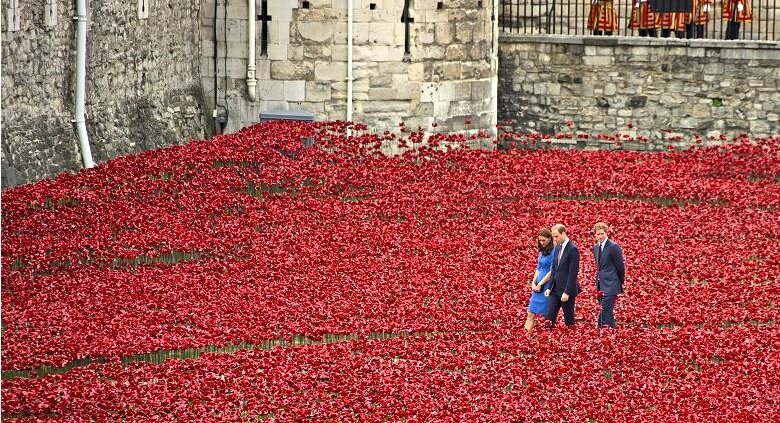
As the days have passed however and as I have seen the sea of ceramic poppies grow, each one representing a life lost, the visual impact of that display has turned my admiration and respect for the brave souls who died into a raging anger at the callous stupidity and the criminal negligence of those who sent so many men off to die – the leaders of our nation during the First and Second World Wars who were so stupid that they thought a country such as ours could afford to lose so many men in such a short period of time without it blighting the future health and welfare of our nation.
Only today when one sees in one place a stark visual display such as that provided by those ceramic poppies does the enormity of our national tragedy become apparent, but those leaders of the past must have seen the endless columns of those cheery faced young men marching to their doom, they needed no field of ceramic poppies to realise what they were doing. And for what?
Prior to the Great War, Britain was the pre-eminent world power. Life was far from perfect in Victorian and Edwardian Britain and our working classes often suffered terribly from poverty and neglect, but as a nation we commanded the largest empire the world had ever seen, our people were world leaders in almost every field of endeavour and our industrial heartlands were the ‘workshop of the world’.

By the end of the 20th Century however, we had been financially bankrupted by war, our people diminished by the loss of so many of our most vital elements have been left apologising for our past accomplishments, our industries reduced to a shadow of their former glory and foreign owned as is much of the commercial life of our nation.
We grieve each year for the loss of those men who fell in battle, but no-one thinks of the women from two successive generations who had no young men to marry, who had no husbands to father their children and who whiled away their most productive years as spinsters and who now die alone in residential care homes, having no living relatives left to care for them.
A hidden consequence of that Great War in which we lost 888,000 men, is that 888,000 young women’s lives passed unproductively and the genetic line of roughly 1,776,000 people came to an abrupt end. Some of the men will have fathered children before they went off to fight of course, but probably not the full complement that one might have otherwise expected, but most of them will have died childless. If we take these factors into account, and estimate that 700,000 couples were deprived the opportunity of marriage and of raising a family, then at 3.5 children per family, which was the average during the early 20th Century, that means the loss of over 2.4 million children that otherwise would have been born in the 1920s and 1930s. Furthermore at 3.0 children per family, which was the average during the 1950s and 1960s, the loss of that 2.4 million children translates into a loss of 3.6 million children in the next generation.
This exercise can be conducted for each of the nations of Europe and only then, in today’s world in which White people are a shrinking minority, do we fully appreciate the ghastly folly of the Great War alone in terms of the loss of power, vitality and prestige of our race.
The leadership of a nation is an onerous undertaking with great responsibility, not just for the generation that lives today, but for the generations that have passed and the generations as yet unborn. What separates the fate of one nation from that of another is the quality of its people as well as the quantity of its people and anyone who aspires to lead their nation should be cognisant of their duty to conserve and protect the human riches under their command.
A nation should only go to war for one of two reasons:

- That it is under attack or threatened with imminent attack from another belligerent nation and has no choice but to defend itself; or
- There is a real prospect of acquiring assets in terms of living space and natural resources, such that these assets will more than compensate the nation for the loss of life and resources expended in winning that war.
In neither the Great War nor World War Two were these potential reasons for involvement in those wars present. Kaiser Wilhelm had no intention of militarily threatening Britain and neither did Adolph Hitler. Furthermore, in neither case did we have any prospect or intention of territorial gain from winning those wars. There was nothing to win and everything to lose.
Our involvement in the two world wars was akin to digging an enormous pit, filling it with people, money and natural resources and then setting it on fire, twice! And so, when I look at the moat of the Tower of London, filled with that bewildering number – that sea – of ceramic poppies, one side of me is choked with sadness and regret for the tragic loss of life and the lives that were not lived, or which were blighted by the war, while the other half of me is filled with rage that any king or minister of this great nation could be so criminally negligent of their duty to our people that they allowed such obscene carnage to take place in their name.
By Max Musson © 2014
# # # #
Read also: War and the Breed
# # # #
Walter Greenway
- Edit
As the season of goodwill fast approaches consider giving your loved ones a good sheaf knife for Christmas. Then should the lunatics of Westminster go off their heads as they did in 1914 they can be dealt with quickly.
Walter Greenway
- Edit
And buy a sheath to put the knife in for their birthdays.
katana
- Edit
Powerfully emotive thoughts Max. Thank you for sharing your personal story.
.
.
The untold sacrifices and suffering caused by those two unnecessary wars should warn and enrage people to realize that it can happen all over again. The same tribe of people that engineered those wars are more than ever in control of our societies and are the cause of the current Middle East wars, the mass third world immigration into our countries, etc.
.
Let’s learn from those two wars and all the other wars since. Let’s be determined to wrench control of our destinies from these tribal supremacists that rule over us and make these psychopaths and their goy helpers suffer justice.
.
A Burke said, “In order for evil to flourish, all that is required is for good men to do nothing.”
.
——————
.
My latest blog post, All America Must Know the Terror That is Upon Us, is here: KATANA
.
[katana17.wordpress.com]
Michael Woodbridge
- Edit
I have in my possession a letter written by my Uncle Ted to his Mother from the First World War in which he says how he was looking forward to seeing her new baby on his return to England. That new baby was my Mother, the last of 10 children…he never saw the new baby.
Uncle Ted was so keen to join up and fight for his country that in order to enlist he lied about his age. When he proudly announced what he’d done, his girlfriend, Amy, chided him for his foolishness. Therefore on this return to barracks he pretended to be deaf and was discharged. However, on reaching eighteen years he was accepted back into the Army. Amy told me this story in her London flat when i was a child. Eventually she married someone else. I remember the old soldier beside her quite clearly because as a consequence of the war he only had one leg.
Gallienus
- Edit
Hello Max and thank you for another fine article. I still owe you closing comments on your “Condell Moment” thread but am especially moved by WW-I so I have to respond. This war (WW-I) was completely avoidable, unlike WW-II in which our (Allied) options were much more constrained.
..
Last year I had the opportunity to visit the battlefields of the Somme and saw the fields of crosses for both Allied and German sides. I recall this whole town of Canadians, it may have been the Newfoundland Regiment, went into battle on the first day. They ran into machine gun fire and according to Wikipedia, out of 780 men who were in the charge only 110 survived unscathed. From the memorial there I recall the numbers of survivors as being much lower. However, practically all the men were from this one Canadian town and I recall they were almost completely wiped out on that 1st day. A memorial at the site gives biographies of the soldiers.
..
One of them, around 20 years old, wrote that he didn’t especially want to fight the Germans but there was some sort of harsh winter in Canada and he was concerned that his parents and siblings, who were farmers, would starve to death. At least as a soldier he’d have some money to send back to Canada. None of this Government welfare we now use to feed wildly procreating, ungrateful Muslims, or angry black populations. His written command of English was about on the level of my own as far as clarity and expressiveness. I don’t think he survived that day. I’ve forgotten his name but you can find it if you go to the battlefield memorial at the Somme for the “lost Canadian regiment”. This is just one of over 1 million men lost in the mud of “the battle of the Somme, 1916”.
..
Another great loss from the war was the German West Africa and Italian Eritrea (lost in WW-II). Once I disliked the Bosche and thought Edward VII, The Encircler, was the paragon of diplomatic capability. Now I wonder if perhaps he could’ve redirected the Kaiser’s naval ambitions, perhaps guaranteeing German access to its overseas colonies in Africa, rather than defeating them? Today those old German and Italian colonies are just another part of demographically exploding black Africa, poised to send another billion invaders sorry, refugees, into Europe.
..
The Boer Wars, WW-I and WW-II were truly huge losses for our people.
GEORGE
- Edit
I have nothing to add to your article. I just wanted to say that it is one of the best articles I have ever read. Completely brilliant. Thanks Max for opening a new line of thought that contributes to Nationalist thinking.
Albert
- Edit
Britain has never got over WW1, To me it was the beginning of the end of this Country….and WW11 finished it off.
Due to mass immigration since 1948, The Country has become fragmented into a living nightmare of different races and religions, with nothing in common, the English people have lost their confidence and lost their way, 1400 years of what was England destroyed in the last Sixty years.
The only future I see is Civil war that will eclipse both World Wars in casualties and destruction…that will send this country back to the Stone Age.
Tiglath
- Edit
Our sheeple have been trained by an army of liberal counsellors and therapists to enjoy emoting sadness, sentimentality and passive helplessness at these spectacles. Remember the thousands of men bubbling over Diana’s death.
In 100 years, few have bothered to find and read the revisionist’s histories of the real causes of the WW parts 1&2. ANGER and HATRED (towards the wicked men and their successors in Parliament today, who lied and deceived and dragged us into this terrible fratricidal war and holocaust of our best Celto-Saxons) ought to be the dominant response to this red poppy tribute. How ironic that the most recent disaster in Afghanistan was largely about poppies!
PharmaPhil
- Edit
& to think that even with this reminder so stark in the public eye, we have TPTB trying to get us into yet more war of once sort or another.
On the news they are raising sympathy for Ebola orphans but what about malaria or AIDS or civil war ones?
I wouldn’t put it past them to suggest that we need to take them in.
Chris
- Edit
There is nothing more striking than the above images. The wars of the 20th century have sacrificed much blood only for the defense of the powerful.
We see William, Kate and Harry preceding through a metaphor of Anglo-Celtic blood, sacrificed so ‘the tribe’ and their acolytes could further their interests. To me it draws parallels with the ‘2,500 year celebration of the Persian Empire’, held 8 years before the Shah’s toppling. Well I hope anyway.
Gallienus
- Edit
Rome’s 1st Emperor was Augustus who took that name in 27 BC (previously named “Octavian”) and ruled until 14 AD. Western Rome’s last Emperor also had the name Augustus, i.e. Romulus Augustus and ruled only a few months in 476 AD.
After that barbarian tribes controlled and fought over the region.
Steed
- Edit
The really uncomfortable conclusion is that the loss of English, Scottish, Welsh and Irish warriors, and their potential offspring, was a deliberate part of the plan. Every policy and decision the British (and other European) State makes is geared towards one thing: The slow genocide of the Germanic and Celtic peoples.
Shaun
- Edit
I’m proud of my great-granddad’s stoic reaction to having his arm blown off in the Battle of the Somme; but I’m also aware that I wouldn’t be here if the mine he walked onto would’ve killed him. Most of his regiment (the Highland Regiment) never came home. What a waste of life.
How many of their great-grandchildren would’ve been nationalists today? I reckon, a high amount.
Instead, we’re burdened with a huge amount of people whose ancestor’s couldn’t fight. Comfort-seeking, individualistic, superficial consumers. That’s the central nature of so many of today’s White masses. Let’s hope the Palaeolithic elements amongst us start to organize ourselves — dysgenic morons will never do anything but submit to the strongest force that surround’s them.
SerpentSlayer
- Edit
It would be interesting to conduct a study of the likelihood of people with ancestors of brother’s war veterans becoming Nationalists. Both my grandfathers were in the army, fate prevented one from fighting, the other fought in Italy. I have a great, great grandfather who fought at Mons and who knows how many fought on my pater’s side (large family, little time with my elders to find out) I think possibly the more warriors in your past, the more likely you are to take a stand to protect your people.
Max Musson
- Edit
I think you are probably correct!
BritishActivism
- Edit
I am sure I will not be alone in my years of wrestling when it come to what to think (and do) regarding the remembrance of the last two world wars. I think this wrestling is one of the things which differentiates a nationalist from a more general ‘patriot’, although of course some people can be both.
.
I suppose what I mean is, that we nationalists have to wrestle with a different perspective of what these wars did, how they happened and indeed wrestle with the disjointed awareness of certain things about the backdrop to these wars and the issues which the Germans faced, which most people do not tend to see or give consideration to.
.
As a result, I am no longer sure what I think about the whole ceremonial affair with poppies and politicians and the more wider ‘patriotism’ of groups and parties which have a rather unhealthy (to me) admiration for our troops in the present time and a wider ‘support our country, right or wrong’ approach to decision making.
.
Well, I suppose I do know what I think of it! – but I mean disjointing oneself from the generality and superficiality of it all can be pretty alienating.
.
This is why it is good to be in tune to some of the recent articles on this site which try and explain things in their nationalistic context. A very good explanation and viewpoint they are too. It brings forward a much more mature reflection on these things and is something which I think is sorely missed in the wider nation’s narrative.
.
Myself, I suppose I try and strike the the balance between remembering those who lost their lives for what they thought to be their people and their country (being proud of them and in awe at their efforts and sense of duty to, in their view, protect their own people and the British nation)….and on the other hand, being rather bitter about what was really going on, bitter about the lies, bitter about what has happened since the end of the war and bitter about the betrayal of those people who fought so valiantly.
.
I also get bitter at liberals who twist their heroic war-time efforts to justify their own ends in the present day, whether it be multi-racialism or homosexual marriage and “equality”, when they suggest “we fought two world wars to have equality and freedom to do {whatever degeneracy is their issue of the day}”.
.
They most certainly did not die for these things, or for “liberal values”. I am sure many folks of that era would be horrified at what has transpired. Maybe not all, but certainly a majority, given the wider societal and racial attitudes of the time.
.
Well, I don’t know what else to say over the matter, particularly when the Western Spring articles really have it nailed down so well. So on that note, enough from me!
.
Max Musson
- Edit
Your thoughts are as ever pertinent and most welcome. 🙂
Albert
- Edit
Two dates that sealed the fate of Western Europe, 22 June 1941 Operation Barbarossa The German Invasion Russia, and 7 December 1941 The Japanese Attack on Pearl Harbour.
The British today are still totally Brainwashed in their hostility to Germany, I say to people do you really think it would have been that bad if Germany had Won the War?
The English and Germans are related by Blood…..Our Culture is Germanic.
frederickdixon
- Edit
Max’s article is excellent and thoughtful, as always, but not all of the media coverage has been equally restrained. I heard a young woman commentator at one of the recent commemorations refer to those who fought as “a generation that we never knew”.
Well, I knew them. When I was a boy most men in their fifties and sixties were veterans of WWI and when I started work there were still one or two about in the office, and very interesting they were. Having known them, I suspect that they would have been embarrassed by much of the recent fuss, verging on the maudlin and sentimental as some of it has been – in stark contrast to their own, very English, reticence. Nowadays they would be condemned for their lack of “emotional intelligence”, another symptom perhaps of the feminisation of our society.