By Frederick Dixon:
As racial nationalists we can all agree that the State’s definition of “Britishness” i.e. possession of a British passport (or even just being an “established resident of the UK”) is not for us. Such a definition is nothing more than the casting into legal form of the elite doctrines of multi-racialism and multi-culturalism, and leads to such absurdities as “British” men shooting at British soldiers in Afghanistan.
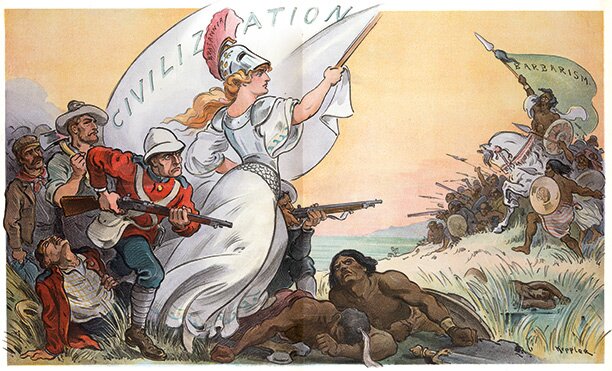
For us, the nation is a community of the blood, of common ancestry, of racial identity. To common ancestry can be added a common language, shared history, shared culture. It is these latter things which distinguish us from the racially very similar peoples of the near continent. But where did our common Britishness – rather than our original identities as English, Scots and Welsh – actually come from?
In her book “Britons: Forging the Nation, 1707-1837” (London, 1996) Linda Colley argues convincingly that it was in those years that England, Scotland and Wales “acquired some common sense of Britishness that must be called British nationalism”, for it was then that the British together repeatedly encountered, and repeatedly defeated, what had once been the most powerful European nation, France. But an even more powerful unifying factor came later, in the great shared adventure of Empire, and in particular in overseas settlement.
Overseas emigration initially went mainly to the United States but increasingly, as the nineteenth century wore on, an ever increasing number – and eventually the majority – of emigrants went to the white settlement colonies of Australia, Canada, New Zealand and the Cape of Good Hope. Not only did the destination of emigrants change as time went on, but so did the numbers – in the eighteenth century some half a million people emigrated from the British Isles, but between 1815 and 1924 twenty five million did so. From a desperate adventure for people who, for one reason or another, had little or no choice, emigration had become a positive good combining personal advancement with a patriotic duty to populate the Empire. It was a very great advantage for those who went to the settlement colonies that they were going to reproductions of home, where they would live under the Union Jack, subject to familiar laws, and surrounded by people like themselves. Significantly, while they remained British they – and more particularly their descendants – could no longer assert their old particularities; they were no longer English or Irish, Scots or Welsh, they were now British and Australian, British and South African. Thus Britishness was forged in the colonies rather more than it was forged at home.
This overseas Britishness was reflected in so many ways: in a “White Australia policy” which was originally designed not merely to keep Australia white, but to keep her British; in a public opinion poll published in the same country in 1954 which showed that Australians emphatically rejected a separate Australian identity in favour of remaining British; in Canada’s claim in 1935 to be the “Great White Britannic Empire of the North”; in New Zealand lamb described as “British lamb from New Zealand”. Although the loyalty of the overseas British to their own countries cannot be doubted, their deepest loyalty was to their race – British race patriotism was the great unifier among the British world wide.
There was among the overseas British a certain feeling that they were “better Britons”, those of our people with the intelligence, the courage and the get-up-and-go to make new lives for themselves thousands of miles from their ancestral homeland. Perhaps they were not wrong to see themselves as better Britons for it has been reported that the average IQ among that sadly near extinct breed, the white Rhodesian farmer, was 130.
Not surprisingly, by the latter years of the nineteenth century the evident growth and prosperity of the settlement colonies had given rise to schemes for their union with the United Kingdom. This concept had a name, “Greater Britain”, coined by Sir Charles Dilke in his 1860’s book of the same name. Theoretical flesh was put on the bones in 1883 by Sir John Seeley, Professor of Modern History at Cambridge, in his “The Expansion of England”. Seeley argued that in the white settlement colonies Britain had the territory, the resources and the potential to match the inevitable rise of such immensely endowed powers as the United States and Russia, and that the incorporation of those colonies with the United Kingdom in one country would halt the likely decline of Britain to second class status. It should be mentioned that the spread of the electric telegraph, and the supremacy of the Royal Navy made a trans-oceanic federation a realistic possibility.
For reasons too numerous and complex to consider here, an Imperial Federation did not come about despite the enthusiastic advocacy of Joseph Chamberlain, Colonial Secretary during the 1890s. Nevertheless, some progress was made for it was during the premiership of Joseph Chamberlain’s son, Neville, that the first prerequisite for federation was put in place – the free trade agreement known as “Imperial Preference”, which Neville once said was his proudest achievement.
After the Second World War the bonds of Empire weakened and the thoughts of UK politicians, particularly of the Tory variety, turned to the continent of Europe with the baneful consequences which we now endure. Britain’s first application to join the then European Economic Community in the early 1960s was greeted by the overseas British with “rage or resignation” because they saw it as betrayal of their own Britishness. When Britain joined the EEC on the 1st January 1973 any reason for the white dominions to seek to remain British countries disappeared, and in the forty years which have since passed Australia, Canada and New Zealand have all alike opened their doors to ever greater flows of non-white, and especially Asian, immigration so that the demographic character of those countries is utterly changed. Greater Britain will not come again.
So what remains? Some thirty five million white people of British Isles descent are still to be found in Australia, Canada, New Zealand and South Africa, and many of them remain very British in their ways and in their loyalties. At least a further fifty million are to found in the United States (plus twenty million Irish Catholics). So there lie the boundaries of the British nation, a nation defined by common ancestry. We, as racial nationalists, when defining who we recognise as fellow members of our nation should extend that recognition to all white persons who are substantially of British Isles descent together with their white spouses. When we have a nationalist government, all such persons – and only such persons – should have a right to settle in Britain for they are family and this is the family home.
By Frederick Dixon © 2013
# # # #
Max Musson
- Edit
I agree with almost all of what you have written here Frederick, although I believe events have overtaken us somewhat and it is no longer appropriate for us to foresee an exclusively British future for our nation.
.
The parlous state of the European nations and of our nation is such that the first White nation to break free from the New World Order will need to call upon the support of all White men and women, regardless of their nationality if we are to secure our existence.
.
We must begin thinking of ourselves and other European peoples as a ‘family’ of nations and as a ‘White brotherhood’ united in a common struggle for survival.
.
Having said that, we must strive to preserve within that wider sense of racial nationhood, all of the current national/ethnic traditions that give Europe such a rich cultural heritage.
frederickdixon
- Edit
The European Union is very much a part of that New World Order and those chains must be broken if we are to have a national future of any sort. Perhaps some sort of European alliance of nation states could take its place, but if so it should include all white countries and not merely those which are situated in the geographical space marked “Europe” in atlases – why should Turkey be considered for membership of the EU, while Australia (for example) is ineligible?
One of the greatest sins of the EU is its harmonisation programme, which includes the erosion of national identities by freedom of movement. I believe very firmly that any kind of European alliance – even a nationalist one – which does NOT allow for countries to control their own borders must be avoided. I do not accept, as someone one remarked, that east European immigration into Britain is “pouring milk into milk” because I am a British nationalist, not a white nationalist – of course whiteness is essential to Britishness, but merely being white is not enough. .
Max Musson
- Edit
Frederick, again I find myself in agreement with almost all you have written, however a more accurate version of that analogy would be pouring ‘strawberry flavoured milk into raspberry flavoured milk’, not necessarily something that would ideally suit everyone’s sensibilities, but infinitely preferable to many of the alternatives one might envisage.
.
My point is that we may not have the luxury of choice in these matters as the future may only offer us a limited choice between; a not ideal but still very palatable ‘mixed fruit flavour’; or something wholly indigestible, and we should be careful not to burn our ideological bridges before we come to them.
Nationalist4UK
- Edit
Well i recognise it as pan British Isles. I am half Irish and half English, it makes me British.
I am just sick and tired of hearing news about Scottish Independence which is a Marxist liberal plan done by the zionist scum!
I am all for a pan British Isles state, our homelands are ours, I like to travel anywhere in the British Isles, I do not sing the anthem because the lyrics is about praising the unelected monarch! I am all for getting our Islands back for the sake of our race and nation! The flag of “United Kingdom” today is actually the flag of the British Isles which unites the nations of England, Scotland, Wales and Ireland into one nation.
At the end of the day, we are White and we need to overthrow the unwanted zionist regime as soon as possible!
Michael Woodbridge
- Edit
In proposing “Europe a Nation” Sir Oswald Mosley was in danger of allowing his grandiose dream of White unity to obscure the local patriotisms from which racial nationalists draw their sustenance. It was understandable that Mosley should have come to the conclusion he did when we consider that the British Empire fought on the wrong side in the 2nd World War, just as Britain has continued to take the part of her natural enemies ever since. However, as Frederick Dixon points out we are a unique people and even at this late stage with a new spirit of British racial kinship could count upon about 150,000,000 as the foundation of a revitalised White Commonwealth.
Jonathan Bowden once said that the more English one is, the more British one is and by extension the more European one is. But it has to be in that order…from the particular to the general, like all good arguments, and not the other way around.
frederickdixon
- Edit
Excellent points Mike. I don’t think I could ever have become a racial nationalist if I had not been an English patriot first – and, to be honest, I would have little interest in the survival of the white race if the English were not to be among the survivors. We all know that people from the continent have settled in England in small numbers over the centuries – Flemings, Huguenots, Poles post WW2 etc.- and have disappeared into our bloodstream without harm to our national identity. To me, any white person who is half British and half, say, Italian, is White British if that is what he thinks he is. BUT it’s all a matter of scale; the large scale movements which are happening now, and will go on happening, will dilute and erode our national identity as English/British and that is precisely what they intended to do in the interests of “European Unity” – that is why the EU is so insistent on freedom of movement and open borders.
Msbridgit
- Edit
It was the United Nations that accused Australia of having a ‘White Australia’ policy. The first emigrants were British, when that source dried up Australia looked to Europe. I assume the European culture was as close to a British culture as they could get as many Europeans migrated to the UK in a trickle over many years. It was mainly Europeans that built the Snowy Mountains project, so Australia at that time happened to be “White” by default as Africa is black by default.
.
Mixing cultures was not going to work as we have found to our horror. The UN did not like Australia’s policy as they were busy dispersing the Third World to the FIrst World, Australia had to comply. The UN being a globalist entity are still doing it and deliberately .