By Frederick Dixon:
The winter solstice is upon us, the shortest day in the depths of the coldest, darkest, wettest time. With what dread our ancestors would have watched the slow decline of their living God, the sun. With what joy they would have welcomed his return to life and health as the days began to lengthen after the solstice! A joy breaking out in feasting, drinking, merrymaking, in the lighting of fires to reach out and strengthen the greater fire with warmth and light. The name our ancestors gave to this great festival – the first day of the ancient Germanic year – was Yule, a name so old that no-one knows its original meaning, “ultimate origin unknown” is all the dictionaries say.
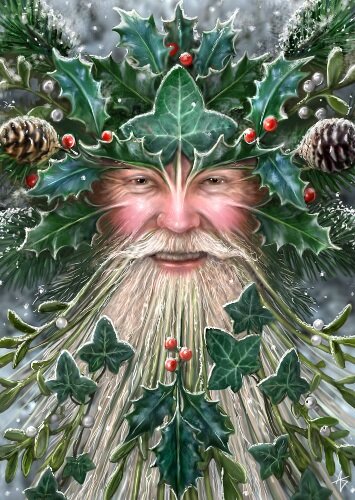
All societies mark the solstice in some way, but it was of particular significance in the north of Europe where the days grow shorter than anywhere else. So it was that in the last days of the pagan Roman Empire, when the Roman Army had filled its ranks with Germanic recruits, that Yule was marked with a special dedication as the “Dies Natalis Sol Invicta” – the “Day of the Birth of the Invincible Sun.” It was then very easy, when the Empire became Christian under Constantine, to rededicate the day to the birth of a very different Invincible Son; so Yule – the 25th December in the Roman calendar – became Christmas, the actual birthday of Christ being unknown. Despite its Christianization, almost all of the trappings and customs of Christmas remain pagan, often rather obviously so. Take the practice of bringing greenery into the house as a symbol of life continuing through the darkest days; holly and ivy are still not permitted in churches because of their pagan associations and the famous carol (despite the attempt to Christianize it by pretending that Christ’s crown of thorns was a crown of holly) has only slowly and reluctantly been accepted as suitable for singing in church. Another evergreen plant always associated with Christmas is mistletoe, but its association has a dark past for it was with a spear of mistletoe that the fair god of the waxing year (from Yule to Midsummer) is slain by his dark twin, the god of the waning year. Anyone who knows what a mistletoe bush looks like might wonder how it was possible to make a spear out of it, but gods move in a different reality from we mere mortals!
The centrepiece of the great fires which were lit to welcome and strengthen the returning sun was the Yule Log, not a chocolate swiss roll but a huge block of wood, or even an entire tree trunk. The Yule fires had their own spirit so when the log had largely burned away, the last unburned fragment in which the Yule spirit had taken refuge, was carefully put away until next year and used to kindle the new Yule Log and release the spirit to do his work of bringing light and warmth to the dark days.
An animal closely associated with Yule is the pig. Until turkey began to appear on British tables in the nineteenth century, the usual Christmas dish was pork, and many families (my own included) still have a pork or gammon dinner at some time during the twelve days. This tradition is very ancient – a few years ago a bronze age feasting place was excavated near Stonehenge and a great many animal bones were found, overwhelmingly from pigs; thanks to the wonders of science it was possible to show that these pigs had all been slaughtered in mid-winter. So, for centuries our ancestors celebrated Yule at Stonehenge and while there they ate pork. This would have had a ritual significance; the pig was a sacred animal in prehistoric Britain and its flesh was taboo except once a year when the people entered into communion with the god by eating it. This is universally true of all religions which preserve a taboo on certain animals, it is because they were once sacred and were once sacrificed and eaten on one day in the year.
As patriots we have a particular interest in the beliefs and practices of our ancestors and at this time of year in particular we take heart, as they did, from the knowledge that light follows darkness as it always has and always will.
By Frederick Dixon © 2013
# # # #
Gramme
- Edit
I feel like being disagreeable this evening of the day before the eve of the solstice so please do not be too annoyed. Firstly there is no particular proof that the Christians hijacked the Christmas ceremony or Yule or whatever pagans want to call it.
I mean there are not that many ancient written sources and the only mention of Yule in England is by the Venerable Bede, and he only classified it as a month and nothing else. Of course, one of the glorious things about ancient customs is that they can reinvented and then become indisputably really ancient in the public estimation after a short period. (I was once told a story in this respect about folk dancing in another country).
Maybe Nationalists can reinvent St. Johns eve for the shortest night of the year. Now that would be a holiday worth celebrating.
The ancients had lots of feasts around the year cycle and possibly one was celebrated in or around the darkest night. But then they did not have that much to eat nor feed for the animals, so the swine were slaughtered when the fodder ran out,
it is repeated ‘ad infinitem’, that the Christians stole Christmas but it is much more likely that the Christians boosted a very minor feast into a whole holiday. we do not know much about ancient Christmas traditions in England save those still going on in up to recent times.
As for the Yule log, the understanding is that this ceremony, within the twelve days of Christmas, was imported from Germany in the middle Ages, it is not specifically English as far as one knows.
But one thing it would be nice to see is Father Christmas back in his Green robes. Green the colour of virility and manhood. Not the modern ‘Coca- Cola’ Santa in his whoreish red garb. Anyway, a merry Christmas to all at Western spring and season’s greetings to all Nationalists of goodwill.
May your Santa always wear green.
Thomas a'Becket
- Edit
Here is Bede at his desk Gramme https://www.youtube.com/watch?v=XttCCQXZI20
However if you would like to learn more about early English yourself try reading the Runes https://www.tha-engliscan-gesithas.org.uk/education/old-english-runes-2
Steve
- Edit
Bah humbug eh?
To me it makes sense that when Christianity came here it was superimposed on an existing festival which may not have been observed by all.
I feel certain that the winter solstice would be observed as important in a farming community.
I think a lot of traditions probably are born out of practical behaviour as you mention but then the roots of that get a bit lost.
Our present Christmas is a bit of a mish mash of different things some imported including a coked up Santa who is about 100 years old now.
Russian Santa can be blue with gold stars but some of their stuff comes from the Stalinist era.
I guess a green Santa comes from the Green Man concept rather than one who has over indulged!
frederickdixon
- Edit
I am sorry that my little essay so displeased you, but to try to deal with one or two of your points:-
1/ Bede does indeed refer in his “De Temporum Ratione” to Yule (I’ll use the modern spelling) as a month, or rather two months – Ere Yule and After Yule, December and January respectively. It is in the records of our pagan Scandinavian kinsmen that we find out what these months were “before” and “after”, namely a period of twelve days called “jol” (Yule).
2/ You cast a great deal of doubt, unsubstantiated, on the antiquity and significance of Yule. This is Frazer’s “Golden Bough” on the subject:- “if the heathen of ancient Europe celebrated, as we have good reason to believe, the season of Midsummer with a great festival of fire, of which the traces have survived in many places down to the present time, it is natural to suppose that they should have observed with similar rites the corresponding season of Midwinter, for Midsummer and Midwinter…..are the two great turning points in the sun’s course through the sky, and from the standpoint of primitive man nothing might seem more appropriate than to kindle fires on earth at the two moments when the fire and heat of the (sun) begin to wax or to wane”.
3/ The Yule log ceremony, you tell us, was imported from Germany in the Middle Ages. Here is Frazer again ” in modern Christendom the ancient fire festival of the winter solstice appears to survive, or to have survived down to recent times in the old custom of the Yule log, clog or block as it was variously called in England. The custom was widespread in Europe, but seems to have flourished especially in England, France and among the South Slavs”. So much for Germany.
4/ You say that it is “repeated ad infinitum that the Christians stole Christmas”. I have made no such assertion nor have I repeated it “ad infinitum”. I have made the point that the Christians (of whom I am one) very sensibly adapted – not “stole” – an existing custom so very popular that it could not have been eradicated.
I could try everyone’s patience by going on for several more paragraphs, but I think it’s enough to end by saying that while criticism is acceptable, it would be best if it were based on knowledge.
Thomas a'Becket
- Edit
I believe Winter Solstice was known as ‘Hweoler-tid’ and the sacred boar feasted upon was called ‘Sachimner’.
frederickdixon
- Edit
Interesting words which I hadn’t previously heard, but the second element in “hweoler-tid” is clearly the modern “tide”, so “hweol” might be another spelling of Bede’s “Geol” – yule. So under that strange spelling we get “yule-tide”!
jackdaw
- Edit
Seasons greetings to all my people who follow the old religions. Hope this solstice finds you in good health and good spirits.
My glass is raised to your health . . . Cheers
Thomas a'Becket
- Edit
Wes ðū hāl (Hail / Be Well) Jackdaw.
Michael Woodbridge
- Edit
To assert that Christianity didn’t “steal” Yule from the pagans is to suppose that the pagans didn’t have any previous traditions worth stealing. Are we to suppose that for thousands of years the pagan folk of these islands didn’t honour the significance of the seasons? On the contrary, is it not much more likely that by living closer to nature, as they did, the forces of nature would have a much stronger impact on their sense of reverence. Today, many of us have allowed our senses to become dulled through our unnatural cosseted way of life. For many, Christmas has become primarily a money making racket whereby our folk are driven into a spending frenzy.before collapsing exhausted in front of “goggle-box” whereupon they’re urged to spend more money.in the January sales.
Steve
- Edit
Sadly so!
Steve
- Edit
It’s good to be reminded of the origins of Christmas especially for those who may not have thought deeply about this part of their culture.
In Japan many years ago a store thought it would be a good idea to have a Western style Christmas theme but it went horribly wrong featuring a Father Christmas crucified on a large cross!
Weard
- Edit
It’s about time people stopped looking to a jewish religion* to save our people.
It’s great to know others feel the same.
*nothing against Jews – their middle-eastern religion has naff all to do with us, is all.
Steve
- Edit
True but the problem is that they feel we owe them something, the demands will never stop until we’re gone.