Brace yourself because THIS IS SPARTA! Again.
The first 300 movie ranks among my favourite films of all time, less due to its cartoonish stylised gore offering as its wonderfully unapologetic masculine heroism.
When I walked into the cinema this week to watch this follow-up I really didn’t know what to expect as I’d read nothing at all about it before hand. My assumption was that it would be a sequel but the story began with a telling of the early life of Xerxes and how he transformed from a man to a ‘god-king’ and I realised that it was in fact going to be a prequel.
Further into the story the full nature of the production became apparent – it is actually a parallel story to that of the heroic stand of 300 Spartans telling the part played by the Athenians, specifically their naval forces, before, during and after the battle of Thermopylae.
The Athenians are led by Themistocles, a character not so well (or favourably) remembered in history as King Leonidas but who played no lesser part in the salvation of Europa from the multi-racial hordes of the Persian Empire.
The Themistocles character remains little developed and pales in significance when compared to Gerard Butler’s portrayal of King Leonidas – this was disappointing. A far more imperfect man, he is not shown to live up to the heroic ideal one might have hoped to see but perhaps we could argue that this is a rather more realistic. I can, however, get all the realism I need in my local high street so I make no apologies for demanding inspiration and idealism in my movie characters.
It is undoubtedly action packed so fans of the first film will not be disappointed by a lack of characteristic slow-motion, close-up lopping of Persian limbs and splatters of blood, especially if, as I did, you watch it in 3D!
There are moments in this film where you get a sense of awe and joy, especially toward the end when the various city states come together to finish the job at the battle of Plataea – Spartans and Athenians and brother Greeks united as one. May such unity be forged once again in our own time!
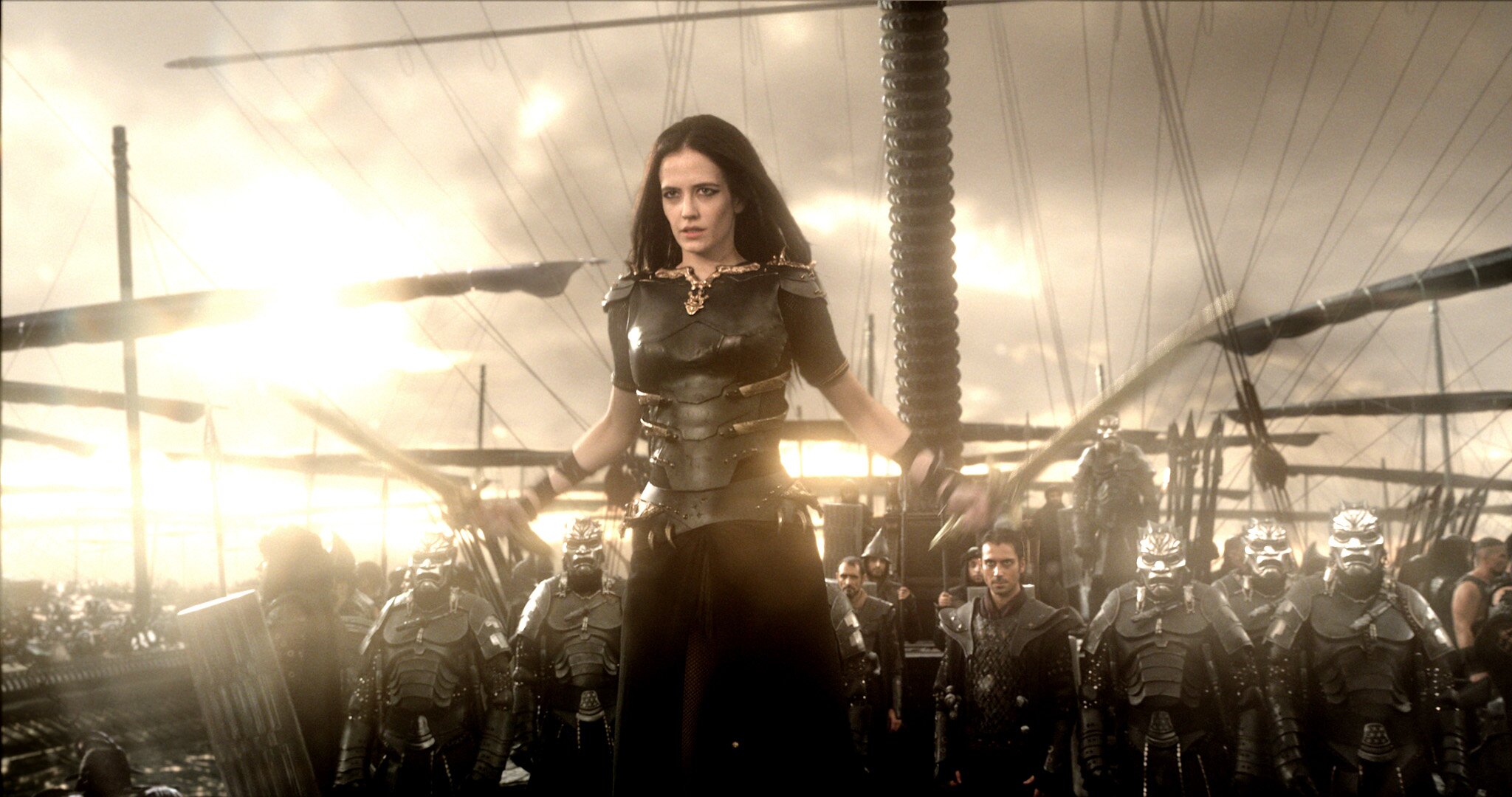
The body of the story is taken up by naval warfare around the battle of Salamis in 480 BC. Themistocles’ nemesis is Xerxes’ naval commander Artemisia, a Greek woman who sided with the Persians in this war and is portrayed in the film as being akin to an adopted sister to Xerxes.
Her character was played very well by the actress, who incidentally is rather attractive, but I found it grating to be presented with another movie where a small girly character is able to wield a heavy sword more ably than almost all the men she fights. Sadly the 300 franchise has succumbed to liberal notions of gender inter-changeability.
The Greek’s rally cry throughout seemed to be “freedom!”, a word that to me sadly now only reminds me of George W. Bush’s calls for a ‘war on terror’, and could give rise to the more suspicious among our nationalist ranks to wondering if the creation of this Hollywood production could have a motive above that of other cinema. I can happily report, however, that the lasting refrain of the Greeks was a freedom to be Greek and remain Greek by doing their duty to each other.
A particularly encouraging moment unravels as Artemisia tries to win over Themistocles to the Persian side with an offer of “freedom… without responsibility”. This offer was pleasingly rejected out of hand during a steamy and rather unexpected sex scene that re-establishes, in some style, the roles of men and women in a traditional society.
This film is very watchable and inspiring even if it falls short of its predecessor but its cartoonish stylisation will turn some people off. For many who, like me, are avid fans of the original there will be no doubt about going to see this film. To those readers I say – 2D is for slavish Persians so be a true Greek, pull on your 3D glasses and enjoy!
frederickdixon
- Edit
Looking forward to seeing this film. Although, as far as I know, it is little visited by tourists, Sparta is well worth a visit. It’s set in stunning scenery in a broad, fertile, valley full of orchards and vineyards but with the frowning black cliffs of the Taygetus range not far off to the west. Those who have seen the “300” film will remember the encounter of the young Leonidas with a wolf in those mountains. The town itself is pleasant and modern with low white buildings set along tree lined roads while, at the ancient centre of Sparta, odd chunks of antique masonry rise out of a grove of ancient olives. Luckily, for a visitor, there is nothing too Spartan about the experience!
PharmaPhil
- Edit
There have been criticisms of the depicted history in this film but I guess it’s just meant to be entertainment.
Ingvar Briggya
- Edit
+I think that anyone who likes european history,and enjoyed the first 300 movie should read that:
https://cienciologia.wordpress.com/category/esparta-y-su-ley/
+This is the best booklet I have ever read,and it is about Spartan History.