By Max Musson:
I have always found it ironic that journalists often end up as specialist feature writers for subjects that they have no real knowledge of or qualifications in, and I was reminded of this again this morning when I saw popular science articles on most of the newspaper websites today quoting Dr David Carrier of the University of Utah, who has done much research into vertebrate physical adaption for either fight or flight.
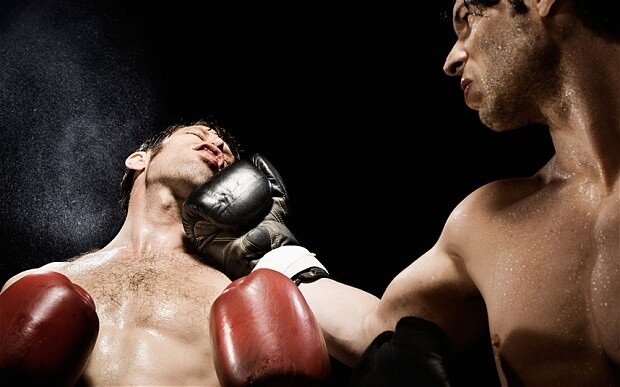
In these articles the various ‘science correspondents’ refer to a recent study by Dr Carrier published in the journal ‘Biological Reviews’ and reproduce extracts claiming that Dr Carrier’s research indicates that modern humans are by comparison with our more ape like ancestors, specifically adapted for fighting. Furthermore, as if to underline this the Telegraph publishes a photograph if two boxers and Fiona Macrae, science correspondent of the Mail, publishes a photograph of a ‘modern human skull’, presumably to illustrate the adaptions.
The Guardian goes further and publishes two photographs to illustrate the story, one contrasting a Homo erectus skull with a modern human skull, and the second purporting to show an evolutionary line from what appears to be a chimpanzee skull, to the skull of Australopithecus afarensis, then Australopithecus boisei, Homo erectus and finally a modern human skull. The fact that the first three skulls are from creatures that were not ancestral to modern humans, appears not to have occurred to the journalist concerned, although this misleading graphic is labelled as “an artist’s impression of how human faces may have evolved”.
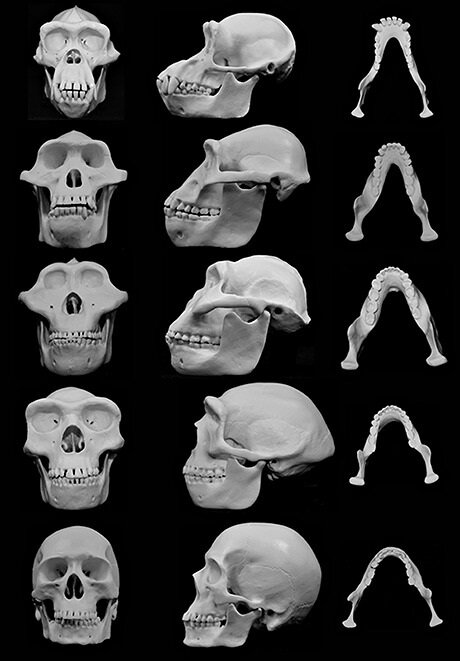
What also seems to have eluded the Telegraph is that the progression represented in this graphic does not actually show the skulls concern becoming more robust as an adaption to fighting, but the opposite, with the first four skulls showing considerable adaption to withstand physical punishment, while the modern human skull is the most gracile and delicate of the five specimens featured.
In stark contradiction of this graphic, the Telegraph website states: “Millions of years of fist fights have altered the human face to leave men’s jaws more robust than women’s, … Evidence suggests it evolved to minimise damage from bruising altercations after ancient ancestors learned how to throw a punch”.
The Telegraph then goes on to quote Dr Carrier directly: “The australopiths were characterised by a suite of traits that may have improved fighting ability, including hand proportions that allow formation of a fist; effectively turning the delicate musculoskeletal system of the hand into a club effective for striking.
“If indeed the evolution of our hand proportions were associated with selection for fighting behaviour you might expect the primary target, the face, to have undergone evolution to better protect it from injury when punched.
“When modern humans fight hand-to-hand, the face is usually the primary target …
“What we found was that the bones that suffer the highest rates of fracture in fights are the same parts of the skull that exhibited the greatest increase in robusticity during the evolution of basal hominins.”
The key words to focus on in the above quotation, I have heighted in bold and these indicate that Dr Carrier is not talking about recent human evolution at all, but the evolution of australopithecines from our more remote pre-human ancestors. Those more remote ancestors such as Proconsul africanus were similar in form to modern day gibbons and therefore in comparison with chimpanzees and later australopithecines such as Australopithecus afarensis and Australopithecus boisei, the latter of which was in terms of skull shape very similar to a gorilla, there is indeed evidence of adaption to resist damage from blows to the head.
From the Middle to Upper Palaeolithic, our human ancestors went through the evolutionary stages of Homo erectus and Homo heidelbergensis to Homo sapiens and finally modern man and throughout most of this period of pre-history our ancestors lived very dangerous, brutal and physically demanding lives and therefore retained the adaptions needed to withstand blows about the head; the large brow ridges, the robust cheek bones, heavy jaws and receding chins, but as the Upper Palaeolithic drew to a close, life became less brutal and anatomically modern humans emerged with a far greater dependency on tools making the earlier physical adaptions redundant. Thus modern humans by comparison with our middle to Upper Palaeolithic ancestors have smaller brow ridges, less robust facial features, and lighter jaws with more prominent chins – exactly the opposite of the conclusions drawn by the newspaper journalists.
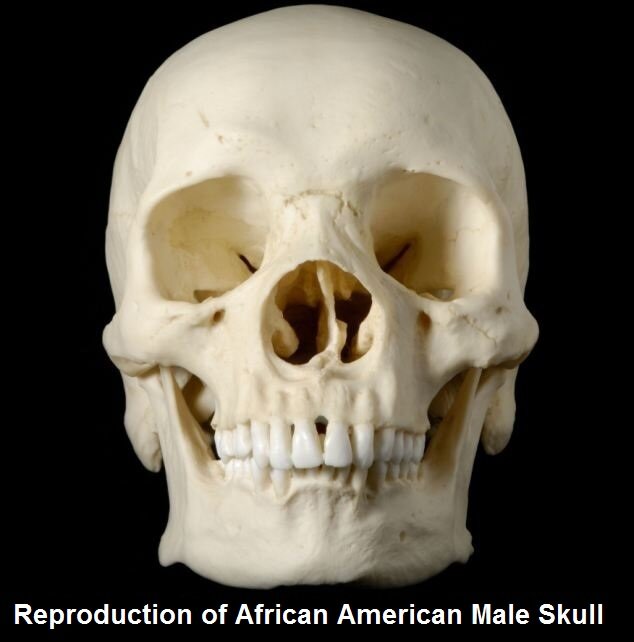
Therefore photographs of boxers fighting do not accurately illustrate what Dr Carrier was describing and neither do the photographs of modern human skulls like the one featured on the Mail website. Amusingly the photograph shown on the Mail website, which presumably is intended to show a modern skull adapted for a brutal life of violence, is in fact a photograph of an anatomically realistic reproduction of the skull of an African American male produced by a firm called Bone Clones. You have to laugh at the irony of this!
By Max Musson © 2014
# # # #
Walter Greenway
- Edit
Cows have strong jaws because they eat a lot of grass and chew the cud! I have never seen one swinging through a tree like an ape though.
PharmaPhil
- Edit
We can think of a few people who deserve a good punch in the face!
Max Musson
- Edit
Can’t we all! 😀
PharmaPhil
- Edit
The desk jockeys & auto reading cuties on the news sometimes say some jaw dropping stuff without losing their poker faces.
I remember once going “WTF” to a news item about how they were going to vaccinate kids against becoming drug addicts, all a bit “Minority Report” or “pre crime”.
For a start it doesn’t exist & surely such a thing would be given to existing drug addicts first to stop them relapsing.
But the idea of giving a kid a vaccine because they might become a drug addict one day?
I understand that African drug Ibogaine can be used to treat addicts but I think it’s pretty unpleasant.