By Max Musson:
In the local and European elections later this month, it is estimated that nationalist and patriotic parties will field a total of 2,570 candidates; 289 in the European elections; and 2,281 in local elections. In many of these elections, these candidates are standing unopposed by any other nationalist or patriotic candidates, but all too often, particularly in the European elections and also in local elections in wards that have traditionally produced much support for nationalist candidates, there are nationalist and patriotic candidates standing in opposition to each other, thereby making it inevitable that the nationalist and patriotic vote will be split, minimising the possibility of electoral success.
Furthermore, this deplorable situation is made all the more tragic when one considers that to all intents and purposes, their policy schedules and offering to the public are almost identical in every case.
Because of their high media profile and their, albeit ostensibly reluctant support by the media, UKIP are in a stronger position to win seats than any of the other nationalist or patriotic parties, and they undoubtedly will do well later this month, clocking up a record number of victories and annihilating their nationalist and patriotic competitors.
Other than UKIP, I don not expect that any other nationalist or patriotic candidates will get elected and most notably, while Andrew Brons is not competing for re-election this year, I expect that Nick Griffin will fail to scale the minimum threshold necessary to retain his European Parliamentary seat.
So what are we to make of all this?
Firstly, while UKIP is not a nationalist party, but a populist reactionary conservative party with a clearly multi-racial, albeit non-PC ideological position, the electoral success they are almost certain too enjoy should be a source of comfort to most nationalists. The reason for this is that while the party leadership position is as I have described, many of the party’s members and candidates are in fact very nationalistic in their beliefs. Furthermore, UKIPs electoral success prizes voters away from the mainstream establishment parties and in so doing, radicalises voter thinking to some extent, making it more likely that they will support a genuine nationalist party at some future date.
Truth be told, regardless of how we might feel personally about UKIP, its members as a whole, or Nigel Farage as an individual, we can’t do much about their popularity in the polls at present and so we might as well seek to benefit from the positives that can be found and this leads us to question why the other nationalist and patriotic parties are even bothering to field candidates against UKIP, especially in the European elections?
We can’t do anything to affect the eclipse of other nationalist and patriotic parties by UKIP, because we lack the wherewithal to compete with them at the same level on the national stage. We lack the Six Prerequisites.
However, if we were to cease giving in to the manic compulsion to stand candidates in the forlorn hope of getting elected, and looked at our opportunities from a different perspective, we would see that there is much to be gained by adopting a different strategy.
If we were to form a broadly patriotic front from all the nationalist and patriotic parties taking part in these elections, we could for one thing save the costs involved in taking part and apply the money saved to some project of lasting value.
Of the candidate totals quoted above, the non-UKIP candidates total 218 standing in European elections and 452 standing in local elections.
From my time in the BNP I know that it costs around £5,000 per candidate to stand in the European elections and around £250 per candidate in local elections. Therefore the cost of fielding those candidates in terms of capital outlay alone, ((218 x £5,000)+(452 x £250)) equates to just over £1.2 million.
Let us now consider the hours that were spent by the various candidates and their campaign teams, leafleting and canvassing and taking part in other fund raising and promotional activities:
To leaflet an average local election ward once, takes approximately 60 man-hours. Therefore, even if all of those local wards were only leafleted once, and that each candidate and a campaign team of just four people spent just ten hours each ward canvassing, that means a total of (452 x (60+40)) or 45,200 man-hours were wasted, and based upon the national minimum wage of £6.31, this means that in the time wasted, the individuals concerned could have earned themselves an additional £285,212, or £427,818 at time and a half for overtime.
The true cost of all this wasted effort is therefore approximately £1.6 million, and immediately we begin to think what else could have been purchased with that money, we begin to realise the folly of nationalism’s hitherto obsession with futile electioneering.
That amount of money could have bought an entire village in some parts of the north of England where starter homes still sell for as little as £25,000, and instantly the nationalist movement could have had the makings of a show-piece White nationalist community with which to inspire our people. Alternatively, we could have bought every third house in three such villages and established three White enclaves.
With £1.6 million we could have bought several hundred acres of farmland, or we could have commissioned the building of a substantial training and administrative centre for the nationalist movement, or equipped a state of the art media centre.
If the leaders of all the nationalist micro-parties, whose policy schedules are to all intents and purposes fundamentally identical, were able to bring their parties together and started to place the interests of nationalism ahead of their own ambitions and their own personal vanity, we could within a decade have a movement capable of mounting a serious challenge to the current corrupt regime.
Instead, it is as though we dug a large pit, filled it with money and burned it. And we wonder why nationalism has struggled all these years?
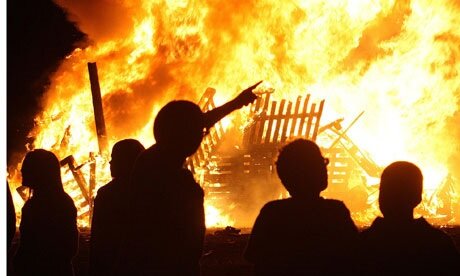
The bonfire of the vanities, indeed!
By Max Musson © 2014
# # # #
Shaun
- Edit
I totally agree! As it stands, without a foundation to fight from, the very concept of wasting our time fighting the mainstream political parties in (probably rigged) elections is insane! It is a total, total, total waste of money — you are not, unless you have enough resources, going to get anywhere near victory.
We are, however, still 80% of the population; so we still have time to turn it around. Even if it gets really bad, we still have the collective intelligence to create our own enclaves and go from there. Wasting millions of pounds on pointless — at this stage — endeavour’s like elections should be avoided at all costs!
Brin of the family Jenkins
- Edit
I agree totally, voting is a waste of effort, because as Stalin said what is important is who counts the votes.
So we come back to the question, what shall we do?
Max Musson
- Edit
What shall we do? … Find out by reading here: https://www.westernspring.co.uk/essential-truths/
PharmaPhil
- Edit
“It’s not the man who votes that counts,
It’s the man who counts the votes, that counts.”
“The death of one man is a tragedy, the death of millions, a mere statistic.”
“Quantity has a quality all of it’s own.”
“A journey of a thousand miles begins with one step.”
Valhalla Valkyrie
- Edit
“From my time in the BNP I know that it costs around £5,000 per candidate to stand in the European elections and around £250 per candidate in local elections. Therefore the cost of fielding those candidates in terms of capital outlay alone, ((218 x £5,000)+(452 x £250)) equates to just over £1.2 million.”
I would dispute the figure of 218. The £5000 fee is for each region irrelevant of whether they are standing 1 or 7. If I am not mistaken it would be (12 x £5000) which is £60,000 and not £1,090,000. On the other hand I would point out that it is £500 for each general election seat (452 x £500 = £226,000). Even so that makes the figure about a quarter of £1.2million at £286,000.
Most importantly it must be stated that those costs are deposits. For general election seats if a party receive 5% or more they have their deposit returned. For the Euros the figure can be in fact lower than 5% depending on the region. Nationalist parties have and evidently can achieve more than 5% (whatever tricks the establishment plays). So if through these elections enough votes are received to get deposits back on, for example, 50% of seats then the cost would be £143,000 and that’s considering those elections are over a 4-5 year cycle. Over a four year period such an example works out at £35,625 a year. That is less than 2x the median yearly salary including NI and income tax.
The latter costs about activists’ time assumes that the time spend by activists could be spent making income from working. Activists are already working 7-8 hours a day not including communing and getting ready. Through all that I doubt people want to do even more work (even if they had the opportunity to do it). That leaves a few hours in the evenings and two days on the weekend to potentially do something that would otherwise be spent on personal recreation. When a party runs for a MEP or MP seat then for free they are allowed to have one of their leaflets sent to every house in the election area so you are getting distribution done even if you do lose the deposit.
I will concede that you used the hourly minimum wage which would make the true estimation given by you in the scenario as an under estimate and the cost of producing material has not been taken into account.
“That amount of money could have bought an entire village in some parts of the north of England where starter homes still sell for as little as £25,000, and instantly the nationalist movement could have had the makings of a show-piece White nationalist community with which to inspire our people. Alternatively, we could have bought every third house in three such villages and established three White enclaves.”
That is the selling point and should be where finances are focused. Soil & Brick.
Max Musson
- Edit
Hi V.V., My recollection is that in order to fund the printing more than a million pieces of literature for the East Midlands electorate of 3.45 million in 2010, the BNP’s East Midlands Region alone needed to raise over £25,000. That’s a region with a candidate list of five candidates per party.
.
Perhaps Geoff Dickens will let me know if I’m wrong on this.
frederickdixon
- Edit
“ostensibly reluctant support by the media” Well, reluctant or not, UKIP are certainly not getting media support now! Exactly as happened with the BNP five years ago the media has opened the sewer and squirted it all over UKIP. With what results, we shall soon see.
Max Musson
- Edit
Yes, the recent new twist bringing about much more negative media exposure is interesting, and as you say, we can only watch and wait to see what the effect will be.
.
I have predicted all along however, that as far as media coverage is concerned, the ‘switch’ will be flicked to negative the moment the establishment suspect that UKIP can no longer be trusted. Perhaps that point has been reached.
Steven
- Edit
I think far more damaging to UKIP will be when the powers-that-be in the mostly Tory media decide this party is harming Tory election chances next year and instead of giving them bad publicity give them NO publicity. That will happen after the Newark By-Election I suspect. The Tory press won’t want UKIP disturbing the run-up to the next general election which is now just a year away.
AAA
- Edit
Splendid article, Max. I especially liked your (however accurate) analysis of how much financial and social capital is expended in the pantomime of electioneering and how this money would be better spent elsewhere. I’d like to see a further article from you which specifically addresses in more detail how finances might be better directed to initiatives, perhaps outlining the pros and cons of such suggestions and analysing their validity.
.
Taken from an in-depth analysis of UKIP and the EU in the wider nationalist narrative, I offer the final paragraph:
.
“The populist wave that will deliver UKIP success in the upcoming elections is not of our making, and we are in no real position to influence it. But the populist wave will alter the political landscape in ways that will be favorable to our cause. In the meantime, while UKIP is ascendant there is no room for a nationalist party. Instead of bemoaning this fact, nationalists should count it as a blessing and take this opportunity to refocus our attention away from party politics to metapolitics. The publishing of cultural magazines such as Mjolnir[29] and efforts to form intentional nationalist communities are steps in the right direction.[30] Through activism like this, the Overton window can be reframed in our direction and one day make nationalist politics possible.”
.
‘UKIP: The Evolution of Closet Racism’ by Simon Lote: https://www.counter-currents.com/2014/05/ukip-the-evolution-of-closet-racism/