By Max Musson:
A frequent refrain heard whenever nationalists meet to talk these days is that, “what we need is a leader, a great leader like … “, and with that the people gathered reminisce about the great leaders of old, attributing to them wonderful qualities that are believed to be absent in all current prospective leaders.
With each conversation of this kind we dismiss the people around us and further convince ourselves that no significant advance for our cause can be achieved until a leader complete with all of the desirable qualities discussed, emerges from their mystical hiding place, a knight in shining armour to lead us to salvation.
When I hear such conversations, I am reminded of a story told long ago by American author Russell H. Conwell, which I have reproduced below, slightly adapted and abridged:
# # # #
Acres of Diamonds
While travelling down the Tigris and Euphrates rivers many years ago with a party of English travellers I found myself under the direction of an old Arab guide we had hired in Bagdad.
The Arab thought that it was not only his duty to guide us down those rivers, and do what he was paid for doing, but also to entertain us with stories curious and weird, ancient and modern, strange and familiar. Many of them I have forgotten, and I am glad I have, but there is one I shall never forget.
The old guide told me that there once lived not far from the River Indus an ancient Persian by the name of Ali Hafed. He said that Ali Hafed owned a very large farm, that he had orchards, grain-fields, and gardens; that he had money at interest, and was a wealthy and contented man. He was contented because he was wealthy, and wealthy because he was contented.
One day there visited that old Persian farmer one of these ancient Buddhist priests, one of the wise men of the East. He sat down by the fire and told the old farmer how this world of ours was made.
He said that this world was once a mere bank of fog, and that the Almighty thrust His finger into this bank of fog, and began slowly to move His finger around, increasing the speed until at last He whirled this bank of fog into a solid ball of fire. Then it went rolling through the universe, burning its way through other banks of fog, until the moisture, falling as rain upon its hot surface, cooled the outer crust.
Then the internal fires bursting outward through the crust threw up the mountains and hills, the valleys, the plains and the prairies of this wonderful world of ours.
If this internal molten mass came bursting out and cooled very quickly it became granite; less quickly it became copper, less quickly silver, less quickly gold, and, after gold, diamonds were made.
Said the old priest, “A diamond is a congealed drop of sunlight.”
The old priest told Ali Hafed that if he had one diamond the size of his thumb he could purchase the county, and if he had a mine of diamonds he could buy a kingdom and place his children upon throne through the influence of their great wealth.
Ali Hafed heard all about diamonds, how much they were worth, and went to his bed that night a poor man.
He had not lost anything, but he was poor because he was discontented, and discontented because he feared he was poor. He said, “I want a mine of diamonds,” and he lay awake all night.
Early in the morning he sought out the priest and asked him: “Will you tell me where I can find diamonds?”
“Diamonds! What do you want with diamonds?” asked the priest.
“Why, I wish to be immensely rich.”
“Well, then, go along and find them. That is all you have to do; go and find them, and then you have them.”
“But I don’t know where to go.”
“Well, if you will find a river that runs through white sands, between high mountains, in those white sands you will always find diamonds.”
“I will go”, said Ali Hafed.
So he sold his farm, collected his money, left his family in charge of a neighbour, and away he went in search of diamonds.
He began his search, very properly to my mind, at the Mountains of the Moon. Afterward he came around into Palestine, then wandered on into Europe, and at last when his money was all spent and he was in rags, wretchedness, and poverty, he stood on the shore of that bay at Barcelona, in Spain, when a great tidal wave came rolling in between the pillars of Hercules, and the poor, afflicted, suffering, dying man could not resist the awful temptation to cast himself into that incoming tide, and he sank beneath its foaming crest, never to rise in this life again.
When that old guide had told me that awfully sad story he stopped the camel I was riding on and went back to fix the baggage that was coming off another camel.
As he did so, I remember saying to myself, “Why did he reserve that story for his ‘particular friends’?” There seemed to be no beginning, no middle, no end, nothing to it.
That was the only story I had ever heard told in my entire life in which the hero was killed in the first chapter.
When the guide came back and took up the halter of my camel, he went right ahead with the story, into the second chapter, just as though there had been no break.
The man who purchased Ali Hafed’s farm one day led his camel into the garden to drink, and as that camel put its nose into the shallow water of that garden brook, Ali Hafed’s successor noticed a curious flash of light from the white sands of the stream. He reached in and pulled out a black pebble having a curious reflective property. He took the pebble into the house and put it on the mantel, which covers the central fires, and forgot all about it.
A few days later this same old priest came in to visit Ali Hafed’s successor, and the moment he entered the drawing-room he saw the pebble on the mantel, and he rushed up to it, and shouted: “Here is a diamond! Has Ali Hafed returned?”
“Oh no, Ali Hafed has not returned”, said the new owner, “and that is not a diamond, that is nothing but a stone I found right out there in my own garden.”
“But,” said the priest, “I tell you I know a diamond when I see it. I know positively that is a diamond.”
Then together they rushed out into that old garden and stirred up the white sands with their fingers, and lo! there came up other more beautiful and valuable gems than the first.
“Thus,” the guide told me, “was discovered the diamond-mine of Golconda, the most magnificent diamond-mine in all the history of mankind, excelling the Kimberly itself. The Kohinoor, and the Orloff of the crown jewels of England and Russia, the largest on earth, came from that mine.”
When that old Arab guide told me the second chapter of his story, he then took off his Turkish cap and swung it around in the air again to get my attention to the moral. Those Arab guides always have morals to their stories.
# # # #
And what is the moral of this storey for us nationalists?
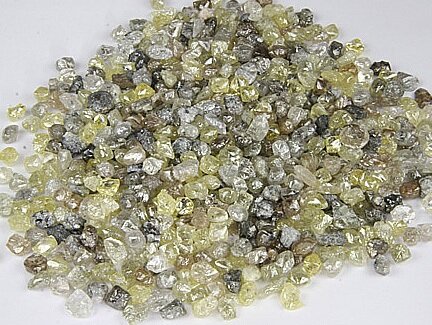
The moral is that in our yearning for that which we regard as an ideal; the answer to our prayers, we all too often have in our minds eye a vision of the finished article, the polished diamond, and we overlook completely the riches in uncut, unpolished diamonds that already lie at our feet.
There is an old proverb that, “A prophet is never hallowed in his own land”, because when we look upon someone of great ability with whom we are already very familiar, our view of them is often coloured by our intimate knowledge of their human imperfections.
When we compare such people with the great leaders of old, the past leaders are invariably seen through rose coloured spectacles, which obscure their human imperfections, and through sanitised accounts of their achievements, embellished through skilful story telling and our natural tendency to recall with nostalgia the ‘good old days’. Inevitably therefore, our comparison is not a fair one and we do ourselves, our colleagues and our cause a great disservice when we overlook the potential of those around us.
We are a great people and we stand with ‘acres of uncut, unpolished diamonds’ at our feet.
It is for this reason that we at Western Spring have made a conscious decision to gather together people young and old who have shown leadership potential and why we have a policy of mentoring each other and guiding each other through a personal development process, so that we benefit to the maximum from the leadership abilities of everyone involved and so that we maximise the potential for the next great leader to emerge from within our ranks.
So, don’t ‘scan the horizons’, wistfully longing for first sight of some distant saviour, but look instead at the man or woman standing beside you and think, “with a little help from me, could he/she become the great leader of the future?”
By Max Musson © 2013
# # # #
Richard Barker
- Edit
A true, honest and timely post.
BritishActivism
- Edit
Is there a need for a ‘strong leader figure’ anyway?
.
The article here (quite rightly in my view) starts off kind of chastising the idea of waiting for and expecting this ‘leader’ figure to emerge which will be the white knight on a horse that can save the day, yet somewhat paradoxically near the end, it seems to suggest that such a leader may be found right at the side of us if we only recognised what we had.
.
Perhaps I can only speak for myself, but I think it is perhaps more prudent to first try and become better leaders of our own lives (if we are not so already) and uphold living a nationalist life as much as is possible in our everyday life and actions, so we can each ‘lead’ by example.
.
Until we can lead our own lives and be worthy of inspiring respect and integrity, I do not see how we can hope for others to follow us as individuals or as a movement.
.
Are we relatively fit and healthy? Are we able to cease binge-drinking, smoking, even taking drugs in some cases, to lead a more ‘wholesome’ life? Are we mindful of how we shop, what we buy, where we do business, what kinds of charities we give to or refuse to give to? What values do we hold, and how can they be upheld and respected in wider circles?
.
Nobody can be perfect all the time, but I think we have to try and strive for excellence within ourselves and try and be a good representation and manifestation of what we intend to be in the future. A leader cannot do this kind of thing for us, we have to try and step up for ourselves.
.
I may well be talking nonsense, but if nationalists and nationalism became a more attractive and admired representation in society, I think it would make the job of inspiring others to join us a little bit easier compared to some of the antics and situations in which the movement has previously been dogged with (and the kinds of image that is often attributed to us by the media, however unfair they are being).
.
I think the words we use, the way we present ourselves, our actions and image are important. People need to look up to us, not see us as outcasts or people being ‘left behind’ in a rapidly changing country. We have to be desirable and offer a future that is more desirable than the one currently rolling out against us. It should not be hard considering the state of affairs, but we still do not seem to exude that air about us.
.
That is something we can all be responsible for building, and it is only ourselves who can be responsible for doing it, not through a leader figure.
.
I am not really sure where a leader would fit in Western Springs methodology, so perhaps somebody can expand on that for me, as I know it is not a party and I believe it does not plan on using politics for quite some time.
.
In the past, people in parties have longed for “strong leaders” and a kind of Oswald Mosley, a Hitler, a Mussolini type to rise up, somebody of that kind of stature to awe and inspire millions to a victory. But I think people of such ‘calibre’ are few and far between. We could be waiting forever.
.
I think the chances of finding one are extremely slim, especially in the kind of society we have now become. I also have doubts about ‘leaders’ anyway, in terms of them being a head which can be cut off.
.
When one man, or even woman, becomes the sole embodiment of a movement, it seems to me to be much easier to attack – and if the head of the organisation is decapitated somehow, or fails in their task, the movement easily disintegrates.
.
We have even seen this to a lesser degree with Nick Griffin – who made himself the face and sole embodiment of the BNP. It seems that movements like that rise and fall with the man, not necessarily via the movement underpinning the man. I therefore see such ‘leadership’ figures as being risky and detrimental, not particularly advantageous.
.
UKIP at the moment is practically embodied by Nigel Farage as a leader and representative, but if Nigel was suddenly removed at a pivotal time, there would no doubt be some chaos and cracks appearing in the UKIP structure, leaving it weak to attack.
.
It would not be the same without Nigel, especially if nobody is familiar with anybody else. This is again a flaw in the BNP, where Nick did not seem to allow others to develop a talent for public interaction with the press or otherwise risk another person being more capable and ‘leader like’ than he wanted to maintain himself.
.
These are just my own thoughts, others may disagree and prove me wrong. A face or front for an organisation may be necessary, but I am not sure whether a ‘strong leader’ or ‘Führerprinzip’ model of complete obedience and loyalty is a good one, especially if it can have an effect of suppressing dissent within a movement or being a mechanism where everybody expects the ‘leader’ to sort everything out whilst they simply cheer at meetings or whatever, thinking they have done their part.
.
Community ‘leaders’ are a different thing entirely. Some people excel at being community leaders, running youth clubs, being active parts of a community life. I am sure we all know the sort. Those who establish five-a-side football teams, those who start Scout groups, those who start neighbourhood watch areas or establish petitions to limit wagons trailing to quarries at all hours of the day and night, or new-build housing estates on greenbelt.
.
Some people are good at organising and leading others into action like that. I am certainly not one of those people, but I can appreciate the ones that are. A healthy and admirable nationalist movement that can establish such leaders could be a good starting point. When it is concentrated into solid areas, I suspect the effect will me magnified.
.
Or am I just waffling on again? lol. Probably.
.
ConnalOakesHolt
- Edit
You have raised some very valid considerations British Activism.
I believe that you are correct in your thinking. The old adage goes , a chain is only as strong as its weakest link. Therefore as links in the chain we should each endeavour to become strong links. The persuit of healthy activities for our bodies and minds ought to be a prime concern. For some of us due to age or illness this may be problematic, though as you suggest, some people are good at this and some at that. Some may excell at providing care and support for our elderly or ill, whilst the youth and the fit take up more active roles. The elderly are a source of wisdom acquired through experience, that too is a strength. People in positions in which they excell.
Whilst there needs to be a structure, a heirarchy, does there need to be one leader? Or head as you say. That head, if removed can set a movement back a long way,even finish it. A council of elders on the other hand. Beyond them? well i’ll leave that up to the elders concerned, we each have our own faiths and gods or not, as the case may be.
Those “strong” leaders of the thirties, were men of their time, suited to that time. We must build a movement of our time,with men and women of our time.
I also think that Max ,you are correct to point out that we have an immense wealth of resourses within our people and to build upon what we have, work with what we have. If you dont have a particular tool for a particular task, does the whole job grind to a halt? No of course it doesn’t, you find something else to be getting on with or improvise a tool until a more appropriate or the right one, is available.
These are are also,just my thoughts and opinions.
frederickdixon
- Edit
Excellent analogy Max. Point taken.
Michael Woodbridge
- Edit
We need leadership certainly, but it’s only by finding leadership within ourselves that we’ll recognise it in others. The Victorian poet, William Ernest Henley, expresses these qualities best in his poem ‘Invictus’
Out of the night that covers me,
Black as the Pit from pole to pole,
I thank whatever gods may be
For my unconquerable soul.
In the fell clutch of circumstance
I have not winced nor cried aloud.
Under the bludgeonings of chance
My head is bloody, but unbowed.
Beyond this place of wrath and tears
Looms but the Horror of the shade,
And yet the menace of the years
Finds and shall find me unafraid.
It matters not how strait the gate,
How charged with punishments the scroll,
I am the master of my fate;
I am the captain of my soul.