As historians and archeologists marvel at the discovery of the remains of King Richard III of England, the public are reminded of a time when our leaders were real men and suffered the consequences of their actions.
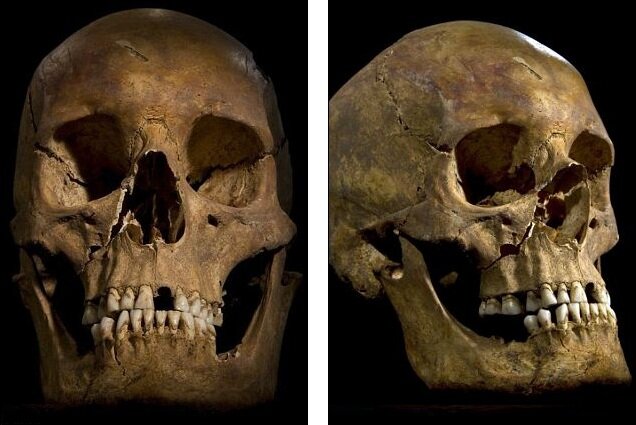
Despite a deformity of the spine, Richard III was man enough to comply with the customs and expectations of his time and lead his armies into battle. He may have been on horseback initially and surrounded by a bodyguard of knights sworn to defend him unto death, but none-the-less Richard would have been at the epicentre of the Battle of Bosworth in 1485 and he paid for asserting his right to retain the throne of England with his life.
At a time when world leaders are apt to send our young men to war in military adventures of dubious merit and in which there is no clear national interest being served, one wonders how keen those leaders would be to engage in military adventures if they or their adult sons were required to fight on the front line in hand to hand combat.
One cannot imagine David Cameron, George W Bush or Barack Obama volunteering to lead the advance during any of the major battles that took place during the Gulf conflict, or during the wars in Afghanistan etc. – such an idea would be laughable. However, we should stop and think how effective would be a revival of such a custom in preventing our leaders from taking us into unnecessary wars. If Princes William and Harry were taken from the relative safety of their helicopter gunships and their reconnaissance tanks and required to advance in the vanguard of our infantry?
Furthemore, how many of our effete life and hereditary peers would be so keen to lord it over us if the price of their enoblement was a similar expectation that they or their adult sons should fight alongside their king as was expected in medieval times?
Further still, how many of our current political and social elite are charismatic enough to command the respect of our troops such that our troops would even be prepared to follow them into battle?
One measure by which I have long judged our politicians is my perception of how compellingly they could deliver the speech in Shakespear’s Henry V, supposedly delivered by King Henry on the morning of the Battle of Agincourt in 1415.
Close your eyes for a moment and try to imagine David Cameron, Nick Clegg or Ed Miliband standing at the head of an army of weary but battle hardened troops, and then read on, and I think you will realise that we need to find a different breed of men to lead or nations in future, men within whom still resides not just the courage and charisma of our kings of old, but also their honour and their sense of responsibility for their actions:
Earl of Westmoreland : O that we now had here
But one ten thousand of those men in England
That do no work to-day!
The King : What’s he that wishes so?
My cousin Westmoreland? No, my fair cousin:
If we are mark’d to die, we are enow
To do our country loss; and if to live,
The fewer men, the greater share of honour.
God’s will! I pray thee, wish not one man more.
By Jove, I am not covetous for gold,
Nor care I who doth feed upon my cost;
It yearns me not if men my garments wear;
Such outward things dwell not in my desires:
But if it be a sin to covet honour,
I am the most offending soul alive.
No, faith, my coz, wish not a man from England:
God’s peace! I would not lose so great an honour
As one man more, methinks, would share from me
For the best hope I have. O, do not wish one more!
Rather proclaim it, Westmoreland, through my host,
That he which hath no stomach to this fight,
Let him depart; his passport shall be made
And crowns for convoy put into his purse:
We would not die in that man’s company
That fears his fellowship to die with us.
This day is called the feast of Crispian:
He that outlives this day, and comes safe home,
Will stand a tip-toe when the day is named,
And rouse him at the name of Crispian.
He that shall live this day, and see old age,
Will yearly on the vigil feast his neighbours,
And say ‘To-morrow is Saint Crispian:’
Then will he strip his sleeve and show his scars.
And say ‘These wounds I had on Crispin’s day.’
Old men forget: yet all shall be forgot,
But he’ll remember with advantages
What feats he did that day: then shall our names.
Familiar in his mouth as household words
Harry the king, Bedford and Exeter,
Warwick and Talbot, Salisbury and Gloucester,
Be in their flowing cups freshly remember’d.
This story shall the good man teach his son;
And Crispin Crispian shall ne’er go by,
From this day to the ending of the world,
But we in it shall be remember’d;
We few, we happy few, we band of brothers;
For he to-day that sheds his blood with me
Shall be my brother; be he ne’er so vile,
This day shall gentle his condition:
And gentlemen in England now a-bed
Shall think themselves accursed they were not here,
And hold their manhoods cheap whiles any speaks
That fought with us upon Saint Crispin’s day.
# # # #
By Max Musson © 2013
Steve
- Edit
I thought quite amazing that under the letter R in a car park, that they could dig down & the first thing they find is his legs!
We now also know a lot more about him, what was propaganda or truth.
I think reburying him Leicester is a mistake though.